Massachusetts Voters Pass Right-To-Repair Expansion Opening Up Car Data
One election night issue that appears to have an answer already is the passage of Question 1 in Massachusetts, which asked voters to strengthen laws guaranteeing people are able to repair things they own.
In this case, it focused on cars, preventing manufactures from locking third party repair shops and car owners out of advanced telematics data that’s increasingly being collected by vehicles via driver assistance tools.
Automakers spent millions opposing the proposal, claiming that third parties wanted to scoop up information, violate privacy and possibly enable criminal acts. From this information, a third party, such as a sexual predator, could stalk and/or harm victims by exploiting insecure transmissions of vehicle information.”
Read the article at Autoblog.

Roush CleanTech to Provide Electric Ford F-650 to Penske Truck Leasing
Roush CleanTech is introducing battery-electric trucks, based on the Ford F-650, which soon will be deployed by Penske Truck Leasing across Southern California.
For Penske Truck Leasing, Roush CleanTech's EVs are simply another option to evaluate as the electric truck market is still in its infancy. We know that the company is testing also Freightliner eM2 and heavy-duty Freightliner eCascadia trucks.
According to the press release, the demonstration units were funded in part by the South Coast Air Quality Management District. The production (regular production, we assume) of electric Ford F-650 will start in 2021.
Read the article at Inside EVs.
Illuminated Seat Belt Buckles Are Finally a Thing Thanks to Skoda
Historic Czech carmaker and Volkswagen Group fan favorite Škoda has just introduced illuminated seat belt buckles, claiming they will put an end to the hassle and faff of trying to belt up at night. Perfect or not, we have no idea why this took the industry six decades to accomplish.
Škoda's new smart buckles feature a clear transparent button in place of the traditional red eject button. This new button features a pair of multicolour RGB LEDs that operate in two modes. With nobody in the seat, the LEDs glow white to show the passenger where the buckle is located at night.
Škoda does think of the children. When somebody is sitting in the seat, a weight sensor switches the LED to red, indicating that the occupant should put their seat belt on. This way, parents can immediately see if their children have either forgotten to fasten or have not engaged the buckle correctly. Once that's corrected, the LED changes to green to confirm, and then back to white.
Read the article at The Drive.
Reducing Risk. Getting Customers Paid Fast!
By Bill Bishop, Vice President, FLD
November 2020
As 2020 inches to conclusion, no one would argue that this has been perhaps the most challenging year not just for our industry, but for our existence.
At a time like this, people in all walks of life - and business - are looking for ways to mitigate risks to ensure their ability to survive in a world of unknowns.
In fleet, perhaps no function is riskier than vehicle remarketing, a service with many moving parts. Executed flawlessly, it can add meaningful value, helping improve total cost of ownership while fulfilling the promise of vehicle leasing. Mishandled, it not only costs money, but wastes valuable time and company resources as well.
Unfortunately, the vast majority of third-party providers and preferred channel partners make the remarketing process not only cumbersome, but risky for sellers.
The Importance of ‘The Big Picture’ for Fleet Managers
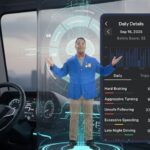
How do you effectively use aggregated driver risk insights to reduce your exposure to crashes/incidents/injuries and possible business-ending events?
By Jim Noble, Senior Vice President of Risk Engineering, eDriving
November 2020
Driver risk management is a complex picture of dozens of interconnected influences that, layered together, create a total picture of risk.
Using just one element of that picture, even an important element like today’s in-vehicle intelligence provided by telematics or cameras, is like viewing the old console tube-type television picture.
It just doesn’t provide the high definition picture you get with the TVs of today which can process massive amount of data to give that “I can see the individual grains of sand” picture clarity.
If you want a high definition overview, you need the “bigger picture”.