By Ed Pierce, Contributing Editor, Fleet Management Weekly
March 25, 2026
Artificial intelligence is quickly transitioning from a technology concept to a practical management tool for fleets.
An increasing number of AI platforms now serve as digital assistants, capable of analyzing fleet data, producing reports, detecting operational issues, and automating administrative tasks.
For fleet managers overseeing vehicle acquisition, maintenance, telematics, driver safety, and fuel management, these tools provide a new way to handle the growing complexity of modern fleet operations.
 While fleet software platforms already produce extensive operational data, the latest AI solutions aim to turn that information into actionable insights and automated workflows.
Fleet managers have traditionally depended on telematics, maintenance management software, and fleet analytics platforms to track vehicles and drivers. However, these systems often demand extensive manual analysis to gather valuable insights.
AI systems are now being developed to automatically interpret this information. By analyzing data from various fleet systems, AI tools can recognize patterns, spot anomalies, and provide real-time summaries of operational trends.
For example, AI systems can:
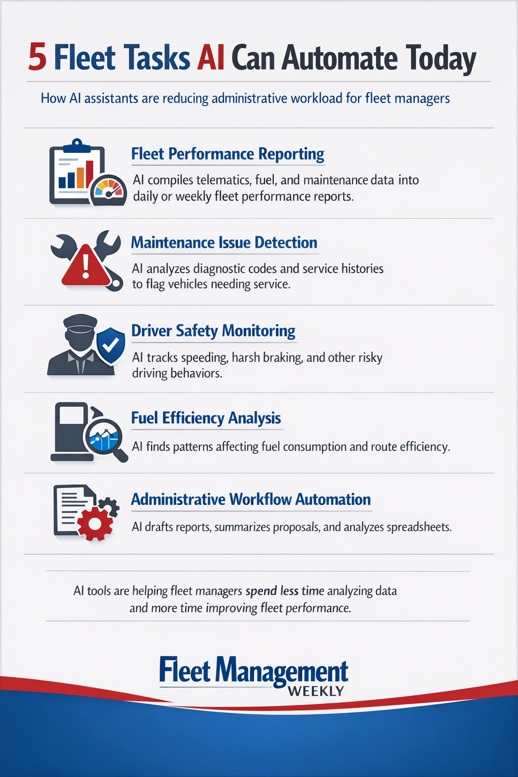
- Analyze telematics data to identify excessive idle time or inefficient routes
- Detect early indicators of vehicle maintenance issues
- Summarize fleet performance metrics into management reports
- Highlight changes in fuel consumption patterns
- Monitor driver safety behaviors
Instead of manually reviewing dashboards and spreadsheets, fleet managers can increasingly use AI tools to query their data using natural language and get clear explanations of operational trends.
New AI Assistants Designed for Workplace Automation
 A new category of technology called AI agents or AI workplace assistants is emerging to automate knowledge-work tasks. Several tech companies have introduced systems capable of planning and executing complex tasks across different software platforms.
These tools are not made exclusively for fleet management but can be used for many of the analytical and administrative tasks that fleet managers handle.
Examples include:
- Claude (Anthropic): an AI assistant created for complex reasoning, document analysis, and workflow automation. Tools like Claude Code and related workplace assistants can analyze large datasets, summarize reports, and help automate tasks that involve interpreting operational data.
- Perplexity AI: systems that merge research capabilities with automation features enabling users to analyze data, generate reports, and carry out multi-step tasks across digital platforms.
- OpenClaw: an open agent framework created to automate computer tasks, enabling AI systems to carry out actions across software applications and automatically perform workflow steps.
These emerging platforms are part of a larger trend toward AI assistants that can serve as digital support staff for knowledge workers.
Fleet Applications Already Emerging
 AI assistants are becoming more commonly integrated into fleet management software platforms. These systems enable managers to communicate with fleet data via conversational interfaces instead of navigating numerous dashboards.
Examples of how AI is being applied in fleet operations include:
- Maintenance Monitoring: AI models can analyze diagnostic codes, service records, and vehicle performance data to detect patterns indicating developing mechanical issues. This helps fleets prioritize maintenance and minimize unexpected downtime.
- Operational Reporting: Instead of manually compiling reports, AI systems can automatically generate summaries of fleet activity, fuel consumption, or utilization rates.
- Driver Performance Analysis: AI tools can analyze telematics data to identify driver safety trends and opportunities for coaching or training.
- Fuel Efficiency Insights: By analyzing route data, idle time, and vehicle performance, AI systems can identify factors that cause higher fuel consumption and suggest efficiency improvements.
- Administrative Task Automation: Routine tasks like drafting operational reports, summarizing vendor proposals, or analyzing spreadsheets can be managed by AI assistants.
- How Fleets Are Using AI Today: Early adopters across multiple industries are already using AI tools to simplify fleet management tasks. While implementations differ, several practical uses are beginning to stand out.
- Telematics Data Interpretation: Instead of manually reviewing telematics dashboards, some fleets use AI assistants to analyze daily vehicle data and generate summaries highlighting issues like excessive idle time, speeding incidents, or underutilized vehicles.
- Automated Management Reports: Fleet managers can utilize AI to automatically create weekly or monthly performance reports. AI systems can gather data from telematics platforms, fuel programs, and maintenance records to generate executive summaries for management teams.
- Maintenance Prioritization: AI can analyze diagnostic trouble codes and historical service data to help fleet managers identify vehicles most likely to need service soon, enabling more proactive maintenance scheduling.
- Vendor and Proposal Analysis: Fleet managers often review vendor proposals for services like maintenance plans, telematics systems, or vehicle purchases. AI tools can condense lengthy documents and emphasize key differences between vendor options.
- Operational Research and Benchmarking: I systems can also assist with research tasks, collecting industry information on vehicle technologies, safety programs, or fuel trends to support operational decision-making.
AI as a Workflow Automation Layer
 One of the biggest advances in artificial intelligence is the capacity to coordinate tasks across various software systems.
Fleet managers usually handle multiple platforms at once, such as telematics systems, maintenance management tools, dispatch platforms, and financial systems. AI assistants could potentially serve as an automation layer across these systems.
For example, an AI system could:
- Gather telematics data and maintenance alerts overnight
- Generate a morning operations report
- Flag vehicles requiring service
- Summarize fleet performance metrics for management review
As AI agents become better at handling multi-step workflows, their role in operational management is expected to grow.
Human Decision-Making Remains Central
Despite quick advancements in AI automation, fleet managers continue to play a crucial role in interpreting operational context and making strategic decisions.
 AI systems excel at processing large amounts of data, but human oversight remains essential to assess business implications, handle exceptions, and direct operational strategy.
Many fleets are currently testing AI through pilot projects focused on data analysis and reporting before expanding to broader workflow automation.
What Fleet Managers Should Watch
The adoption of AI in fleet operations remains in its early stages, but several advances are likely to speed up its influence.
- Natural-language fleet analytics: Fleet managers will more often use data through conversational interfaces.
- Automated operational reporting: AI will produce routine reports without manual data compilation.
- Predictive operational insights: Machine learning models will predict maintenance needs and operational trends.
- Cross-platform workflow automation: AI systems will coordinate tasks across telematics, maintenance, and management platforms.
The Bottom Line
Fleet management has always involved large amounts of operational data. Artificial intelligence is beginning to change how that information is analyzed and used. By helping automate data interpretation, reporting, and routine administrative tasks, AI assistants may enable fleet managers to focus more on strategic decisions and operational performance.
As AI platforms continue to advance, they are likely to become a more common part of the digital toolkit used to manage modern vehicle fleets.
 About the author
Fleet marketing expert and consultant Ed Pierce is an editor at Fleet Management Weekly. He can be reached at 484-957-1246 or [email protected].