By Tod Trousdell, Fleet Marketing Consultant and Partner at RobertsTrousdell Communications/Atlanta
May 27, 2026
No matter which corner of the business world your industry resides, the past decade has been a pretty rough go.
Global conflict. A stifling pandemic. See-saw inflation. Tight credit markets.
That doesn’t even account for how much time, money and resources companies have had to devote to AI, technology advances, EV integration, and a veritable laundry list of challenges that have made the business of fleet more difficult – and fleet managers doing more than ever before.
And then there’s private trucking – A slice of the business world that’s experienced impressive – arguably explosive – growth and success over the past decade plus.
Curious as to what that might look like?
 How about 15 straight years of growth?
Maybe it’s the ability to introduce advancements a decade or more before other industry sectors.
Or – how about the fact that you and your industry peers are so respected that 75% of you are projecting an uptick in the duties your own company assigns you?
No doubt the kind of statistics that would make other industries envious – and factoids I was hoping to learn more about – when I attended the annual National Private Trucking Council (NPTC) conference in Orlando May 9 – 11.
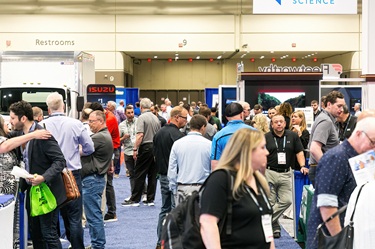
This was an event that drew over 1,000 attendees for three days of education, recognition, and the opportunity to experience the latest and greatest products, services, and solutions from more than 150 exhibitors packed into the Orange County Convention Center – and just a stone’s throw from the Orlando theme parks. Every industry facet was on-hand, from big truck OEMs and traditional fleet service folks (think remarketers and graphics companies) to new era providers of services like AI, software and quite frankly, everything between.

Gary Petty
Like many fleet conventions, the annual event – the first I’ve attended – has an air of camaraderie. But according to Gary Petty, President and Chief Executive Officer of the National Private Truck Council, the secret sauce is its ability to assemble attendees “in a spirit of cooperation where they gain a competitive edge through participating in the combined culture.” In many ways, it differs from the traditional fleet conference in that all speakers and presenters are fleet professionals and not service providers, who are limited to promoting their products, services, and solutions on the show floor and through personal interactions.
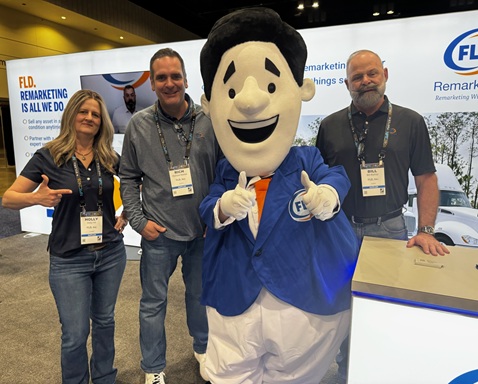
TeamFLD and FLD Frank getting ready to greet attendees at their booth during this year’s National Private Truck Council Conference
Petty added the show’s set up was part of an explicit effort to “create the perfect environment for exchanging ideas.” He continued, “We’ve worked really hard to build a space where top fleet leaders feel safe to exchange ideas and build a community and while the annual convention is perhaps our biggest opportunity to do this, that work continues all year.”
So how do private fleets fit into the overall fleet ecosystem? What benefits do they bring to the industry?
According to NPTC, which also works to advance a legislative agenda, private fleets have not only benefited from the challenges of the last decade, but they have also used them to their advantage.
How?
Without a doubt, one of the biggest drivers of private fleet success was the Pandemic, which taught corporations the value of having their own fleets rather than relying on contract – or “for-hire” providers. Companies that didn’t move to develop their own fleets were often subject to the harsh economic conditions and whims of for-hire trucking companies, negatively affecting their operations, and jeopardizing their future well-being.
(image credit: NPTC)
The outcome had a chilling effect on companies determined to control their supply and distribution channels. As a result, Petty believes, private fleets have done the hard work to justify their existence and growth, a pattern the NPTC – as well as industry watchers – expect to continue over the coming years.
Anxious to help its members take advantage of these changes while best preparing for what comes next, the NPTC looks for ways to provide value while advancing the industry agenda. One of those ways is a develop benchmarking and actionable insights members can leverage to run better, smarter operations and more efficient fleets.
And just what do some of those statistics show about the makeup and state of the private trucking industry?
 Today, private fleets typically handle 70% of their company’s outbound freight, as well as 43% of its inbound.
The average NPTC-member fleet has 502 drives and 1,041 trailers working on average from 49 different locations.
Almost two-thirds of these private fleets – which are mostly comprised of class 7 and 8 vehicles – expect to add new equipment in the coming year, a sign of strength and demand.
The numbers, Petty said, leave private fleets in an enviable position for continued growth, something he thinks will help them not only thrive, but continuously improve – a positive outcome that NPTC is prioritizing in the future.
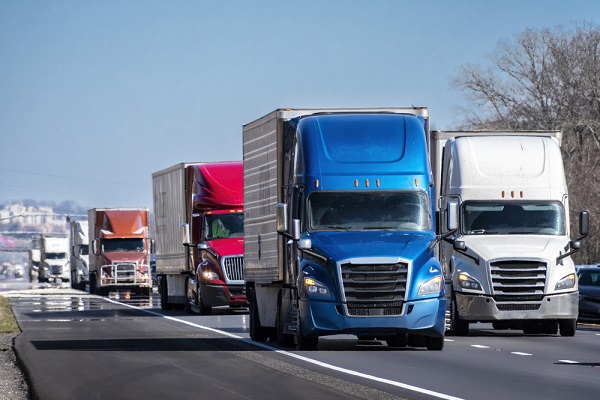 “Private fleets are curated… bright beautiful trucks, the best drivers, the highest level of safety, on-time standards. They invest more in drivers, in vehicles, safety and, something that sets the industry apart, in developing breakthroughs that push the transportation sector forward,” said Petty – who refers to the result as “bespoke” trucking. “At NPTC, we are here to help private fleets continue these trends.”
In support of NPTC’s positive outlook, Petty said NPTC’s benchmarking statistics show private fleets currently perform three times safer than the rest of the trucking industry on key safety statistics for every million miles driven.
Looking down the road, Petty believes there are certainly several mounting challenges that threaten the industry, but that the industry is already at work trying to resolve. Chief among these stumbling blocks are fast growing driver shortages driven by crackdowns on driving schools, as well as English-only language mandates for drivers. While both may ultimately contribute to driver improvement, they have at present provided hurdles for the industry.

(image credit: NPTC)
At the same time, the opportunities for advancement are numerous, including developing best practices for implementing the myriad groundbreaking technologies waiting around the next corner. This includes everything from AI to electric vehicles, and especially autonomous driving, an advancement Petty thinks will have the biggest impact of all on the industry, but whose effect is hard to predict. Regardless, he said, whatever happens next, NPTC is poised, ready and aligned to help private fleets thrive.
NPTC 2027 is currently planned for May 6-8 at the Marriott World Center in Orlando. In addition to the annual education and certification track, the event will host its annual Driver of Hall of Fame recognition awards – won this year by drivers from Unifi Manufacturing, John Deere, CPC Logistics, Shaw Industries and Circle K/Fuel South Express – as well as a two-day exhibit hall.
For more information go to www.nptc.org.
 About the author
Tod Trousdell is a fleet marketing consultant specializing in research and actionable insights, brand strategy, content creation and more. He works with a variety of fleet management companies and service providers and can be reached at [email protected].