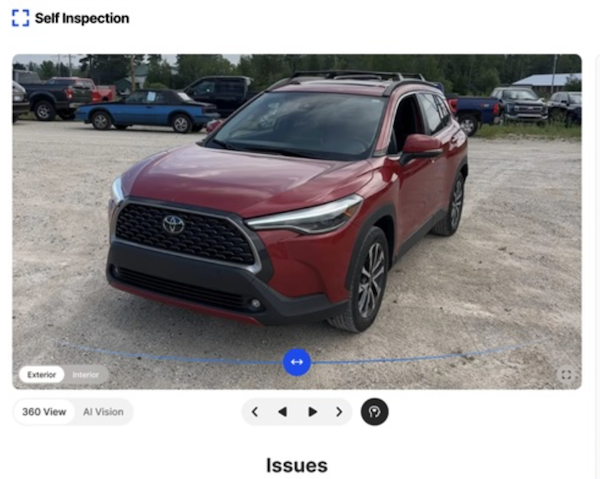
(image credit: Self Inspection)
By Ed Pierce, Contributing Editor, Fleet Management Weekly
May 27, 2026
 At this year’s NAFA Institute & Expo, one emerging theme stood out across the exhibit hall and educational sessions: artificial intelligence is increasingly being applied to everyday fleet management tasks that have historically relied on manual inspections, paper records, and driver consistency.
One area drawing growing attention is AI-driven vehicle condition monitoring — particularly systems that use smartphone-based imaging to document exterior damage, verify inspection quality, and evaluate tire condition.
 Among the companies discussing this trend was Self Inspection, which presented a platform to standardize vehicle inspections and create continuous condition histories throughout a vehicle’s lifecycle. According to the company’s presentation at NAFA I&E, the goal is not simply faster inspections but more consistent documentation and earlier detection of issues that often go unnoticed until remarketing or lease return.
For fleet managers, the discussion highlights a broader industry challenge: how to maintain accurate, auditable vehicle condition data across increasingly decentralized operations.
Closing the “Visibility Gap”
Traditional fleet inspection processes often occur only at key transition points — vehicle delivery, reassignment, lease return, or disposal. Between those events, condition tracking can become inconsistent, especially in fleets with multiple drivers, remote workers, or dispersed locations.

(image credit: NAFA)
During the NAFA presentation, the company described this as a “gap” in the vehicle lifecycle during which damage, tire wear, or minor incidents may go undocumented for months or years.
That lack of visibility can have financial implications. Unreported exterior damage may accumulate, leading to more expensive repairs later. Tire issues that are not identified early can lead to premature tire replacement, alignment problems, or safety concerns. Residual values may also suffer when condition histories are incomplete or unverifiable.
The growing use of AI in inspections aims to address those blind spots by making condition monitoring more continuous and standardized.
Using Smartphones as Inspection Tools
A notable shift across these platforms is the reliance on consumer mobile devices rather than on dedicated inspection hardware.
According to the presentation, drivers receive a link that launches a guided inspection process directly in a smartphone browser, without requiring an app download. The system then uses prompts, overlays, and positioning guides to standardize image capture.
 Standardization is important because inconsistent photography has long been a challenge in digital inspections. Lighting, camera angles, and incomplete coverage can limit the usefulness of image-based assessments.
The AI component analyzes submitted photos to identify vehicle panels, detect visible damage, and estimate severity levels. The company noted that human reviewers remain part of the process, particularly for higher-confidence verification or repair estimation.
This “human-in-the-loop” approach has become increasingly common in commercial AI applications, especially when inspection accuracy affects operational or financial decisions.
Rather than replacing inspectors entirely, many systems are being designed to automate repetitive review tasks while escalating uncertain findings for manual confirmation.
Tire Monitoring Expands Beyond TPMS
Another development attracting fleet interest is AI-based tire analysis using images alone.
While tire pressure monitoring systems (TPMS) are already standard in most modern vehicles, monitoring tread condition has traditionally required manual measurement or specialized scanning equipment.
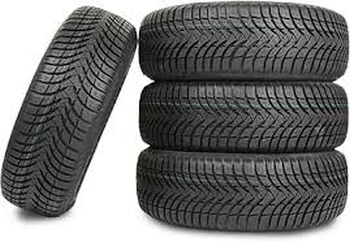 During the presentation, Self Inspection demonstrated an AI-driven tire-scanning capability that estimates tread depth from smartphone photos.
The company said the system has been trained on millions of tire images and is initially focused on identifying whether tires fall into the “good,” “monitor,” or “replace” categories. Future enhancements are expected to evaluate inner, middle, and outer tread wear patterns that may indicate alignment or suspension issues.
For fleet operators, earlier identification of irregular wear could support preventive maintenance and potentially reduce tire-related downtime.
The company claimed its system is designed to detect replacement needs much earlier than traditional inspection cycles.
Standardization May Be the Bigger Story
While AI-based damage detection often receives the most attention, many fleet professionals may find operational standardization equally valuable.
One recurring challenge in fleet inspections is subjectivity. Different drivers or inspectors may document the same vehicle differently, leading to disputes over when damage occurred or whether issues were previously reported.
 The presentation emphasized that the system is designed to reduce much of that variability by requiring consistent capture procedures and predefined inspection paths.
That consistency also creates a more searchable inspection history. Rather than storing static PDFs or disconnected photos, inspection records become timestamped digital files linked directly to the vehicle.
For fleet managers overseeing hundreds or thousands of vehicles, that audit trail could become increasingly important for remarketing, compliance, insurance documentation, and driver accountability.
AI Adoption Still Faces Practical Questions
Despite the growing capabilities of AI inspection systems, fleets are still weighing several practical considerations before adopting broadly.
Accuracy remains a primary concern, especially in environments where lighting, weather, or vehicle cleanliness can affect image quality. Companies developing these tools are responding by incorporating confidence scoring systems and manual review thresholds.
 Integration is another issue. Fleets often rely on multiple platforms for telematics, maintenance management, and remarketing, and standalone inspection systems can add workflow complexity if data does not integrate cleanly.
There are also operational questions about driver participation. Even simplified inspection workflows require consistent employee engagement, and fleets may need policies or incentives to ensure inspections are completed properly and on schedule.
Still, momentum appears to be building as AI imaging technologies mature and smartphone-based workflows become easier to scale.
From Reactive to Continuous Monitoring
The broader shift underway may be less about replacing traditional inspections and more about increasing their frequency and visibility.
Historically, many fleets relied on episodic snapshots of vehicle condition. AI-powered mobile inspection platforms aim to create continuous condition histories instead — documenting changes over time and flagging emerging issues earlier in the vehicle lifecycle.
 As fleet organizations continue looking for ways to control operating costs, improve asset utilization and preserve resale value, AI-assisted condition monitoring is likely to remain an area of active experimentation and investment.
Unlike some emerging technologies that still require specialized hardware or infrastructure, the combination of smartphone cameras, cloud processing, and AI image analysis may lower the barrier to entry for fleets of many sizes.
For fleet managers, the key question may no longer be whether AI can assist with inspections, but rather how much operational value continuous digital condition monitoring can deliver.
 About the author
Fleet marketing expert and consultant Ed Pierce is a contributing editor at Fleet Management Weekly. He can be reached at 484-957-1246 or [email protected].