Electrify America Thinks Hyper and Ultra Are Good Names for the Fastest Chargers
Image Electrify America
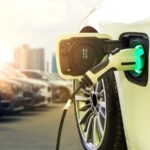
September 12, 2022 - Electrify America's announced that it will rebrand its DC fast-chargers for electric vehicles so that it's easier for EV drivers to plug into the charger that best suits their car. The names for the two highest-level chargers are Hyper-Fast and Ultra-Fast.
Hyper-Fast stations are indeed the most powerful DC fast-chargers. They have a power delivery of up to 350 kW. When an EV that can accept these higher charging speeds uses a Hyper-Fast charger, it can "provide about 20 miles of driving range per minute of charging depending on the EV's charging capability."
EA's Ultra-Fast stations will offer power delivery of up to 150 kW. If your car can't accept rates higher than 150 kW, don't plug into a Hyper-Fast station. Ultra-Fast stations can add around nine miles of range to a compatible EV for each minute they're connected.

Growth Accelerates in Commercial EV Segment with Three New Deals
September 9, 2022 - It was a good week for electrified commercial vehicles as several companies joined forces or announced new products in parallel efforts to accelerate production of electric commercial trucks and vans.
Mercedes-Benz Vans and Rivian signed a memorandum of understanding to create a strategic partnership and launch joint production of large electric vans in Europe under both brands’ badges. EV manufacturer Mullen Automotive Inc. announced that it acquired a controlling interest in EV truck maker Bollinger Motors.
Harbinger, a Los Angeles-based automotive manufacturer, announced the official launch of its new commercial EV platform in the medium-duty category. Harbinger’s initial product line will include electric stripped chassis and cab chassis designed around the performance, durability, and lifespan characteristics required in Class 4 to Class 7.
Ford’s BlueCruise Adds More Tech Features for Safer Hands-Free Driving
Interest in Ford’s BlueCruise, and luxury counterpart Lincoln’s ActiveGlide, has encouraged the automaker to improve its hands-free technology offering that will be available on 2023 model vehicles.
More than 130,000 miles of US roads are now equipped with Hands-Free Blue Zone technology, which alerts appropriately equipped vehicles of its presence,
“We are investing in our ADAS team to constantly improve BlueCruise and ActiveGlide for our customers,” said Doug Field, Chief EV & Digital Systems Officer, Ford Model e.
“The latest improvements allow customers to command lane changes using just a turn signal, and make hands-free driving feel more human-like by smoothly slowing down for turns and giving more room to large vehicles in neighboring lanes. These improvements are just the beginning of a constant journey toward improving safety and, in the future, giving customers valuable time back.”
Delivery Trucks Have a Dirty Secret. And There’s No Easy Fix in Sight
September 12, 2022 - Every day, thousands of trucks drive along miles of freeways and highways completely empty - and the distances they drive with zero cargo onboard reaches many billions of miles every year.
Trucking companies ideally need one customer (or customers) for the outward journey and another for the return. If they don’t have two customers, vehicles run empty. But, as well as needing a shipment for the return journey, they also need a truck that matches their load, with equipment such as refrigeration or a vehicle with a fork-lift attached.
It’s a problem that Loadsmart is trying to tackle. A year ago, it launched a platform called Flatbed Messenger to match empty trucks with shippers needing to transport goods.
Cheaper Electric Vehicles Coming Despite High Battery Costs
September 9, 2022 - Even though battery costs are rising, auto companies are rolling out more affordable electric vehicles that should widen their appeal to a larger group of buyers.
The latest EV option came Thursday from General Motors, a Chevrolet Equinox small SUV with a starting price around $30,000 and a range per charge of 250 miles. You can get a range of 300 miles if you pay more.
The only EVs with starting prices under $30,000 (including shipping) now are versions of the Nissan Leaf and Chevrolet Bolt. Both are smaller than a typical gas-powered compact SUV. The Mini Cooper Electric, Mazda MX-30 and Hyundai Kona Electric are in the $30,000s, according to Edmunds.