By Neeraj Pal, Growth Manager, Inspektlabs
July 8, 2026
Most fleet damage isn’t discovered when it happens. It surfaces weeks later, by which time it’s more expensive and harder to explain. Yet many fleets still treat vehicle inspections as calendar events: once a month or once a quarter, someone logs what they find during a walk-around. That rhythm made sense when vehicles sat in one yard and ran predictable routes. It makes less sense now.
Fleets face real pressure to cut downtime, control repair spend and keep liability off the books. The gap between when damage occurs and when it is recorded has quietly become one of the more expensive problems in fleet operations, and modern AI-powered fleet vehicle inspection software is built to close it.
The Hidden Costs of Periodic Fleet Inspections
Scheduled inspections have one basic flaw: damage does not follow a schedule. A curbed wheel, a scraped quarter panel, a cracked mirror housing. These happen on a Tuesday in traffic, not on the day the inspection is booked.
 When the cycle is monthly or quarterly, discovery is always delayed. By the time it appears in a report, the driver responsible may have rotated off the vehicle, so there is no clear way to link the damage to an event. Accountability becomes fuzzy, and fuzzy accountability usually means the fleet absorbs the cost.
Late discovery also lets small problems grow. A minor crack becomes a structural issue, and every day a vehicle sits idle awaiting repair is costly. Industry estimates place the cost of vehicle downtime at roughly $448 to $760 per vehicle per day. Those idle days add up, and managers make maintenance and remarketing decisions without a clear picture of vehicle condition.
Why Fleet Leaders Need Continuous Vehicle Condition Visibility
Consider how much of a fleet is already monitored in real time. Roughly four in five fleet professionals now rely on GPS fleet tracking, which streams fuel, mileage, fault codes, location, and utilization. A manager can tell within minutes if a van is idling too long.
 Vehicle condition is the odd exception. For most fleets, it is still captured in snapshots taken weeks apart by whoever is holding the device. It remains one of the last blind spots in an otherwise well-instrumented operation.
That gap is becoming harder to justify. Fleets have already moved from reactive repairs to proactive, predictive maintenance, and condition tracking is the natural next step in that shift. When everything else updates live, condition data that is a month old feels out of step, especially for fleets that answer to insurers, lessors, and finance teams.
From Inspection Events to Continuous Damage Tracking
The shift is conceptual before it is technical. A periodic inspection treats a condition as a status to check on a set date. Continuous tracking treats the condition as something that changes over time and records it as it changes.
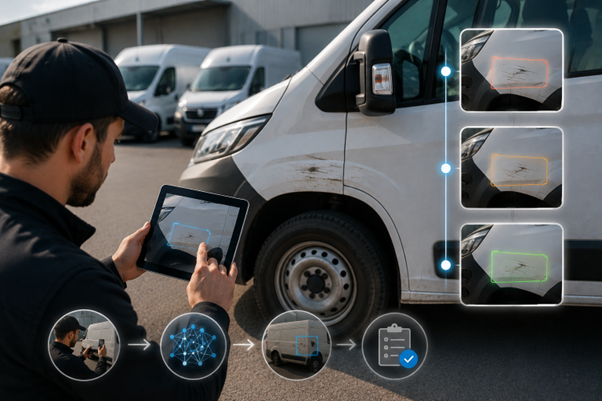
 In practice, that means capturing a vehicle’s state at the moments that matter, such as when it is handed to a driver, when it returns, when it visits a shop, and when it moves between sites, rather than only on the inspection calendar. Each capture is compared against the last known state, so new damage stands out from damage that was already present. That is the idea behind incremental damage reporting; instead of one big snapshot per quarter, you build a running record where every new mark carries a timestamp.
When damage appears, you know roughly when it showed up and what the vehicle was doing at the time.
Operational Benefits of Continuous Damage Tracking
The advantages show up across the operation. Damage is logged close to when it happens, so it can be triaged before it worsens. Downtime drops because a problem caught early and well documented lets the shop prepare before the vehicle arrives.
 Driver accountability improves and feels fair rather than punitive: a clear before-and-after record tied to each handoff grounds those conversations in evidence, not guesswork. Maintenance planning gets easier, too, since a running condition history makes patterns visible. Remarketing also benefits, because a documented history makes a vehicle easier to value and sell at auction or back to a lessor.
The Role of AI in Modern Fleet Inspection Programs
None of these scales with manual effort alone. Photographing every vehicle at every handoff would overwhelm a large fleet, so AI does the heavy lifting.
 Modern AI-powered vehicle inspection systems use image analysis to detect and classify damage from photos or short videos captured on a phone. The model flags dents, scratches, cracks, and missing parts, then compares current images with earlier ones to surface what is new. Because the assessment is automated, it remains consistent regardless of where the images are captured.
That consistency is what makes the approach workable at scale. Good fleet vehicle inspection software enables a small team to oversee the condition of thousands of assets with the same standards everywhere. The technology supports the program. It does not replace the judgment of the people running it.
What Continuous Damage Tracking Looks Like in Practice
 It helps to follow one vehicle through its life in the fleet. It arrives after acquisition, and its condition is captured on day one to set the baseline. It goes to a driver, with a quick capture at handover that both sides can see. The capture on return is compared against it, so anything new is flagged right then. A maintenance visit adds to the record, and a transfer to another site carries the history along instead of resetting it. By the time it is prepared for remarketing, there is a complete, dated account of every mark it picked up.
No single capture is dramatic; the value lies in the accumulation. Instead of a few quarterly snapshots, the fleet ends up with a continuous record that tracks the asset from its first day to its last.
Questions Fleet Leaders Should Ask About Their Inspection Strategy
If you are weighing whether your current approach is keeping pace, a few questions tend to cut to the heart of the matter:
- How quickly is new damage identified after it happens, in days or in weeks?
- Can you reliably separate new damage from pre-existing damage on any given vehicle?
- How much damage is discovered too late to assign or to repair cheaply?
- Is condition data available across the whole vehicle lifecycle, or only at scheduled checkpoints?
If the answers point to long lag times and murky accountability, the program has more room for improvement than the calendar suggests.
Final Thought
 Periodic inspections are not going away, and they should not. A thorough scheduled check still has its place, particularly for safety and compliance. What is changing is the assumption that periodic checks are sufficient on their own.
They leave too much time uncovered, and during that time cost and risk quietly build. Continuous damage tracking fills those gaps with a current view of each asset. The direction is clear: fleet inspection is becoming proactive rather than reactive. The question is no longer whether fleets should move beyond periodic inspections. It is how long they can afford to wait.
 About the author
Neeraj Pal is Growth Manager at Inspektlabs with expertise in AI-driven vehicle inspections, motor insurance, and fleet management, sharing real-world insights on automation and claims.