By Ed Pierce, Fleet Management Weekly
July 8, 2026
While the Right-to-Repair debate over H.R. 7389, the Motor Vehicle Modernization Act of 2026, has drawn polarized coverage, I want to reframe the issue around fleet operations, lifecycle cost, uptime, and data governance—the topics most likely to resonate with fleets.
The debate over “Right-to-Repair” has once again moved into the national spotlight following congressional action on H.R. 7389, the Motor Vehicle Modernization Act of 2026. The legislation recently passed the House Energy and Commerce Committee by an overwhelming 48-1 vote and has garnered public support from major automakers, including Ford, General Motors, and the Alliance for Automotive Innovation.
 At the same time, independent repair organizations and aftermarket advocates have expressed disappointment, arguing that the bill fails to address the most significant issue in modern vehicle repair—access to connected vehicle data.
For consumers, the debate has largely centered on a familiar question: Who should have the right to repair my vehicle? Should owners be free to choose any repair shop, or will manufacturers increasingly control where and how vehicles are serviced?
Fleet operators, however, should view the legislation through a much broader business lens.
What the Bill Does—and Doesn’t Do
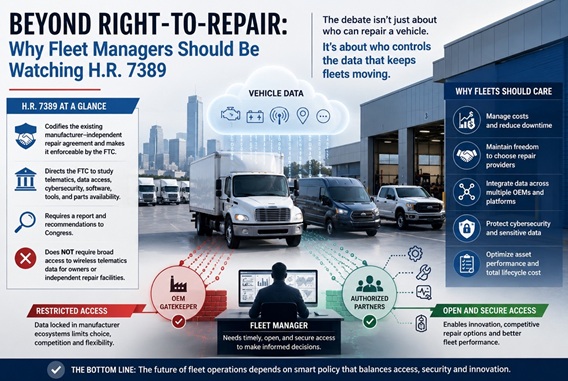
H.R. 7389 includes several automotive-related measures to modernize vehicle regulation. On repair, the committee-approved version codifies the long-standing voluntary agreement between vehicle manufacturers and independent repair organizations, making it enforceable by the Federal Trade Commission. The legislation also directs the FTC to study issues related to vehicle telematics, repair data, cybersecurity, software, and tool and parts availability before making future recommendations to Congress. (NADA)
What the bill does not do is require manufacturers to provide vehicle owners or independent repair facilities with broad access to telematics data transmitted over wireless networks. Those provisions were included in earlier Right-to-Repair proposals but were removed from the version approved by the committee.
That distinction has fueled much of the controversy.
The Fleet Perspective Is Different
For most fleet organizations, this is not primarily a debate about where a vehicle is repaired. It is a discussion about who controls the information that keeps fleets productive.
Today’s fleet vehicles continuously generate data on engine performance, battery health, fault codes, emissions systems, ADAS calibration, maintenance needs, driver behavior, and hundreds of other operating parameters. That data drives many of the technologies fleet managers rely on every day:
- Predictive maintenance
- Remote diagnostics
- Maintenance scheduling
- Recall management
- Warranty administration
- Fleet analytics
- Vehicle lifecycle optimization
- Uptime reporting
The ability to access and integrate this information often determines how quickly vehicles return to service—not merely where they are repaired.
Data Is Now a Competitive Advantage
Historically, fleet managers focused on controlling acquisition costs, fuel costs, and maintenance costs. Increasingly, competitive advantage comes from managing vehicle data.
 A mixed fleet may include vehicles from Ford, General Motors, Stellantis, Toyota, Isuzu, and several truck manufacturers. Many organizations also rely on third-party fleet management companies, maintenance management providers, and telematics platforms to consolidate information from those manufacturers.
If access to connected-vehicle data becomes increasingly proprietary, fleet operators could face several long-term challenges:
- Greater dependence on manufacturer-specific ecosystems
- More complicated integration with fleet management software
- Reduced flexibility when selecting maintenance providers
- Higher administrative complexity across mixed fleets
- Potential increases in diagnostic and repair costs
- Longer vehicle downtime while information is retrieved through manufacturer channels
Whether these outcomes ultimately occur remains uncertain. However, they represent the operational questions fleet professionals should begin asking today.
Cybersecurity Matters Too
Manufacturers argue that unrestricted access to connected vehicle systems raises legitimate concerns about cybersecurity, consumer privacy and vehicle safety. These concerns become even more significant as vehicles incorporate autonomous technologies, advanced driver assistance systems and over-the-air software updates.
 Fleet operators should not dismiss those concerns.
Commercial fleets have every interest in safeguarding sensitive operational information and preventing unauthorized access to connected vehicles.
The challenge for policymakers is finding the balance between protecting connected vehicles from cyber threats and preserving competition, innovation and customer choice.
Questions Every Fleet Executive Should Ask
Regardless of how H.R. 7389 ultimately evolves, fleet leaders should begin evaluating several strategic questions.
- Who owns the operational data generated by our fleet vehicles?
- Can we authorize third-party maintenance providers to access that data?
- Will our fleet management platform continue integrating information across multiple manufacturers?
- Could future vehicle purchases limit our ability to choose maintenance or technology partners?
- How will connected vehicle policies affect total lifecycle cost—not simply repair expense?
These questions extend well beyond today’s Right-to-Repair debate.
Looking Beyond the Headlines
The public conversation about H.R. 7389 has understandably focused on consumers and independent repair shops.
 Fleet organizations face a different reality. For them, connected vehicle data influences productivity, maintenance efficiency, technology integration, procurement strategy, and ultimately the total cost of operating thousands of vehicles.
As commercial fleets become more connected, the issue is shifting from the right to repair to the right to manage the information that keeps fleets moving. That may prove to be a far more salient issue.
 About the author
Fleet marketing expert and consultant Ed Pierce is a contributing editor at Fleet Management Weekly. He can be reached at 484-957-1246 or [email protected].