Is the World Ready for Hydrogen Powered Cars?
Inventor Hugo Spowers has a dream: to replace today’s cars with his own hydrogen prototype.
Fuel cells work by electrochemically combining hydrogen, stored in a pressurized tank, with air to generate an electric current; the only emission is water vapor. Development of fuel cell technology has been slow. They are expensive to produce (platinum is a key component), as is hydrogen.
In 2016, Spowers unveiled his first production-ready car: the Rasa, a radical, ultra-light two-seater powered by a hydrogen fuel cell. Spowers hopes to have the car on the market in 2019. “As far as we can tell,” he says, “we are the only independent hydrogen car startup in the world.”
Read the article at The Guardian.

Donlen Named One of the Best and Brightest Companies to Work for in the Nation for the Third Consecutive Year
Donlen has been recognized by the National Association for Business Resources (NABR) for the third year in a row as one of the 2017 Best and Brightest Companies to Work For® in the Nation.
“One of the core values of Donlen is that we strive to attract and retain the best, brightest, and most engaged employees through rewarding work and exceptional career development and advancement opportunities. When employees are engaged and invested, they provide higher levels of customer satisfaction, and our clients appreciate that,” Donlen’s president Tom Callahan said. “To be recognized as one of the Best and Brightest Companies to Work For in the Nation for our efforts for the third year in a row is an honor and an affirmation for all of us at Donlen.
Can Your Next Car be a Smartphone on Wheels?
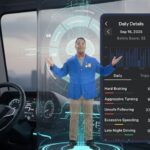
After a visit to the Detroit Auto Show, the newest in-car technology shows that automakers have fallen behind with features already available in the iPhone X.
While many drivers wish their infotainment systems worked like their phones, the biggest deterrent to making your car too much like your phone is that you may look at it more than you’re supposed to (when your eyes should be on the road).
“It’s great with the digital stuff with the hype and everything, but we forget we are analog people that want to look at and touch something. We must not forget the real world for the virtual world,” said Mercedes-Benz design chief Gordon Wagner.
Read the article at The Verge.
Want to Add Electric Vehicles to Your Chinese Fleet? You’re Going to Have to Wait.
By Mark Boada, Senior Editor
By all accounts, when it comes to the world’s electric vehicle (EV) present and future, China is the 800-pound gorilla. Consider the following, as reported in This Week in Asia last August:
- In 2015, Beijing declared its plans to dominate the world’s electric car industry by the year 2025.
- In 2016, China sold half a million electric vehicles, making it by far the world’s biggest market. In contrast, manufacturers in the world’s second largest market, the United States, sold just 155,000.
- China’s electric vehicles are manufactured overwhelmingly by locally owned producers, not foreign joint ventures, and they are based on Chinese technologies. Last year China’s leading electric vehicle maker, Shenzhen-based BYD, turned out 100,000 cars. The leader in the US, Tesla, managed to sell 76,000 into its home market.
Elsewhere, you’ll find these facts:
Fleet Logistics CEO Dr Jörg Löffler: Diesel Decline and Increased Mobility Are Key Trends for 2018
The continued decline of diesel market share and the increased provision of total corporate mobility will be two of the key fleet trends for the year ahead. So says Dr Jörg Löffler, CEO of Europe’s largest independent fleet management provider, Fleet Logistics.
In a wide-ranging interview to mark the start of 2018, Dr Löffler said that he believed that demand for diesel would continue to fall throughout the year across Europe and not just the UK, where the decline in diesel demand has been most marked. This trend is firstly driven by irritated private car buyers but fleets might follow soon.
Fleet Logistics also believes that the issue of total corporate mobility will become increasingly important in the near future as many companies examine their total transport and mobility needs and do not restrict this solely to the provision of company cars.
Another key trend for 2018 looks likely to be the continued growth in recharging points for electric and hybrid-electric vehicles with more players entering the arena. Dr Löffler pointed to the recent initiative by oil giant Shell together with major German car manufacturers as evidence of the rapid speed of change within the European charging infrastructure.