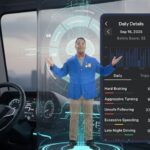
Nexar’s New Dashcam Tech Generates Accident Reconstructions On-the-Fly
While some vehicles are fitted from the factory with 360-degree cameras that record and playback in case of an accident, the majority of cars on the road are not and owners instead turn to aftermarket dashcams for peace of mind.
Dashcam manufacturer Nexar has taken the idea of a simple dashcam and created something way more useful to the millions of drivers who end up in a collision each year - collecting data and using it reconstruct the scene using machine learning.
Nexar says it can automatically detect about 90 percent of accidents to ready a report. The reconstructed footage and metrics collected by the camera are one click away and can promptly be assembled into a usable resource. Then, it's ready to be sent to an insurer to establish First Notice of Loss (FNOL) and clear up the majority of accident ambiguity.
Read the article at The Drive.

Global Chip Shortage Means Thinner New-Car Supply, Higher Prices
The thin line between just-in-time auto manufacturing and an idled production plant has become crystal clear again with the spreading effects of a global semiconductor chip shortage and other logistical problems.
Several automakers have announced some sort of production delay due to the chip shortage as well as the dramatic cold weather that hit Texas and other parts of the U.S. recently, affecting the production of some plastic and foam vehicle components.
The number of vehicles at or in transit to dealerships was down 26 percent in February 2021 compared to the same month in 2020. For pickup trucks, the number was closer to 50 percent. That all leads to a few unfortunate realities for anyone looking to buy a new car soon: you're likely looking at fewer choices on the lot, higher prices, or a longer wait time for your car to arrive.
Read the article at Car and Driver.
$300 a Day For a Kia Rio. Why Rental Cars Prices Have Gone Insane
A year ago, air travel came to a near halt, leading to a glut of rental cars. Rental companies sold off more than a half a million cars, about a third of their combined fleets, just to generate cash they needed to survive the crisis.
Following a year of deep losses, rental car companies have been unable to rebuild their fleets, especially with auto plants shut by a shortage of computer chips needed to build cars. This has led to a severe shortage of rental cars in vacation hotspots, resulting in sky-high prices for vacationers.
A recent of car rental sites Wednesday showed a Kia Rio, a sub-compact car, going for $300 a day in Orlando, next week. On Maui, Hawaii, the only rental available next week is a Yukon for $500 a day.
Read the article at CNN Business.
Tesla’s In-Car Cameras Raise Privacy Concerns, Consumer Reports Says
Tesla's use of in-car cameras to record and transmit video footage of passengers to develop self-driving technology raises privacy concerns. Consumer Reports said the usage potentially undermines the safety benefits of driver monitoring, which is to alert drivers when they are not paying attention to the road.
"If Tesla has the ability to determine if the driver isn't paying attention, it needs to warn the driver in the moment, like other automakers already do," said Jake Fisher, senior director of Consumer Reports' auto test center.
Automakers such as Ford and General Motors, whose monitoring systems do not record or transmit data or video, use infrared technology to identify drivers' eye movements or head position to warn them if they are exhibiting signs of impairment or distraction, the magazine said.
Read the article at Autoblog.
Can the Electrical Grid Handle a Boom in Electric Vehicles?
The vast majority of electric vehicles built, sold, and especially driven in the United States will continue to use internal combustion engines for years to come. EVs are growing fast, though, and the technology improves every day.
The U.S. has more than enough electric generating capacity to power every EV expected to hit the road. A 2020 report by the Department of Energy concludes, “through 2028, the overall power system, from generating through transmission, looks healthy up to about 24 million EVs.” That’s sixteen times the roughly 1.5 million EVs operating in the U.S. today.
The key is for EV owners to do most of their charging at night when a lot of the electricity generating capacity that already exists is idle. Most utilities will offer low rates to encourage owners to charge then.
Read the article at USA Today.