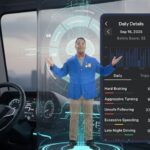
Using a Little Friendly Competition to Improve Driver Behavior and Protect Your Bottom Line
Harnessing the power of gamification to achieve greater safety, productivity and compliance
Today’s fleets all have a powerful tool at their disposal – and it’s one of the most basic tools we all carry with us: mobile apps that run on our mobile phones and tablets. New applications tied into existing fleet management and work order management solutions such as Telogis Coach can significantly improve how mobile workers perform their day-to-day jobs – and it can all be unlocked through the mobile device they’re already using.

Bryant Walker Smith: Autonomous Vehicles Won’t Happen Automatically
There will be many steps to get to a fully driverless car, and there will be a variety of great opportunities along the way.
Ford, MIT Project Uses LiDAR, Cameras, to Measure Pedestrian Traffic and Predict Demand for New, On-Demand Electric Shuttles
Ford Motor Company and the Massachusetts Institute of Technology are collaborating on a new research project that measures how pedestrians move in urban areas to improve certain public transportation services, such as ride-hailing and point-to-point shuttles services.
The project will introduce a fleet of on-demand electric vehicle shuttles that operate on both city roads and campus walkways on the university’s Cambridge, Massachusetts, campus.
The vehicles use LiDAR sensors and cameras to measure pedestrian flow, which ultimately helps predict demand for the shuttles. This, in turn, helps researchers and drivers route shuttles toward areas with the highest demand to better accommodate riders.
Feds Slow to Adopt Crash-Avoidance Technology in Their Vehicle Fleet
The federal government is taking a number of steps to promote auto-safety technology in the U.S., but there is one area that may be getting overlooked: its own fleet of vehicles.
Regulators are working to expand the prevalence of collision-avoidance systems and other semi-autonomous features in cars, which have been praised for their ability to save lives, reduce traffic and improve fuel use.
The Department of Transportation (DOT) is expected to release guidance for states on self-driving vehicles later this summer.
Liability and the Autonomous Vehicle
There's no doubt that the future looks bright for autonomous vehicles; projections for its commercial deployment vary wildly, from a few years, to not in our lifetime.
While most of the focus is on the technology that enables autonomy, too little attention has been paid to other aspects of driving and our highway system, such as insurance and regulation, and even the willingness of drivers to surrender agency — the ability to control outcome — even if the autonomous system can do better in most instances.