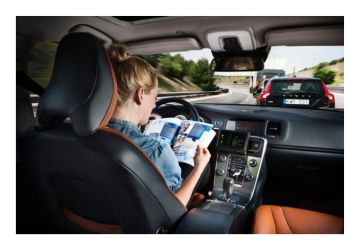
Once autonomous driving cars become prevalent in the not-too-distant future, we’ll all be able to read, watch videos and text message to our hearts’ content – safely, that is – while en route to a given destination, and probably enjoy lower insurance rates due to the resulting drop in accidents caused by human error.
But you can bet the proverbial farm that state and local taxes will rise in the process (as if they ever needed a reason). A recent Brookings Institution report by Kevin C. Desouza and Kena Fedorschak suggests that’s because local governments’ coffers will sorely miss the lack of revenue from a dearth of citations being issued for moving violations.
Though the numbers couldn’t be verified elsewhere, according to the venerable Statistic Brain Research Institute, American drivers pay over $6 billion a year in speeding tickets alone.
What’s more, an estimated average 4,000 people are nabbed for drunk driving every day in the U.S., which are even bigger-ticket items as far as revenues are concerned. We figure city and state governments in Ohio, Pennsylvania, New York, California and Texas – the top five states for issuing moving violations – are likely to feel the greatest financial sting once self-driving cars rule the road.
Take a human’s lead-footed acceleration out of the equation and self-driving cars are likely to get much better fuel economy, which will result in dwindling gas tax revenues, especially if and when electric cars prevail. And if increased car/ride sharing of self-driving cars indeed leads to fewer vehicles being sold, as has been suggested, that means fewer dollars coming in the door from registration and licensing fees as well.
Sure, we all like to pay less taxes, but tomorrow’s prevailing politicians will undoubtedly need to make up the shortfall to, say, help build and fix roads and bridges, subsidize public transportation, educate our kids, and so forth.
What inventive ways might states and communities employ to recover the lost revenue?
Aside from raising local property and/or sales taxes, we’d expect to see:
♦ increased vehicle registration and license fees
♦ higher gas/energy taxes
♦ additional sales/use taxes for car-related costs like tires and auto repairs
♦ a rise in the number of toll roads and bridges being established from coast-to-coast and their per-mile/crossing rates
♦ autonomous-vehicle owners may still required to obtain and renew drivers’ licenses, if only to collect the associated fees, which will likely become quite steep.
On the plus side of the ledger sheet, the Brookings report suggests that many of us who might otherwise perish in auto accidents at the hands of human motorists – that’s some 32,675 Americans last year – will live on and continue to pay taxes.
Other benefits could include:
♦ a prevalence of self-driving cars hope to reduce congestion and road damage
♦ unrealized safety improvements that waste resources,
♦ states and cities could save an estimated $100 billion a year.
Not to mention the savings communities might realize in lower payrolls, namely the police officers who might otherwise spend the bulk of their days issuing said citations, traffic court judges and workers and the municipal workers who process all those tickets.
To see the original article go to Forbes.