By FMW – FleetWiki
August 21, 2024
Editor’s Note: Fleet Management Weekly and FleetWiki, the fleet industry’s foremost knowledge base of fleet-related technologies, prepared this — the first — in a series of articles based on FleetWiki content. We invite fleet service and product providers to share fleet-related news for inclusion in FleetWiki by contacting FMW Brand Acceleration’s Ed Pierce.
Commercial fleet managers and consultants are at the forefront of a transportation revolution as the global transition to electric vehicles (EVs) accelerates, driven by regulatory actions, increasing fuel economy, and improving technological efficiencies.
This shift offers substantial cost savings, sustainability, and corporate social responsibility advantages. However, one key challenge in this transition is the availability of efficient, reliable, and convenient charging infrastructure. Various charging station technologies have been developed to address this challenge, each presenting unique benefits and catering to specific fleet needs.
Exploring Advancements
In this comprehensive guide, we’ll explore these advancements and forecast the growth potential for each technology, providing fleet industry professionals with the insights needed to navigate the evolving EV charging landscape.
Level 1 Charging Stations:
 Entry Point—Level 1 charging stations provide charging through a standard 120V AC plug and represent the simplest and most cost-effective charging technology available today. These chargers require no additional infrastructure beyond a standard electrical outlet, making them an attractive low-cost entry point into EV charging for small commercial fleets or those with long dwell times.
Benefits:
- Low initial cost
- No additional infrastructure is required
- Suitable for small fleets or vehicles with long overnight parking periods
The future outlook for Level 1 charging in commercial fleet applications, however, is limited. While they remain relevant for specific use cases, their slow charging speeds (typically adding only 3-5 miles of range per hour) and the growing need for rapid, on-the-go charging for larger commercial fleets restrict their growth potential. Consequently, the adoption rate of Level 1 chargers is expected to decline compared to more advanced charging technologies.
Level 2 Charging Stations:
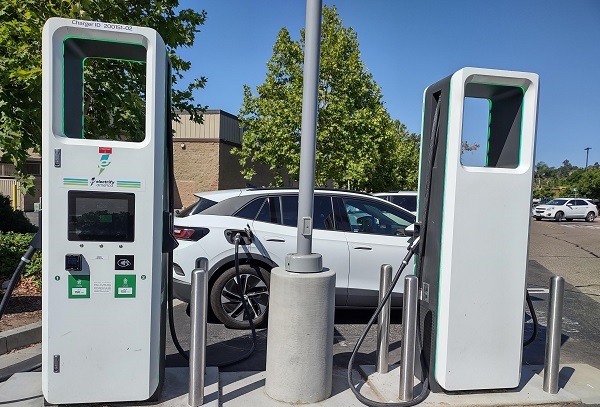 A Versatile Solution – Level 2 charging stations are currently the most common public and private charging stations, delivering charging through a 240V (residential) or 208V (commercial) AC plug. These chargers balance cost and speed, charging an EV up to five times faster than Level 1.
Benefits:
- Faster charging speeds (typically 10-20 miles of range per hour)
- Suitable for a wide range of fleet applications
- Cost-effective for medium-duty cycles or overnight charging
The future outlook for Level 2 charging technology in the commercial fleet sector is promising. With increasing technological advancements and decreasing costs, the Level 2 charging market is predicted to grow significantly.
Their broad applicability and enhanced charging speeds compared to Level 1 charging make them suitable for a broader range of commercial fleet applications, from delivery vehicles to company cars.
DC Fast Charging Stations (DCFC):
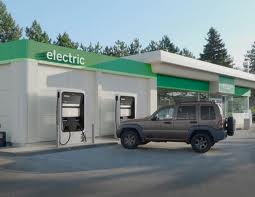 The Speed Champion- DC fast chargers can deliver very high power levels, reducing charging times significantly compared to Levels 1 and 2. These stations can recharge a depleted battery to 80% in around 30 minutes, making them ideal for commercial fleets requiring quick turnaround times or long-distance travel.
Benefits:
- Rapid charging times (80% charge in 20-60 minutes)
- Ideal for high-utilization fleets and long-distance routes
- Enables extended operational hours for electric fleets
The future outlook for DCFC technologies in the commercial fleet sector is exceptionally bright. Although DCFC technologies are significantly more expensive than Level 1 and Level 2, their faster charging times and growing efficiency propel growth.
As EV battery capacities increase and the need for rapid charging grows, DCFC technologies are expected to witness accelerated adoption among fleet operators. Moreover, developments in ultra-fast DC chargers, delivering power output up to 350 kW, are taking fast charging to another level. These chargers can add hundreds of miles of range in just 15-20 minutes, further enhancing the operational efficiency of electric fleets.
Wireless Charging Stations:
 The Convenient Future – Wireless charging uses inductive charging technology to eliminate the need for physical connectors or cables. While still in its early stages, this technology offers unique benefits that could revolutionize fleet charging operations.
Benefits:
- Convenience and reduced maintenance
- Eliminates wear and tear on charging sockets
- Potential for innovative applications like dynamic wireless charging
The future outlook for wireless charging in the commercial fleet sector is promising, albeit uncertain. The technology has enormous potential for growth due to its unique benefits, particularly in scenarios involving autonomous electric vehicles. The ability to charge vehicles while in motion (dynamic wireless charging) could significantly extend electric fleets’ range and operational hours.
However, the growth rate will heavily depend on developing cost-effective and efficient solutions. As the technology matures and costs decrease, we expect to see increased adoption, particularly in controlled environments like depots or dedicated fleet parking areas.
Battery Swap Stations:
 The Time-Saving Alternative – Battery swapping is an alternative to traditional charging, where the depleted battery of an EV is replaced with a fully charged one. This technology eliminates the waiting time for charging, providing a fully charged battery in just a few minutes.
Benefits:
- Minimal downtime for fleet vehicles
- Potential for improved battery lifecycle management
- Scalable solution for high-utilization fleets
The future outlook for battery swap technology in the commercial fleet sector is uncertain but potentially significant. While it offers unique benefits, particularly for fleets with high utilization rates and predictable routes, it also faces challenges like the need for standardized batteries and high infrastructure costs.
In regions where this technology is already prevalent, like China, sustained growth is possible, especially for specific fleet applications such as taxis or urban delivery vehicles. However, widespread adoption in other markets will depend on overcoming standardization challenges and proving the model’s economic viability.
Conclusion: Navigating the Future of Fleet Charging
As commercial fleet electrification accelerates, efficient and convenient charging solutions are paramount. Each charging technology offers unique benefits and caters to specific fleet needs:
- Level 1 charging provides a low-cost entry point but is limited by slow charging speeds.
- Level 2 charging offers a versatile and cost-effective solution for many fleet applications.
- DC Fast Charging enables rapid charging for high-utilization fleets and long-distance routes.
- Wireless charging presents a convenient, low-maintenance option with the potential for innovative applications.
- Battery swap technology offers minimal downtime but faces standardization challenges.
For fleet managers, the key to successful electrification lies in understanding and aligning these technologies with specific fleet operational needs.
Factors to consider include:
- Daily mileage and route predictability
- Vehicle dwell times
- Operational schedules
- Budget constraints
- Future scalability requirements
As the EV charging landscape evolves, staying informed about technological advancements and market trends will be crucial. In the future, we will likely see a mix of these technologies deployed strategically to meet diverse fleet needs, with DC Fast Charging and Level 2 charging forming the backbone of most fleet charging infrastructures.
 Emerging technologies like wireless charging and battery swap stations, while currently niche, could see substantial growth depending on technological breakthroughs and market acceptance. Their potential to minimize operational disruptions makes them particularly interesting for specific fleet applications.
Ultimately, the transition to electric fleets represents a change in vehicle technology and a fundamental shift in operational paradigms. By embracing this change and strategically implementing the right mix of charging technologies, fleet managers can position their organizations at the forefront of the sustainable transportation revolution, reaping cost savings, operational efficiency, and environmental stewardship benefits.
As we move forward, continued innovation in charging technologies, driven by increasing adoption of EVs in commercial fleets, will further shape the future of EV charging infrastructure, contributing significantly to the global transition towards sustainable transportation. For fleet industry professionals, staying ahead of these trends will be critical to successfully navigating the electric future of transportation.
Fleet Management Weekly and FleetWiki have teamed up to update you about today’s fleet industry technology and trends in this new monthly Fleetology column. We welcome your ideas for topics that would be of interest to fleet professionals. Contact Ed Pierce at (484) 957-1246 or [email protected] .