By Paul A. Eisenstein
Despite smaller vehicles having five-star crash ratings, a new study suggests that bigger vehicles are still the safest in a collision.
While conventional wisdom has a way of being wrong, a new study by the University of Buffalo suggests that, when it comes to cars, one traditional belief is correct: bigger cars tend to be safer cars.
While even some of the smallest cars on the market today earn five-star crash ratings, it doesn’t necessarily reflect what happens in the real world – especially when that little car smashes into a big one or, worse, an 18-wheeler. The bottom line, according to a study presented during the annual meeting of the Society for Academic Emergency Medicine, is that bigger, more expensive vehicles tend to be the safest.
“The most important point of our study is that vehicle weight and price have a positive relationship with vehicle safety,” said Dr. Dietrich Jehle, a professor of emergency medicine at University of Buffalo School of Medicine and Biomedical Sciences, who presented the research.
The study upends conventional industry data. Using their own methodology, U-B researchers place such popular vehicles as the Honda Accord and Civic, as well as the Toyota Corolla, in their “least safe” category. They had 40% more injuries than the industry average, according to the study.
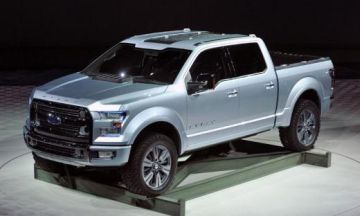
Researchers say that no matter how good the crash rating is on a car like the Honda Civic, it’s not as safe as a bigger vehicle, such as an F-150.
At the other extreme are such large vehicles as the Ford F-150, Range Rover, Chevrolet Silverado and Cadillac Escalade ESV. One notable exception to the bigger-is-better rule: the “safest” list includes the Mini Cooper Countryman – which is, nonetheless, the British maker’s biggest product line.
The study found that the safety of the average vehicle increased by 19% for every 1,000 pounds of additional weight, while there was a 12% improvement for every additional $10,000 in a vehicle’s price tag.
“One of my pet peeves is that I don’t think consumers have very good information about vehicle safety,” Jehle said. “Neither media advertising nor the five-star safety ratings accurately reflect the level of danger or lack of danger in vehicles.”
The Buffalo study was based on a retrospective study of 360 different vehicle models from 2010 to 2012 and used Highway Loss Data Institute, or HLDI, data to calculate real world injuries. The new study tried to accommodate the fact that some vehicles are driven significantly more than others and, among other things, excluded sports cars because they typically clock relatively few miles.
By comparison, the National Highway Traffic Safety Administration and the Insurance Institute for Highway Safety, base their ratings on crash tests in which vehicles are normally run into fixed barriers. But that may not be a particularly accurate reflection of what happens in the real world, especially when a small car and a big pickup lock horns, the study warns.
“When smaller cars hit a larger, moving vehicle, that change in velocity can force the smaller car to go into reverse, resulting in far more serious injuries to driver and passenger,” said Jehle.
The study cautions that cost and weight don’t always seem to be the final determinant of crash safety. The Mini Countryman and Jeep Wrangler both had an average 40% fewer personal injury claims. The Volkswagen Golf and the Subaru Outback scored more than 25% better than average. But, on the whole, big pickups and large SUVs tended to top the chart, while small vehicles such as the Honda Civic, Ford Fiesta and Kia Forte had much higher-than-average injury claims.
The study raises some potentially troubling issues for the auto industry at a time when manufacturers are putting heavy emphasis, as it were, on lightweighting. The newest, “aluminum-intensive” version of the Ford F-150 is, for example, about 700 pounds lighter than the steel-bodied version included in the U-B study. And most products are expected to continue getting lighter in the push for better fuel economy.
Read the original article in The Detroit Bureau