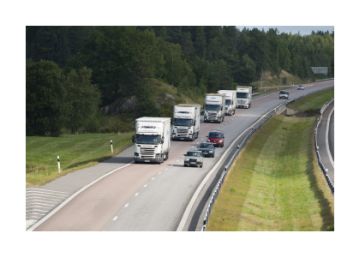
Platooning, more formally known as driver assistive truck platooning, or DATP, could be the low-hanging fruit in taking driving to the next level.
Walter Sullivan, head of Elektrobit Automotive’s newly established Silicon Valley Innovation Lab, notes that platooning will be one of the first implementations of automated truck driving, due to the promise of greater fuel economy.
Pointing out that OEMs are happy to eke out a 3% reduction in fuel each model year, “When a vehicle is driving 200,000 miles a year, if you can save 10% on fuel, that’s massive,” he says.
Peloton Technologies has demonstrated just that with a study headed by Auburn University’s GPS and Vehicle Dynamics Laboratory, finding that the lead truck gained as much as a 5% improvement in fuel economy, while the trailing truck got up to 10% improvement.
Peloton started with two-truck platooning because it’s simpler technically, according to CEO Josh Switkes but there’s an additional reason. “We want to make sure the public doesn’t complain about trucks in their way getting on and off the highway,” he says.
That’s a concern brought up by many that will have to be eventually addressed: If a 10-truck platoon is passing an exit ramp, how will single vehicles maneuver through it to get to the exit?
There’s plenty more scepticism.
Wes Mays, director of OEM product innovation at Omnitracs, points out that all drivers in the platoon will still have to steer their individual trucks. “The lead driver, short of a major accident, will not be able to change lanes, brake heavily or do a lot of the things they normally do,” Mays says. “And the following drivers will have to stay alert 35 feet behind the lead truck. You’re not going to have a lot of scenery to look at. “He also thinks it’s dangerous, because following drivers won’t be able to see what’s on the road ahead of the leader. He thinks that eventually platooning systems will need to let following drivers take their hands off the wheels. Ted Scott, director of engineering for the ATA, also has concerns about driver acceptance. “The driver in the first vehicle probably doesn’t have a problem, but the driver in the second truck may not be too happy. He’s 30 feet back from the trailer in front. What’s his view, and who’s controlling his life? … ‘I’ve gotta steer, but I can hardly see.’ That’s tough.”
These are valid concerns, and ones that Peloton is addressing, according to Switkes. Following drivers in platoons will be able to see a video feed from the lead truck, so that they can be alerted to hazards ahead. And, having driven many miles himself testing his company’s systems, Switkes says that the view for the following truck is not that bad – although the Auburn study used only tractors without loads. While it sounds close – and is closer than anyone would drive manually, he says, “You can see the other lanes and off ahead of you just fine. It’s not that much different from driving a couple hundred feet behind another vehicle.”
Furthermore, even though the following driver will have to pay attention and steer, Switkes says that they will be able to relax more than in manual driving. “When we talk to drivers, they say one of their big concerns is they won’t be able to react in time to something on the road. If they hit something, and they’re blamed, they could lose their job or it could impact their career. Safety automation can help address that. When you are in the rear truck, you will be protected by the system. It will react quicker than you could react.”
Other feedback Peloton has gotten is that drivers pretty quickly realise that the system will react for them by braking and distance-keeping, so they can relax somewhat. Switkes describes the level of attention required as “still paying attention and in command but not white-knuckle ready to slam on the brakes. That’s the trade-off.”
This article was released in the lead up to the Connected Fleets USA 2015 Conference & Exhibition. Find out more at http://www.tu-auto.com/fleet/.