|
|
 |
|
Distracted Driving Awareness Month should be every month! This spring is a timely reminder that even a moment of inattention behind the wheel can have serious consequences.
To support safer habits on and off the road, we invite you to refresh your skills or gain new ones by earning your AFLA Fleet Safety certificate.
From implementing smart safety technologies to optimizing claims and enhancing operational efficiency, this course is the ultimate guide to building a future-proof fleet safety program.
READ MORE
|
|
|
|
|
|
Image: Matthew Salm, New President & COO
Auto Driveaway Transport Logistics LLC, a leading technology-enabled transportation and logistics provider, is pleased to announce that Matthew Salm has been promoted to President and Chief Operating Officer effective immediately.
Rodney Ruth retains his Chief Executive Officer position and has also been named Chairman of the organization. Ruth has served as President and CEO of Auto Driveaway since 2006.
With over 70 years of experience, Auto Driveaway is comprised of three core divisions: Vehicle Transport, Truck Transport, and Drivers on Demand. The company is headquartered in the greater Chicago area.
READ MORE
|
|
|
|
|
|
Kooner Fleet Management Solutions, a leading provider of comprehensive on-site fleet management, preventative maintenance and mobile repair solutions, expands globally with the launch of Kooner Fleet Management Solutions UK.
This expansion is a milestone in growth, bringing Kooner FMS’s proven maintenance model, operational discipline, and customer-first approach to fleets across the UK, beginning in the West Midlands.
“Expanding into the UK is a natural next step for us. Fleets everywhere are facing the same pressures… Our model is designed to meet those challenges head-on.” – Gary Kooner, Founder and CEO of Kooner FMS
READ MORE
|
|
|
|
|
|
Element Fleet Management’s 2026 Market Pulse Report captures insights from organizations across the U.S., Canada, and Mexico, showing how leaders are optimizing fleet and mobility operations, balancing immediate pressures with long-term transformation.
“Clients are operating in an environment where every decision must deliver measurable value,” said David Madrigal, EVP and Chief Commercial Officer at Element.
The report details a pragmatic approach to innovation, where organizations are prioritizing solutions that deliver immediate impact, while building toward a more connected, flexible mobility future.
READ MORE
|
|
|
|
|
|

By Bill Bishop, SVP of Sales and Marketing, FLD Remarketing
Just when you thought things might be returning to some semblance of a normal, predictable order…bam! Global conflict. $6 diesel. See-saw inflation. Unfulfilled rates cuts.
In an effort to bring a little clarity to the current situation, let’s take a look at the current state of the used wholesale vehicle market.
The wholesale used vehicle market has shown some resiliency in the first quarter this year, peaking in early to mid-March, including an 8% increase over the previous 10 weeks.
Realistically for now, it’s more of the same wait and see attitude we’ve been dealing with for awhile. And while not fatal, it certainly has been unsettling.
READ MORE
|
|

By Fleet Management Weekly Staff
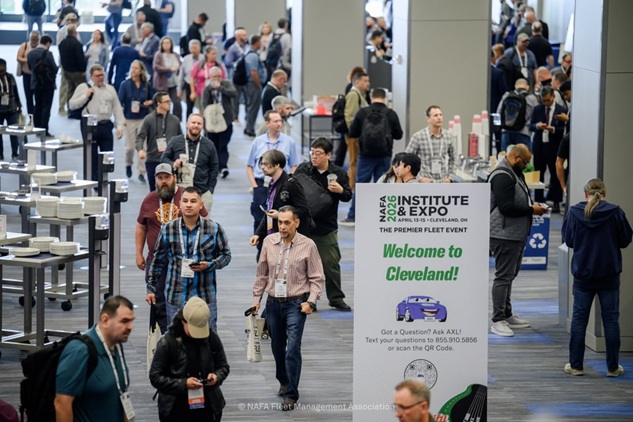
This is a summary of Lori Olson’s insights on the strategic application of data and AI in fleet operations. Lori is Geotab’s Signature Advisor for Data-Driven Decision Making. Her thoughts were delivered at the recent NAFA I&E conference.
Artificial Intelligence (AI) is rapidly becoming one of the most valuable tools for fleet operations managers.
The real opportunity lies in combining AI’s efficiency with human judgment, empathy, and experience.
If AI handles scheduling, service requests, maintenance approvals, or internal support, there must always be a clear path to a knowledgeable human when judgment or urgency is required.
READ MORE
|
|

By Alain Samaha, President, Teletrac Navman
High fuel costs are driving fleets to their breaking point. A recent survey of 217 US fleet operators paints a stark picture of an industry under pressure.
Unlike office-based businesses that can absorb fuel as a minor cost, businesses with fleets rely heavily on driving to generate revenue meaning that fuel isn’t an operating expense that can be trimmed.
The instinct to wait it out may not serve them well – geopolitical risk doesn’t resolve on a quarterly earnings cycle.
For light commercial vehicle fleets especially, the case for electrification as an energy independence play is compelling. Electricity can be generated locally, stored on-site, delivered at off-peak rates, and managed in ways that produce far greater price stability.
READ MORE
|
|
|
|