
By Alain Samaha, CEO, Teletrac Navman
May 6, 2026
High fuel costs are driving fleets to their breaking point. A recent survey of 217 US fleet operators by Coast paints a stark picture of an industry under pressure. Forty percent of fleet operators rated their concern about fuel prices as 10 out of 10.
 Fuel costs are usually a predictable expense category, but the sharp, sudden increase is driving the alarm. Unlike office-based businesses that can absorb fuel as a minor cost, businesses with fleets rely heavily on driving to generate revenue meaning that fuel isn’t an operating expense that can be trimmed.
The root cause isn’t hard to identify. Price spikes tied to geopolitical conflict, shipping chokepoints, and disruptions to global oil production have exposed a fundamental weakness in how most US fleets operate: they don’t control their energy supply. Rather, they’re buyers in a fragile global market, subject to forces entirely outside their control.
The Coast survey shows that fleet operators aren’t sitting still. Only 14% of respondents are not planning to respond to rising fuel prices. The remaining 86% are either already acting or actively exploring options.
But what they’re doing tells an important story about where the industry currently is, and where it needs to go.
Among those who have already made changes, the most common measures are operational and immediate: tracking fuel spend more closely, monitoring driver behavior such as excessive idling or suboptimal routes, directing drivers to lower-cost fuel stations, and tightening fuel card controls to prevent unauthorized personal use. Others are getting creative, tightening routes, doubling up technicians in a single vehicle, and optimizing fuel card rebates to extract every available discount.
 These are sensible, short-term moves. But ultimately, they are reactive and still leave fleet operators entirely dependent on external fuel markets and treat the symptom rather than the cause.
Cost pass-through is the preferred first move for many, perceived as the easiest way to offset rising costs. But, passing margin pressure onto customers is a losing strategy in a competitive market, and it’s exactly where fuel dependency keeps you: reactive, not in control.
Concern is highest among the industries that burn the most fuel. The more a business depends on miles driven to generate revenue, the less buffer it has when fuel prices spike.
The instinct to wait it out may not serve them well, but geopolitical risk doesn’t resolve on a quarterly earnings cycle. While some believe this is a temporary spike, there is little reason to believe the global fuel market will become more stable.
 When it comes to electrification, a gap lies between the strategic opportunity and where operators are. Fleet operators depend on reliability. An EV that can’t be charged reliably on a job site or during a long service day isn’t a solution. The conversation around fleet electrification has largely focused on the vehicle when the real barrier is the energy infrastructure behind it. Operators aren’t wrong to hesitate when charging reliability is uncertain. But the answer isn’t to abandon electrification, it’s to build the infrastructure.
A shift in strategic framing
It’s no longer about: how do we hit our sustainability targets? It’s: how do we operate a fleet that isn’t hostage to global fuel markets or political whims?
For light commercial vehicle fleets especially, the case for electrification as an energy independence play is compelling. Electricity can be generated locally, stored on-site, delivered at off-peak rates, and managed in ways that produce far greater price stability than diesel ever could.
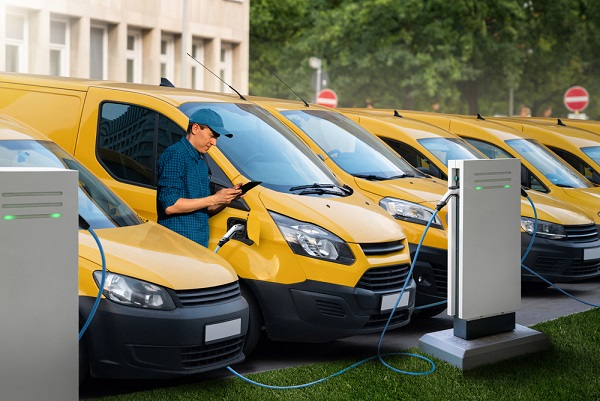 The most forward-thinking operators are beginning to think beyond simply replacing combustion vehicles with EVs. They’re asking a bigger question: what would it look like to become our own fueling station?
Fleet electrification isn’t just swapping combustion engines for EVs. It’s also: energy infrastructure, on-site solar generation, battery storage, smart charging management, and potential grid interaction including the ability to sell surplus power back. This is a different operational mindset, and it requires capabilities that may be new to many fleet organizations.
Where to start
For fleet operators ready to move beyond reactive fuel management toward genuine energy independence, a structured sequence of steps makes the transition manageable.
- Telematics-driven EV readiness assessment. Modern fleet management platforms can analyze trip data across your vehicles and identify which are best suited for EV replacement. These tools model charging requirements, recommend charger types for depot installation, calculate total cost of ownership, and project the emissions impact, turning the transition from guesswork into a data-driven roadmap.
- Depot energy audit. Before installing a single charger, you need to understand your site’s energy baseline, current draw, timing, available capacity, and local grid constraints. This audit will also identify whether a grid upgrade is necessary based on your anticipated fleet charging load.
- Solar feasibility study. A site-specific renewables assessment determines whether solar is viable, accounting for available structures, estimated annual generation, and whether output can meaningfully offset fleet charging demand, along with return on investment over time.
- Battery storage modeling. Storage is what makes on-site generation practical at scale, capturing solar energy for later use, avoiding peak-rate charging costs, reducing the need for expensive grid upgrades, and potentially creating a revenue stream through grid energy export.
- Smart charging strategy. Installing EV chargers without managing how and when they’re used is one of the most common, and costly, mistakes in fleet electrification. Unmanaged charging at peak demand periods can produce energy bills that rival diesel costs. A smart charging strategy incorporates departure schedules, vehicle prioritization, charger load management, and integration with on-site solar and battery systems.
The window is rolled down
 US fleet operators are engaged with the fuel cost problem and actively seeking solutions. But the solutions most are reaching for, tighter controls, route optimization, fuel card management, are optimizations within a system that still leaves them exposed.
There is significant room to offset fuel cost increases through smarter operations, and the best-positioned operators are already finding it. But smarter operations within an ICE-dependent model still leaves you dependent on whatever the global fuel market decides to do next.
For fleet operators willing to make the deeper shift, the opportunity is to stop being a price-taker in someone else’s supply chain and start controlling the energy that drives their business.
To find out how Teletrac Navman can assist your fleet in achieving maximum efficiency, click here.
 About the author
Alain Samaha has served as CEO of Teletrac Navman since 2021. He and his team drive the company’s strategic direction and product evolution, with a focus on artificial intelligence and cutting-edge telematics. Alain brings more than 20 years of deep expertise in digital transformation including smart cities, big data analysis, internet of things, and enterprise asset management.