|
|
 |
Artificial intelligence has been widely adopted across multiple sectors, with applications ranging from productivity tools to more unconventional uses – such as a BMW owner using ChatGPT to generate a custom performance tune.
While the technology is primarily leveraged to streamline workflows and improve efficiency, a report from S&P Global suggests that broader adoption could disrupt automotive production, echoing the pandemic-era supply chain shock.
The report stated that a dynamic random-access memory (DRAM) shortage could emerge in 2026. DRAM serves as the primary working memory for computing systems and is especially critical for AI data centers. The concern is that chipmakers may prioritize higher-margin customers over automakers, potentially triggering another disruption across the automotive supply chain.
via Autoblog
|
A growing social media frenzy suggests that the federal government will soon require a “kill switch” in new cars. In its most extreme form, the claim says it would let government officials deactivate all cars remotely.
The rumor spiraled last week as politicians got involved. Florida Gov. Ron DeSantis posted to X (the social media site formerly known as Twitter) saying, “The idea that the federal government would require auto manufacturers to equip cars with a ‘kill switch’ that can be controlled by the government is something you’d expect in Orwell’s 1984.”
What is this controversy that pits Mothers Against Drunk Driving (MADD) against the governor of Florida and some House Republicans?
via Kelley Blue Book KBB
|
A new report published by Kelley Blue Book and its parent, Cox Automotive, says that average new-vehicle prices reached an all-time high in the last month of 2025.
Initial Kelley Blue Book estimates show that the average transaction (ATP) price paid for a new vehicle in December 2025 was $50,326, a figure up from 0.8% from the same month in 2024, and up over 1.1% from November 2025’s ATP of $49,814.
Notably, KBB and Cox said that a major driver behind this elevated ATP level is more expensive varieties of vehicles, especially “strong sales of full-size pickup trucks.”
via Autoblog
|
Now, you can find, charge, and pay at more than 5,000 Electrify America fast-charging stations, including Hyper-Fast 350-kW chargers, right from the myChevrolet, myGMC, or myCadillac app already on your phone.
“As EV travel continues to grow, so does the need for convenient charging experiences,” said Robert Barrosa, CEO and president of Electrify America. “Through this integration, GM EV drivers have more Hyper-Fast chargers to choose from and a seamless experience they can count on nationwide, helping them get to the places that matter.”
With Electrify America built in, customers get a unified charging experience that eliminates the hassle of multiple apps and puts everything they need in one place.
via GM News
|
|
|
|
|
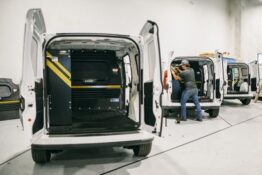
Kingbee upfits, wraps, and delivers fleet vans within two weeks, then rents them on a monthly basis. The flexibility and speed of their process enable fleets to scale as needed.
The secret to Kingbee’s success has been a combination of modern innovation and, interestingly enough, the principles of rave culture.
Scott Haslam, founder and CEO of Kingbee, built the company around PLUR, the core mantra of rave culture: Peace, Love, Unity, and Respect. We interviewed him to learn more about Kingbee’s principles and how the company is disrupting the rental space.
READ MORE
|
|

By Jay Collins, Senior Vice President and General Manager of EV and Mobility, WEX
Heading into 2026, the mixed-energy fleet is at a crossroads – the era of EV experimentation is over and the era of optimization phase is here. The question is no longer whether to electrify, but how to do it in a way that actually delivers value.
For most operators, that means managing mixed-energy fleets more intelligently, balancing electric vehicles (EVs) and internal combustion engines (ICE) while keeping a close eye on costs, utilization, and risk.
The EV conversation is becoming more grounded with an industry moving beyond early adoption. Fleet leaders are prioritizing smarter integration, better data, and more resilient systems.
READ MORE
|
|

(Image credit: Motive)
By Motive
To better understand how collision patterns evolved over the past year – and where risk is headed – Motive analyzed data from commercial drivers using the Motive AI Dashcam across the United States, Mexico, and Canada.
The 2026 Motive AI Road Safety Report is based on aggregated, anonymized insights from the Motive platform covering October 2024 through October 2025, with select analyses extending through December 2025.
This analysis focuses on AI-detected safety events captured in 1.2 billion hours of video to identify when, where, and why collisions occurred from 2024 to 2025.
READ MORE
|
|
|
|