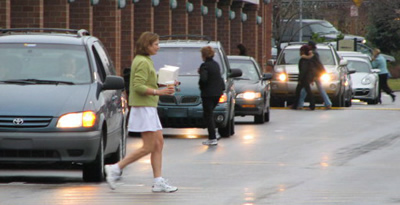
Pedestrians sometimes wander into traffic. Imagine if their cell phones could alert oncoming drivers. In a system being tested by auto-parts supplier Denso, computer software in the car would receive the phone signal, analyze speed and direction, and instantly determine if the pedestrian will cross the car’s path. That cuts down on false warnings. “It even can go as far as applying the brakes for you,” said Doua Vang, a Denso engineering manager.
This life saving technology, along with four other life and/or time saving technologies, are being shown this week at the Intelligent Transport Systems World Congress in Detroit.
• Walking Safely
The technology is five or more years away. Cars need receivers and radio frequencies need to be set aside by the government. Sending out a constant signal will quickly drain a cell phone battery. And engineers are working on distinguishing between a phone in a pedestrian’s pocket from one held by a passenger inside another car, Vang said. The hope is fewer pedestrian deaths. In 2012, the last year for which data is available, 4,473 pedestrians died in traffic crashes, the highest number in five years.
• Preventing Pileups
Black ice that forms suddenly is often blamed for multi-vehicle pileups worldwide, because drivers can’t stop in time. Now, state transportation officials in Nevada, Minnesota and Michigan are testing technology that can warn people when the first car hits ice. “We’re using it now,” said Steve Cook, field services engineer for the Michigan Department of Transportation, who wouldn’t guess how long it will take to get all cars on the system.
Sensors on the vehicles measure road surface temperature and other weather data. They also check the pavement for potholes. The cars relay the information, as well as data on location and windshield wiper, antilock brake and traction control use, to a central computer that sends messages telling other drivers to slow down.
• Automatic Braking
We’ve all seen television commercials advertising fancy radar systems that automatically brake a car to avoid a crash and save an inattentive driver. The systems are typically expensive options, around $3,000, on high-end luxury cars. But auto parts maker Aisin aims to bring the technology to mainstream cars.
The system’s cameras, two in the front and two in the back, can sense children, other cars and even deer, and automatically brake the car, said Ichiji Yamada, deputy general manager of chassis systems. Engineers wouldn’t reveal the price, but said Aisin is working with Toyota to put the system on mass-market cars around 2020. The cost is lower because of advancements in camera technologies.
• Traffic Light Alert
Bicycle riders are often ignored by systems designed to change a traffic light when a car arrives. A Raleigh, North Carolina, company called Kimley-Horn has come up with a smartphone app that gets cyclists noticed. It uses the phone’s GPS and signals a central computer via the Internet to turn the light green. The system will be tested this fall with 100 cyclists in Austin, Texas. It could go citywide by 2016, said Kimley-Horn’s Doug Gettman. Similar transmitters could be installed on all vehicles, so the computer can detect them and manage traffic lights, keeping them green for large blocks of vehicles, Gettman said.
• HOV Lane Monitor
Japanese technology company NEC wants to stop single riders from cheating in high-occupancy vehicle lanes reserved for cars with two or more people. NEC has a system of cameras and infrared sensors that records the number of people in a car and the license number. Isamu Suzuki, senior manager of business development, says enforcement is low because a limited number of humans monitor the lanes. The system can immediately notify police or store information so traffic tickets can be sent later. Due to privacy concerns, it doesn’t store facial images. State governments could begin using the system late this year or early next year, hopefully speeding up travel for those who use the lanes properly.