By Ed Pierce, President, Vyral Fleet Marketing
June 17, 2026
A few years ago, marketing success seemed relatively straightforward.
If your company published enough content, targeted enough keywords, and invested sufficient time in search engine optimization, the traffic graphs eventually moved upward. More visitors meant more opportunities—or at least that was the prevailing wisdom.
As of last week, the landscape looks very different.
Google’s recent announcements about AI-powered search and evolving search experiences have sparked anxiety across the marketing world. Industry observers are asking difficult questions. Will websites see fewer visitors? Will traditional SEO become obsolete? Will artificial intelligence replace content marketing altogether?
For companies serving the fleet industry, however, the outlook may be more encouraging than many people realize.
In fact, these changes may create an advantage for organizations that possess something AI cannot easily replicate—years of hands-on fleet experience.
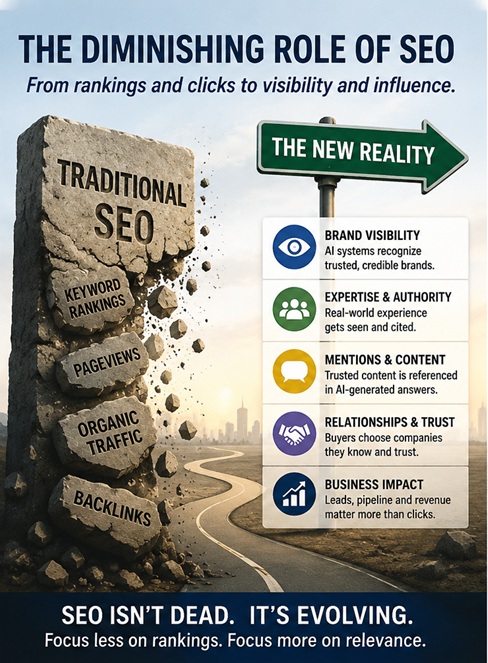
Experience Has Become a Competitive Asset
Consider two articles discussing fleet safety:
One is written by someone who has never attended a fleet conference, interviewed a fleet manager, or witnessed the challenges of managing drivers and vehicles.
The other comes from people who understand accident-reduction programs, driver-coaching technologies, maintenance realities, and the daily pressures fleet professionals face.
 Which source would you trust?
Fleet managers have always preferred information from people who understand their world. Increasingly, Google’s search systems appear to reward that same principle.
Google’s own search guidance continues to emphasize helpful content that demonstrates experience, expertise, authority, and trustworthiness. According to Google’s Search Central documentation, content should be created primarily to help users rather than to rank well in search results.
That philosophy plays directly into the strengths of specialized industries like ours.
The Internet Doesn’t Need More Generic Articles
For years, marketers were encouraged to produce content at high volume.
As a result, countless websites became filled with interchangeable articles discussing “digital transformation,” “industry trends,” and “improving efficiency.” Much of that material sounded remarkably similar because it was.
But buyers in the fleet industry rarely make decisions based on generic advice.
 They want specifics.
They want customer experiences.
They want examples from companies similar to their own.
They want insights that reflect real operating conditions.
An interview with a utility fleet manager who shares lessons learned from electrification may be more valuable than 10 generic blog posts. A customer success story explaining how transportation delays were reduced may be more influential than a lengthy keyword-driven article.
Original experiences are becoming increasingly valuable because they cannot easily be duplicated.
Visibility Is Becoming Bigger Than Search Rankings
Another interesting shift is taking place.
Historically, companies pursued broad search terms in hopes of attracting anonymous visitors. But today’s buyers often discover suppliers long before they visit a website.
They encounter companies through webinars.
They see them quoted in trade publications.
 They hear executives speak at conferences.
They read LinkedIn posts.
They receive newsletters.
Eventually, when a need arises, they search for the company by name.
Brand awareness and search visibility are increasingly intertwined. In other words, the companies buyers recognize are often the companies buyers search for.
For fleet suppliers, that means public relations, thought leadership, educational webinars, and participation in industry media may become even more important than before.
Website Traffic Doesn’t Always Tell the Whole Story
Many marketing departments have long relied on traffic reports to demonstrate success. But traffic alone has never paid for a fleet management system, purchased telematics equipment, or signed a transportation contract.
 Revenue does.
Imagine two scenarios. In the first, website visits rise by 20 percent but lead quality declines. In the second, traffic remains flat while highly qualified opportunities increase dramatically. Most sales teams would gladly choose the second outcome.
As Google’s AI increasingly answers simple questions directly in search results, marketers may see fewer clicks even as overall visibility rises. That means marketing measurement must evolve.
Instead of focusing exclusively on visitors and rankings, organizations should pay closer attention to the following:
- Marketing-qualified leads.
- Sales opportunities generated.
- Pipeline contribution.
- Customer acquisition costs.
- Email engagement.
- Webinar participation.
- Marketing activities influence revenue.
Those measurements reflect business performance—not merely website activity.
Your Audience Is an Asset You Own
Perhaps the most important lesson from recent changes is the value of owning relationships. Algorithms, platforms, and search behavior change. But an engaged audience remains valuable.
 Subscriber databases, email lists, webinar attendees, and customer communities are assets that companies control directly. These relationships are not dependent on changes in algorithms or technologies.
In many respects, owned audiences may become one of the most valuable assets a marketing department can build.
A Return to Marketing Fundamentals
Ironically, Google’s latest evolution may be steering marketers back toward principles that have always worked. These include helpful information, authentic expertise, customer success stories, educational content, trust, and relationships.
Those ideas are hardly revolutionary. In fact, they reflect the same fundamentals that have long driven successful business development in the fleet industry. Technology may change how information is found, but it does not change how confidence is earned.
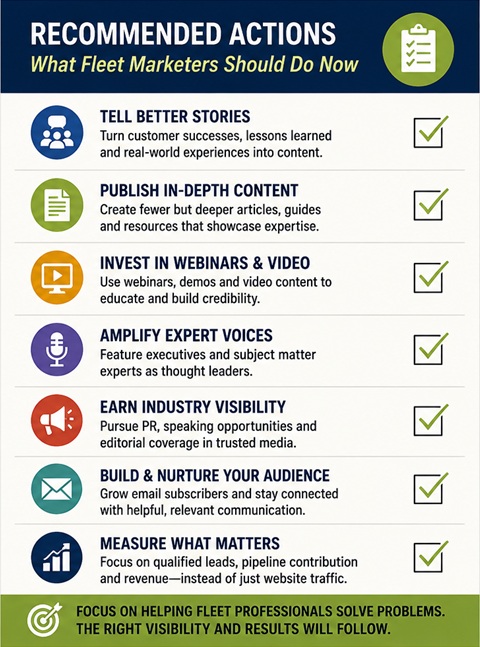
Recommended Actions
Fleet industry suppliers should resist the temptation to chase every new algorithm update. Instead, focus on becoming recognized experts in your market.
Interview customers and turn those conversations into case studies. Repurpose conference presentations into articles and videos. Encourage executives and subject-matter experts to share practical insights. Expand email subscriber programs and continue investing in educational webinars and in industry visibility.
Most importantly, create content that answers the questions customers are actually asking—not content designed solely to impress search engines.
The companies that thrive in the next generation of digital marketing will likely be the same companies that have always succeeded in the fleet industry: those that build trust, demonstrate expertise, and consistently deliver value. Perhaps that’s the most encouraging message of all.
 About the author
Fleet marketing expert and consultant Ed Pierce is president of Vyral Fleet Marketing and a contributing editor at Fleet Management Weekly. He can be reached at 484-957-1246 or [email protected].
Sources: Various industry analyses and commentary were published during May-June 2026:
–Google Search Central, “Creating Helpful, Reliable, People-First Content”
-Google Search Central Documentation, EEAT, and Search Quality Guidance
-Google I/O 2026 Search Announcements
-Search Engine Land coverage of AI Overviews and evolving search behavior