This article first appeared in Escalent’s Blog
By Lucas Lowden, Dania Rich-Spencer
Key Takeaways:
- Rather than betting exclusively on battery electric vehicles (BEVs), fleet decision-makers are prioritizing flexibility—embracing hybrids, plug-in hybrids and extended-range electric vehicles (EREVs) as practical bridge technologies that balance sustainability goals with real-world operational constraints.
- Fleet leaders are committed to sustainability despite regulatory uncertainty, viewing it through a broader lens that includes fuel efficiency, emissions reduction, lifecycle management and operational efficiency—not just zero-emissions targets.
- Legacy automakers will hold their ground with fleets—for now—by offering diverse powertrain portfolios and consultative support, while startups still face awareness challenges.
- As powertrain consideration sets widen, brands that guide fleets to the right solution for specific use cases—not a one-size-fits-all BEV—will earn long-term loyalty.
The commercial vehicle and fleet sector of the automotive and mobility industry is shifting its focus from all-electric powertrains toward a broader mix of electrified alternatives. Findings from Escalent’s Fleet Advisory Hub™ 2025 Fleet Electrification Brand Landscape Report reveal a growing emphasis on optionality, as fleet decision-makers work to balance operational and business realities with long-term sustainability goals. This dynamic is contributing to an increased interest in so-called “bridge” technologies. Powertrains such as hybrid electric vehicles (HEVs) offer a pathway toward full electrification while sidestepping pervasive concerns around range, battery life, payload and infrastructure readiness.
At the time of the study, fleet professionals in the market for BEVs indicated that approximately one-quarter of vehicles in operation (VIO) were electrified and, based on their self-reported ideal vehicle mix, they expect that share will almost double in the next three years.
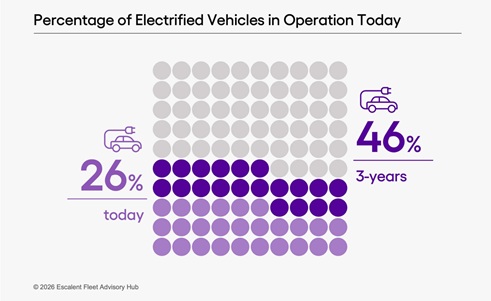
While gas and diesel internal combustion engine (ICE) vehicles remained prominent in this self-reported ideal mix, the share of each fell by about 30%, and our expectation is they will continue to serve select use cases in the near term. The percentage of BEVs stayed relatively flat, while HEV and plug-in hybrid electric vehicle (PHEV) shares rose to approximately 15% each, approaching parity with BEVs. EREVs also demonstrated momentum, achieving strong growth, albeit off a nominal base.
Sustainability Is Multifaceted and Important for Fleet Decision-Makers Despite Regulatory Uncertainty
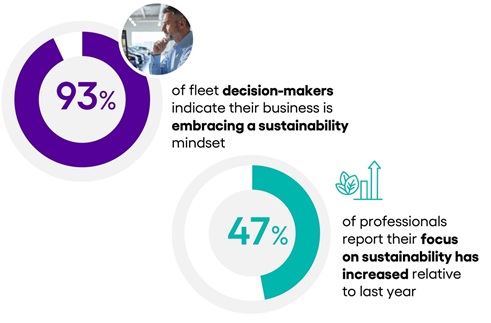
By nature of their operations, fleets are more affected by evolving standards and regulations than the average retail customer. As a result, fleet operators are often forced to adapt on the fly, even in the absence of fully defined policy outcomes. Yet, amid a chaotic regulatory environment, fleets remain committed to sustainability and are focused on choices that are good for the environment—and for the business.
(Image: 2026 Escalent Fleet Advisory Hub)
Additionally, more than one-third of fleet decision-makers said the concept of sustainability is wholly embedded into their company culture or supported by dedicated staff and/or a department. A similar proportion are in the early stages of establishing a formal sustainability program.
For these businesses, sustainability is multifaceted. When asked to define sustainability, the most common answer is fuel efficiency (58%), followed by reducing emissions (41%). However, fleet operators also cited factors such as efficient vehicle utilization (40%), vehicle lifecycle management (38%) and supply chain efficiency (30%). This suggests that, within commercial vehicle and fleet businesses, decisions around sustainability will likely be made through the broader lens of business viability and operational efficiency, beyond the environmental impacts of the operation.
 Given this nuance—and the pressures of a changing regulatory landscape—it’s especially important that automakers and service providers understand the needs and concerns of their fleet customers. With a growing mix of powertrains becoming available on the market, many fleets are looking for guidance in determining which solutions, whether BEV, HEV, PHEV or EREV, will best align with their use cases and support their long-term goals. Partners that work with fleet operators to help them identify the right vehicle for the job can differentiate themselves as trusted partners.
Legacy Automakers Maintain Edge as Low Familiarity With EV Startups Continues Among Fleets
The shift from all-electric to electrified models gives legacy automakers a major structural advantage over EV-native startups—and affords legacy automakers more time to get BEV portfolios in order.
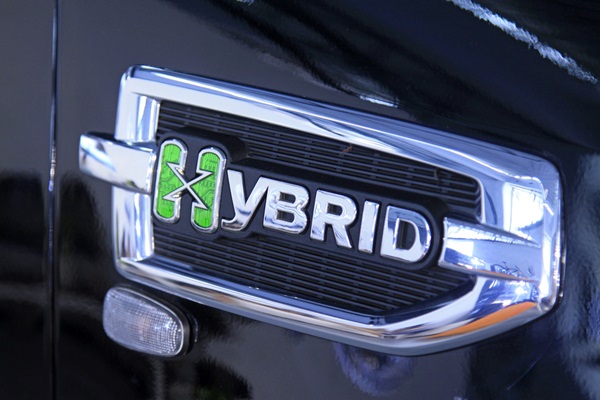 Many legacy brands have spent years developing alternative powertrains, such as hybrids, and have the infrastructure, expertise and scale to compete across a broader mix of solutions. Meanwhile, momentum among startups appears to have stalled. Our analysis found that only four startup brands—Rivian, BYD, Xos and Bollinger—recorded year-over-year gains in familiarity. Even then, that progress was limited to select segments. Despite growing familiarity, Bollinger, like other startups before it, ceased operations since we completed our study—underscoring the difficulty of surviving and succeeding in this space.
Overall familiarity with startups lags well behind that of legacy manufacturers, underscoring the distance these companies will have to cover to achieve broad recognition within the fleet market.
Q: Can startups still find their way into fleet decision-makers’ consideration sets?
A: Absolutely. Among fleet decision-makers familiar with startup brands, opinion and consideration levels remain competitive with in-segment averages. Still, legacy manufacturers now find themselves in a stronger competitive position than they were five years ago because they have experience with electrified powertrains and not only all-electric vehicles. In fact, increased powertrain diversity is expanding choice for fleets, which, in turn, is leading to wider consideration sets. From a brand perspective, the core challenge is unchanged: standing out in a crowded marketplace.
Building the Bridge to Electrification: How Automakers Can Build Trust With Fleet Leaders
Fleets want choice. And increasingly, they will get it. Where the future of electrification was once framed almost exclusively through the lens of BEVs, fleet decision-makers now report a desire for a variety of powertrain alternatives.
 The question, then, is how brands—legacy or startup—can capture (and retain) fleet decision-maker attention. The key lies in trust. During this transition, the concept of trust goes beyond just fulfilling traditional brand promises. Automakers need to build confidence that sustainable alternatives exist and transitioning to electrified powertrains is a sound business decision for fleets. Doing so requires a consultative approach rooted in a deep knowledge of fleet-specific needs and use cases to guide fleet decision-makers to the right vehicle for the job. Fleet professionals never want to second guess their vehicle choices when justifying the cost and investment associated with responsible fleet management. The brands that provide fleet operators with unwavering confidence will be market leaders.
Are automakers ready to meet fleet professionals’ demands with the appropriate product mix and consultative guidance? With product development cycles typically spanning three to five years, those who are not will need to act quickly to get the right powertrains into their pipelines.
Want to better understand the rapidly evolving electrified fleet market and assess how your product mix aligns with future fleet needs? Click here.