By ClunkerJunker.com
March 28, 2023
Sometimes, it’s wise to put the brakes on before you even make it to your car.
There are around 100 fatal accidents on U.S. roads every day, on average. But nobody takes the “average” journey: where and how you drive makes a big difference to your chances of getting home safely. For example, you are four times more likely to be involved in a collision if you drive while using a phone.
And your chances of avoiding an accident are also greater if you drive at certain times of the day, week and year — and these factors, in turn, differ from state to state. To help America’s road users keep those roads a little safer, The Clunker Junker used statistics from the National Highway Traffic Safety Administration to identify the safest times to drive in America — and the hours, days and months when it’s best to leave the keys in your pocket.
What We Did
The Clunker Junker sourced fatal accident data from the National Highway Traffic Safety Administration (NHTSA) and grouped the data by hour of day (nationally and on a state-by-state basis), weekday and month. We also identified the top ten days across the year with the most accidents. Then, we used our processed data to identify the most dangerous periods to drive and illustrate them in a series of charts and maps.
Key Findings
- An average of 5.57 fatal collisions happen between 9 and 10 pm, making it the most dangerous time to drive.
- 4 – 5 am is the safest time to drive, with an average of 2.34 fatal collisions across the U.S. during that period each day.
- Saturday is the most dangerous day to drive, with an average of 4.68 fatal accidents per hour, peaking at 7.08 between 9 and 10 pm.
- September is the most dangerous month to drive ( 106.48/day ), and March is the safest ( 80.95 ).
- Coastal states tend to be more dangerous in the evenings, while central states are most dangerous in the afternoon.
The Most Dangerous Times to Drive Are Rush Hours and Beyond
The clock faces below illustrate the comparative safety of driving at different times of day. The most dangerous times are in the evening after 5 pm, peaking between 9 and 10 pm. Low light levels affect drivers’ depth and color perception and their peripheral vision — even with high-beam headlights on, visibility is limited to around 500 feet. Plus, you’ve got everyone else’s lights coming at you the other way.
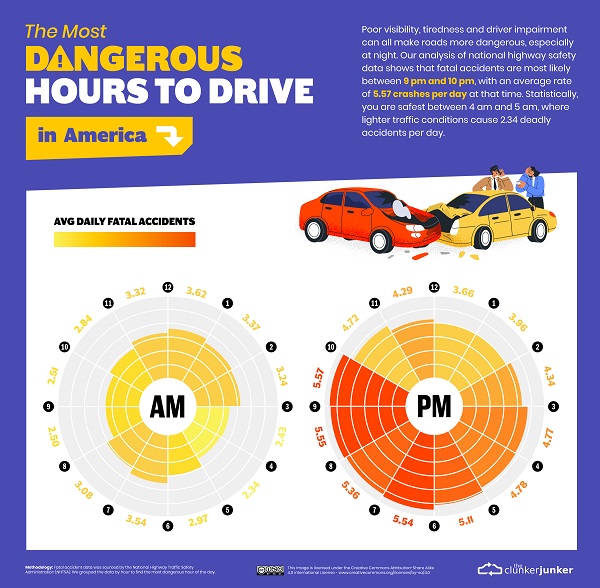
But darkness is not an absolute factor; the safest times are between 3 and 5 am, when there are fewer cars on the road. Rush hour and darkness aside, there is another factor endangering road users in the afternoon and evening: drunk drivers. “Motor vehicle crashes involving alcohol-impaired drivers kill one person every 45 minutes in the United States,” according to the CDC. “That’s 32 people every day.”
Fridays and Saturdays Are More Dangerous, and Dangerous Later On
The clearest divide between daily danger patterns on the road occurs between weekdays and the weekend, although the balance starts to shift as early as Friday lunchtime. Things really heat up during weekend party times, and Saturday and Sunday are the only days when 7-9 am is the safest period on the road. Conversely, the weekday hours of 5-8 am are more dangerous than those directly before and after.
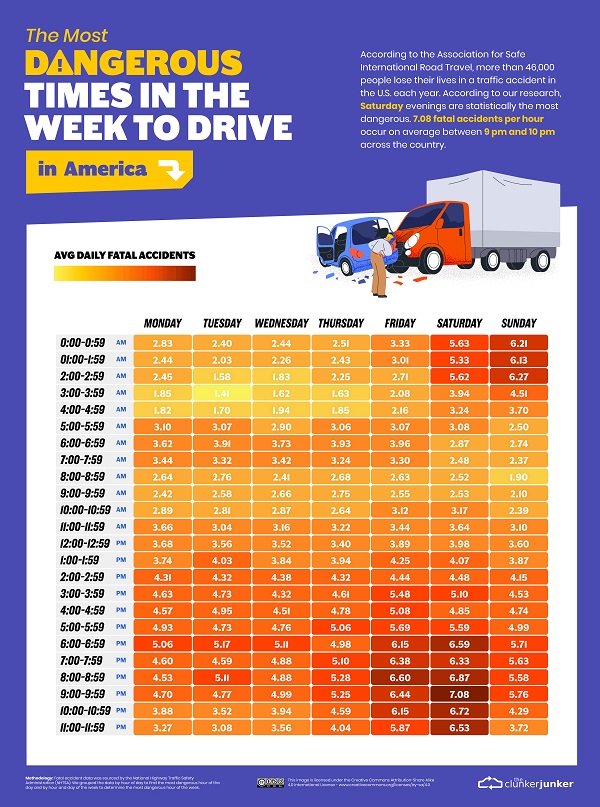
Tuesday (3.46 fatal collisions/hour) and Wednesday (3.50) are the safest days on average, while Friday (4.24) and Saturday (4.68) are the most dangerous. In fact, the roads are more lethal on Saturday and Sunday mornings between 3-4 am than they are during morning rush hours on weekdays. While electing a designated driver to get the crew home without a drink is a good idea, flat-out tiredness is also an issue: losing two hours of sleep has a similar effect to drinking three beers, and 21% of all fatal road accidents involve a “drowsy driver.”
September is the Most Dangerous Month to Drive
September? While the traditional vacation months of June-August are perceived correctly as among the worst times to drive, September is the month with the most fatalities by a margin of nearly 3% over second-placed June. The summer months are plagued by increased traffic, including tourists unaccustomed to long rides and unfamiliar roads, and teenagers out of school and over-excited to get behind the wheel. Heat affects both vehicle and driver performance, and there is more construction work on the roads.
However, September sees a flood of sometimes- inexperienced drivers hitting the road for the new school term. The National Safety Council predicts up to 545 people may lose their lives on the road over Labor Day weekend.
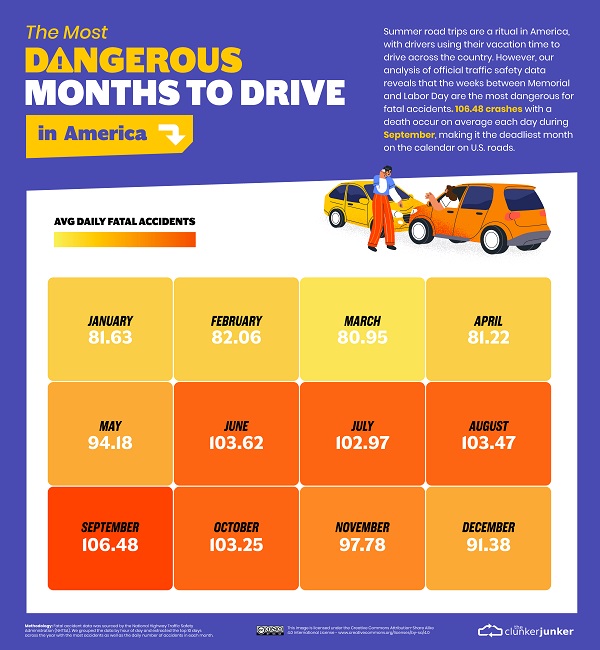
It may be worth saving that major road trip for the late winter and spring months. On average, the months of January-April are 21.77% less dangerous on the road than the months of June-September. October and November are also dicey as the nights draw in and colder weather ushers folk towards their vehicles.
Coastal States More Dangerous After Dark
Neither roads nor traffic patterns nor the changing light and weather are the same across the U.S., so there is a remarkable disparity in the most dangerous time to drive, depending on which state you’re in. Indeed, the reduction in traffic and increase in pedestrianism — and pedestrian road deaths — during 2020 highlighted the fact that low-income communities are less likely to have parks and other safe recreational walking spaces, “and are less likely to have sidewalks, marked crosswalks, and street design to support safer, slower speeds,” according to Smart Growth America.
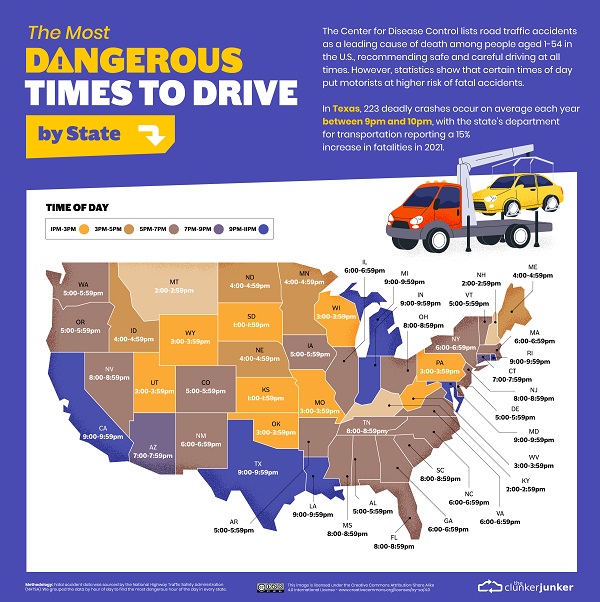
In fact, traffic fatalities are rising in the U.S., against a general downward trend among comparably developed nations. While peak danger time tends to be after dark in coastal and perimeter states, central states suffer their worst hours between 1 and 6 pm. In New York City, record numbers of road fatalities were recorded in 2021, with authorities blamed for “lax prosecution” of dangerous drivers and hesitating to create bicycle lanes and safe walking areas. Across the state of New York, where the most dangerous period is 6 – 7 pm, record numbers of new cars were registered during the pandemic, with more lethal SUVs and pickup trucks hitting the streets.
Drive Safe – Or Stay Home
“Motor vehicles are first, highways are first, and everything else is an afterthought,” National Transportation Safety Board chair Jennifer Homendy recently told the New York Times. America’s road accidents continue to pile up while other countries with similar challenges (drunk and drug driving, cell phones and other distractions) reduce their national toll. If systemic issues with U.S. transport infrastructure carry much of the blame, individual drivers can avoid the dangerous times listed in our full data below.
There are steps you can take to improve your own safety within the car, too. Seat belt use is “45% effective in preventing fatalities among front-seat passenger car occupants,” according to the National Safety Council, while securing potential projectiles (loose luggage or souvenirs) could prevent a fatal blow. Invest in the safest modern car you can, and learn how to maneuver your car during an accident. But best of all, put that cross-country drive off until March.