By Mark Boada, Executive Editor
While it’s true that some of the most significant fleet costs are the result of highway accidents – especially when fatalities are involved – a very substantial amount are the result of injuries work truck fleet drivers suffer that aren’t collision-related.
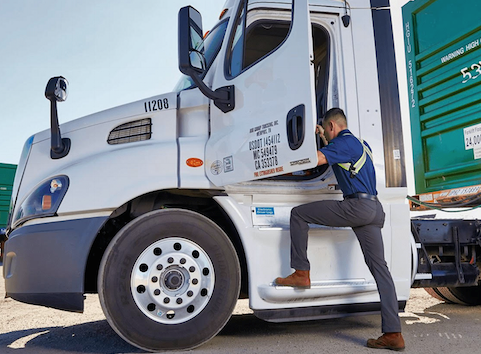
We’re talking here about non-fatal musculoskeletal injuries suffered by drivers of every truck class, from light through heavy-duty. The injuries include sprains, strains and neck, shoulder, back and knee injuries resulting from overextension or repetitive motion. They come from a variety of non-driving tasks that work truck drivers are required to perform, like lifting heavy objects while making deliveries, or climbing utility poles, but others merely from getting into and out of a truck cab improperly, multiple times a day, day after day.
Billions of dollars lost per year
No figures are available for just work truck drivers alone, but the 2019 Liberty Mutual Safety Index says that soft-tissue injuries cost businesses across all industries $16.8 billion a year in worker’s compensation claims and more than 100 million days lost from work. And in the work truck universe, the U.S. Bureau of Labor Statistics found that the vast majority of non-fatal injuries – more than 86 percent – result from causes other than highway collisions, and between 35 and 41 percent from overexertion or poor bodily reaction.
Now, some attribute these injuries to things like fatigue, long work days, poor diet and little exercise. But beyond that, executives at a San Francisco-based company called Worklete, say an underlying problem is that drivers aren’t using their bodies properly, and that by using the correct techniques to lift, bend and climb, more than half of all these kinds of injuries can be avoided.
Says Worklete co-founder and CEO Benjamin Kanner, “You can be the strongest or most flexible guy in the room and still move or muscle stuff around poorly and set up yourself for injury. What I wanted to do when I started the company in 2015 was to take the underlying core principles of human movement and the interaction a person has with his environment to keep himself safe.”
Worklete’s solution: technology-assisted training
The good news for fleets is that Worklete believes it has a technology-assisted program that can enable work truck fleets to achieve that. It’s a continuous educational and movement training program that it says has worked wonders for some 50 different fleets, like Nestlé Waters, the food giant’s bottled water division, Penske Logistics and Hub Group, a $4 billion a year trucking and logistics company with 5,000 employees based in Oak Brook, Illinois.
Kanner says Worklete’s training methods are similar to the those that athletes follow, and are designed to create and retain good habits. At the heart of the program are dozens of three-to-five-minute, interactive video lessons that drivers can access through a mobile phone or tablet to take one every two weeks.
The program’s five core videos teach drivers the basic principles of safe body movement when conducting heavy-duty and repetitive tasks. For example, there is “Brace,” which demonstrates the proper stance for heavy work; “Zone,” which illustrates the positions that bring the greatest amount of strength to bear on a task, and “Hip Hinge,” which teaches how to bend properly from the hips to lift heavy objects. In addition to these, Worklete says it has developed several hundred customized job-specific modules that are relevant to tasks specific to different companies and industries. It also has modules that can help warehouse stock handlers and even office workers who spend long hours seated in front of a computer.
Trainers and tracking
Once a company signs on, Worklete sends out an implementation team to set up the technical aspects of the program, and help the client formulate a communications plan to introduce its program to frontline employees. Worklete’s team also trains a number of front-line supervisors, called “Champions,” to serve as leaders of five-minute group exercise instruction sessions, designed to assure that those enrolled in the program demonstrate the right technique.
The program’s final element is a web-based system that enables any designated level of company management to assign, distribute and track completion of training modules. The system also gathers data from the exercises, including lesson completion, the number of times each enrolled employee interacts with the platform and how effective the program has been in reducing injuries.
Worklete says the entire program content takes up to a year to complete. It starts with fundamental lessons and progresses through to those specific to the nature of the tasks drivers and others perform. Afterwards, Worklete recommends that its clients use it to train new hires and to repeat the program to keep lesson knowledge fresh.
Dramatic results
By latest count, Worklete has more than 25 client companies and has enrolled some 20,000 individuals, many of them drivers, in its injury-prevention program, with impressive results. For example, the company says that three years after implementing its program at Hub Group’s 160 locations the firm saw a 63 percent reduction in its recordable injury rate and an 85 percent reduction in injury-related direct costs.
“We get great feedback from our high-level stakeholders,” says Worklete’s other co-founder and product vice president, John Post. “We see a huge reduction in injuries across the board, averaging a 55 percent reduction in preventable injuries. Even outside the front-line users, more than 97 percent of our users felt they were safer after learning our techniques, and 95 percent like or love the techniques and felt they found value in them.”
Work truck fleet managers looking for another way to meet the demand for cutting costs owe it to themselves to check out what Worklete has to offer.
To learn more about Worklete’s injury prevention program, visit worklete.com.