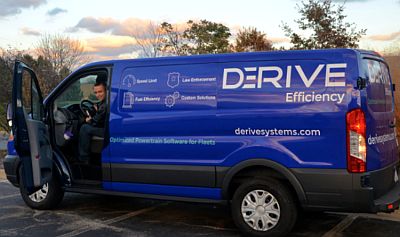
Reprogramming your vehicles’ engines may be the fastest and cheapest — and Derive can do it for you
By Mark Boada, Executive Editor
Getting better fuel efficiency is one of the fleet industry’s major goals, for two reasons: reducing its single greatest category of expense and cutting back on its carbon footprint.
There are many ways of achieving those objectives, but one of the simplest is to acquire higher-MPG vehicles as fleets retire their equipment. After all, OEMs are under a federal mandate to improve the fuel efficiency of the vehicles they sell, and every year they offer increasingly fuel-efficient powertrains of all kinds.
But there are two drawbacks to this approach: it’s expensive and slow. New vehicle prices continue to increase, and fleets just don’t have the budget to replace them all at one time.
So, it takes most fleets at least four years for a full turnover, and in some cases – especially among government and work truck fleets – more than that. Meanwhile, as much as 75 percent of their fleets are burning fuel at less than optimal rates.
Another way is to try to get fleet drivers to change their behavior. This includes their shutting down the engine instead of idling for long periods of time and avoiding speeding and rapid acceleration. Fleets that have deployed telematics systems that monitor such driver behavior have had success, but the approach still relies on drivers voluntarily changing their own behavior.
But there is another and perhaps a better way, and a company called Derive Systems, headquartered in Sanford, Florida, can help you find it. Their secret is to reprogram your vehicles’ computer-controlled diesel and gasoline-powered engines, and it’s saving some 200 of Derive’s fleet customers, with a total of more than two million vehicles, as much as 12 percent a year on their fuel bills.
Notes Karl Weber, senior vice president of sales and marketing at the company, “Derive helps fleet managers improve their fuel efficiency, productivity, sustainability, and safety in their fleets by managing their vehicles, not their drivers. We shift the responsibility for improved performance from the driver to the vehicle itself.”
And how do they do that? By changing a vehicle’s generic operating parameters that an OEM programs into its ECM, or Engine Control Module, the tiny computer that governs such things as a vehicle’s top speed and the RPMs at which it shifts gears and idles. As Joshua Thew, Derive’s projects manager for customer success, explains: “We fine-tune what the vehicle is able to do and improve performance and fuel efficiency. Instead of using the standard settings the OEM applies, we make sure your vehicles are optimized for your fleet’s specific mission and operate the way you need them to.”
Work truck fleet program
The company offers some case studies to illustrate. One involves one of the largest commercial fleets in the country that makes thousands of service calls to homes and businesses in more than 40 states. Derive says it turned to them to help it achieve its ambitious goals for savings and sustainability. Derive’s solution involved four changes to the company’s vehicle computers: optimizing idle RPM, putting in place a speed governor, tailoring shift point, and managing engines’ torque points.
Derive ran a pilot test with 150 of the company’s cargo vans and bucket trucks against a control group of 300 similar vehicles. The results: according to Derive, 9% savings on fuel spend, worth $7.5 million in fuel costs and 2.7 million gallons of fuel saved, equivalent to the CO2 consumed by 620,000 trees over 10 years. As a result, Derive notes, the company now plans to integrate Derive’s technology into its entire 18,000-vehicle fleet.
Police department application
When Derive began to offer its engine management technology in 2010, it found most of its customers in the heavy-duty truck market. Today, Weber says the most of its customers are light- and medium-duty fleets, including clients in the field service industry, telecommunications, oil and gas, electric utility, pest control and law enforcement.
One such customer is a 300-vehicle Florida law enforcement agency, that wanted to reduce fuel consumed while police vehicles were idling, a big part of the way police vehicles spend their day. According to Derive, the average police vehicles idle up to 65% of the time in a 12-hour shift, but this Florida fleet’s vehicles idled 76% of the time.
As it typically does with new customers, Derive calculated some revised engine calibrations and ran a pilot test with a sample set of vehicles that included sedans, SUVs and a K-9 Unit. First, it studied the vehicles to establish a baseline. It then used the data it collected to create a refined solution for the entire fleet that optimize the vehicles’ idle RPM and shift points, customized to the tasks profile of each type of vehicle.
After a two-month evaluation, the sample achieved a 12% reduction in idling fuel consumption, an 11% reduction in total fuel spend, and a 200 lb. reduction in each vehicle’s carbon footprint per month. Impressed with the results, Derive says the agency plans to install the technology in its entire fleet, and that the installation was expected to pay for itself in less than a year.
Installation via the OBD2 port
Derive achieves its results by writing new engine computer code that gets installed via a device that plugs into a vehicle’s OBD2 port. Weber said installation takes around 25 minutes and is so simple that it can be done by drivers themselves anywhere the vehicle is parked. What’s more, he said, while the technology optimizes fuel consumption according to client-customized specifications, it doesn’t void carmakers’ warranties.
Weber said customization is key to the best results and can vary both by fleet and by the types of vehicles within a fleet. “We tailor our engine’s software to work the way you need it to, whether that’s more conservative driving, more power for heavy loads, installing speed limiters, or reducing fuel waste while idling,” he says.
Weber also notes that fleets that lower vehicle maximum speeds also experience a reduction in motor vehicle violations and accidents. Early next year, Weber says Derive will be unveiling a new telematics offering and is developing features that prevent drivers from shifting out of park without using their seatbelt and locks down a driver’s cell phone against texting, checking emails or making phone calls when the transmission is out of park.
For more information, visit the company’s web site at derivesystems.com.