By Clay Siegert, Chief Operating Officer, XL
If you were asked to rank the following green fleet vehicles in order of their net CO2 emissions savings over standard, gas-powered vehicles, from highest reducing to least reducing, how would you order them?
- Plug-in Hybrid Electric Truck (PHEV)
- Hybrid Electric Truck (HEV)
- Battery Electric Sedan (BEV)
(Hint: If you guessed the order above, you’d be right.)
Surprising? Not when you look at the full picture of relative net CO2 emissions.
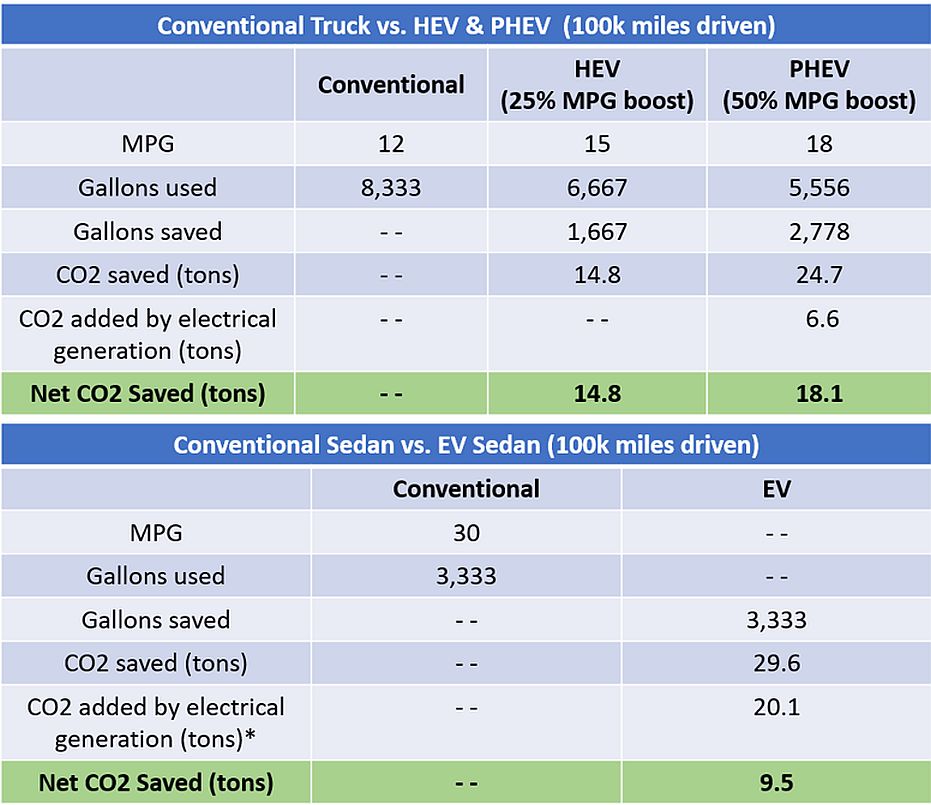
Over the course of 100,000 miles driven, all three vehicles above provide an impressive reduction in the amount of CO2 produced while driving (e.g. 14.8 tons reduced by an HEV truck, 24.7 tons by a PHEV truck, and 29.6 tons by a BEV sedan). However, when taking into consideration the CO2 released during a traditional electricity generation process*, EV sedans fall short when compared to hybrid and plug-in hybrid trucks in net emissions savings when all factors are considered. (See table above.) These projections – which are based on approximations and assumptions relating to electricity generation – are a good reminder that “zero emission” does not equal “zero impact” when it comes to understanding a fleet’s net carbon footprint.
* Electric production data source used in table calculation: U.S. Dept. of Energy via Scientific American)
Zero Emission ≠ Zero Impact
State and local governments today have more available options than ever to improve their fleet sustainability. Yet too often, their own internal mandates call for adding only zero emission vehicles, such as BEVs, with their green fleet budgets. In the process, they’re limiting their vehicle choices and minimizing the benefits they’re achieving.
To be clear, zero emission vehicles such as battery electric powered vehicles are critically important technologies that are helping to drive the transportation industry toward a long-term sustainable future. They offer lower lifetime maintenance costs, reduced fuel charges, and virtually no operating noise. But in the meantime, they pose a number of significant short-term challenges that are limiting their widescale adoption – and therefore, limiting the widescale benefits they can bring. These include:
- High vehicle capital costs
- Reliance on government incentives
- Need for additional charging or fueling infrastructure (both in-house and in the field)
- Limited vehicle options for medium to heavy duty trucks and passenger vans
- Degraded vehicle performance, when compared to existing ICE vehicles in the fleet
- Training or additional responsibilities needed by drivers
- Voided vehicle warranties or limited support availability
Based in large part on these factors, multiple research groups, including the U.S. Energy Information Administration and McKinsey and Company, speculate that even in the next 10-20 years, all-electric vehicles will still comprise no more than 10% of the total fleet vehicles sold. Today’s fleets need a viable alternative in the meantime while these important technologies continue to advance.
Options such as hybrid electric and plug-in hybrid electric trucks provide a highly effective bridge between the gas-powered vehicles of the past and present with the zero emission vehicles of the future. In many ways, they provide a “best of both worlds” approach that can help fleets reduce fuel costs and emissions while sacrificing nothing in terms of vehicle performance or driver requirements.
HEVs and PHEVs: Ready to Roll
Based on the state of the industry today, the hybrid / plug-in hybrid electric category of fleet vehicles is the most commercially viable. XL customers alone have driven more than 65 million miles using the company’s systems. Let’s quickly revisit that same list of BEV challenges (above) and examine how hybrid electric and plug-in hybrid electric technologies stack up by comparison.
- High vehicle capital costs
- Hybrid / plug-in hybrid electric systems can be upfit quickly and cost-effectively onto existing OEM vehicles.
- Reliance on government incentives
- With lower capital and operating costs, hybrids and plug-in hybrids can provide a meaningful ROI (25-50% MPG improvement in many cases) regardless of incentives.
- Need for additional charging or fueling infrastructure (both in-house and in the field)
- None required. Many plug-in hybrid truck options can be charged by wall outlets or existing level 1 & 2 charging stations for supplemental acceleration power.
- Limited vehicle options for medium to heavy duty trucks and passenger vans
- Hybrid and plug-in hybrid upfits are available for many popular Class 2-6 vehicles from major OEMs such as Ford and GM.
- Degraded vehicle performance, when compared to existing ICE vehicles in the fleet
- Since they operate with, and not instead of, the OEM drivetrains, hybrids and plug-in hybrids perform identically to factory standard trucks.
- Training or additional responsibilities needed by drivers
- No driver training is needed, and trucks drive in the same way they’re accustomed to.
- Voided vehicle warranties or limited support availability
- Some hybrid systems allow OEM warranties to remain completely intact.
At a fleet-wide level, these HEV and PHEV technologies offer more opportunities for sustainability since they are currently more adoptable at scale. Fleets can often implement them more quickly and cost effectively than their all-electric counterparts, meaning these HEV and PHEV vehicles can hit the road and make an impact from day one.
Even if state or federal vouchers can be applied, the high purchase costs of medium to heavy duty all-electric fleet vehicles mean that most government fleets are limited in how many BEVs they can buy at one time, meaning the majority of their fleet is likely filled with traditional gas-powered engines that are effectively working against the value being created with the small number of BEVs in operation.
To use a baseball analogy to describe this effect: you win more games hitting singles and doubles consistently than you do the occasional home run. Although on most teams – and in most fleets – it’s especially nice to have both in your lineup.
The Road Ahead
There has never been a more exciting time to be a consumer of electric and electrified vehicles – as new technologies, increased public demand, growing infrastructure investments and thriving support by automotive OEMs are converging to drive this important industry into mainstream prominence. Yet, it’s more important than ever for fleet managers to understand the full landscape of what’s available, and the implications of each system before moving forward on a path to sustainability. For those looking to make an immediate impact today while moving toward a zero-emission future, hybrids and plug-in hybrids might just be the vehicles that get you there.
About the Author
Clay Siegert is the COO of XL (www.xlfleet.com), the leading provider of connected electrification solutions for commercial and municipal fleets.