
Truemag

  • Newsletters
  • Thought Leadership
  • Mobility
  • Safety
  • Work Trucks
  • Videos
  • Home
  • Subscribe
  • Contact Us
  • Media Kit
  • Who We Are

Current Automatic Emergency Braking Systems Suffer from Limitations Drivers Must Understand

By Mark Boada, Senior Editor

The Holy Grail of traffic safety is that someday self-driving vehicles will make traffic accidents a thing of the past. But as increments of that technology are introduced, drivers must be thoroughly trained in their limitations or else run the risk of depending on them for more than the equipment can deliver and of being involved in crashes they thought couldn’t happen.

Case in point: a senior vice president at the Insurance Institute for Highway Safety (IIHS) warned the audience at a global symposium on automated vehicles in Princeton, New Jersey, last week that the currently most successful type of crash avoidance system can’t prevent all kinds of crashes.

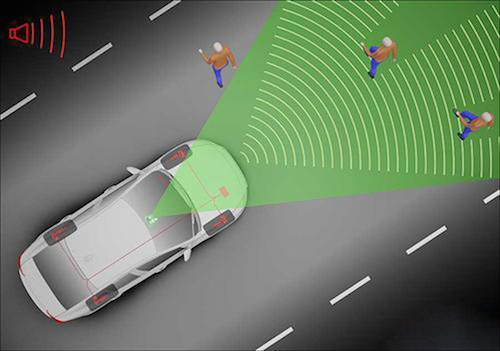
Kim Hazelbaker, who works both for IIHS and its related Highway Data Loss Institute (HDLI), said that in the organizations’ testing automated emergency braking (AEB) has been found to offer no protection at all against collisions with pedestrians who are walking in the same direction as the vehicle is traveling.  When asked if the forward crash avoidance system utterly failed the test, he said, “Yes.”

Hazelbaker also said that the system offers little protection against hitting pedestrians while a vehicle is turning in an intersection, or when pedestrians are crossing the roadway from the driver’s left. “The issue is that the systems don’t have enough time to react to the presence of the pedestrian,” he said.

IIHS conducts tests on forward crash avoidance systems at 12 and 25 miles per hour, the speed at which most forward collisions occur, Hazelbaker said. In practice, the HDLI I has found that AEB systems reduce front-into-rear crashes by up to 50 percent.  Unlike systems that only issue a warning to the driver when it senses an obstacle ahead, AEB systems apply the brakes even without a response by the driver.

In addition to limited protection against pedestrians, Hazelbaker said that AEB systems also offer considerably reduced protection in bad weather, including rain, snow and ice.  Although the vehicles that IIHS tested hit roadway obstacles at a reduced speed, videos he played for the audience showed that not a single one avoided a collision altogether.

Some 22 automobile manufacturers have pledged to make AEB systems standard equipment by their 2022 model year, but Toyota recently announced that it will make them available as standard equipment in 2018.  Hazelbaker said that other carmakers may soon follow Toyota’s lead.

The test results underscore the importance that fleets who adopt the equipment make sure they educate their drivers on the limitations of AEB technology.  Hazelbaker and others at the symposium offered assurances that improvements in AEB systems will continue to be made and that the future of relatively accident-free vehicles remains promising.

Fleet managers take note: none of them denied, however, that as vehicles progress through the various levels of driver assistance toward total autonomy, drivers will need to remain alert and fully aware of the limits of all new safety equipment.


 

May 22, 2017Janice
Maximizing Efficiency for Global FleetsSelf-Driving Car Technology: When Will the Robots hit the Road?
Recent Posts
  • FLD’s Fleet Manager Sentiment Index Quarterly Recap
  • Fleet Pro Focus: Jeff Cunningham, RUD Fleet
  • Lowering Costs, Gaining Control: Why Propane Autogas is the Fleet Industry’s Solution Hidden in Plain Sight
  • Beyond the Dashcam: How InsureVision Is Turning Video Into Fleet Risk Intelligence
  • New Guide from Utilimarc: Are You Replacing Vehicles at the Right Time?
  • Why the Traditional Vehicle Ordering Cycle No Longer Works
  • IMPROVLearning: How Comedy, Behavioral Science and AI Improve Fleet Safety
  • Launch of RoadFlex Direct Puts Fleets in Control of Their Fuel Data With a New Open API Platform
  • Improving Productivity with AI: Turning Fleet Data into Faster Decisions
  • IIHS Crashworthiness Tests Save Nearly 50,000 Lives Since Program’s Launch
ASSOCIATION NEWS
How AFLA Is Positioning Itself for the Future of Fleet Mobility
Last Chance to Save: Register for NAFA’s Maintenance Workshop
‘Raise Your Hand and Get Involved’
NAFA Names 2026 Class of Fellows, Honoring Leaders in Fleet Management
Award Winners Honored at NAFA I&E
2026 NAFA I&E Seeks to Change Perceptions, Invigorate Fleets
NAFA Announces Lineup for Media Day at I&E 2026: Industry Leaders to Showcase the Latest Innovations
TECHNOLOGY
Improving Productivity with AI: Turning Fleet Data into Faster Decisions
Hyundai Unveils New ‘Plasma Care UVC’ Cabin Sanitizer
Fleet Operations Are Changing – The Industry Needs to Evolve With Them
AI-Powered Vehicle Inspections Move Beyond the Checklist
Motive’s New Workforce Capabilities Aim to Improve Performance, Automate Rewards
AI + Human Insight: Why Fleet Leaders Need Both to Win in 2026
NTSB Finds Automation Overreliance Contributed to Two Fatal Ford BlueCruise Crashes
CONFERENCES & WEBINARS
2026 NETS Strength IN Numbers Conference: Early Bird Rates!
AFLA 2026 – Keynotes Announced!
Private Fleets Flex at National Private Truck Council Conference
Free NAFA Webinar: Manage Your Fuel Cost Volatility
Registration Now Open for NETS Annual Conference
Early Bird Pricing for AFLA 2026 – Ending June 1
NAFA Online Seminar: Essentials of Fleet Management
INDUSTRY ANNOUNCEMENTS
Union Leasing Becomes Moventum Fleet Management as 70-Year Company Accelerates into Next Phase
Fleetio Wins Innovations Award at NAFA’s 2026 Institute & Expo
WIFM is heading to NAFA!
Cox Automotive Unveils Cox Fleet, Setting a New Standard for Fleet Uptime Nationwide
AFLA Canadian Fleet Professional of the Year Award: Nominations Open!
NAFA Webinar: Kickoff the 2026 100 Best Fleets Contest on December 4!
Join NAFA’s Free Fleet 101 Live Course

Fleet Management Weekly Newsletter Archive
Access to back issues of the FMW newsletter.

FMW Mobility
How mobility is rapidly changing the fleet management landscape.

Newsletter

Subscribe

FMW Fleet Videos
Video clips of industry leaders speaking on a variety of engaging hot topics in fleet.

2014-2020 © Fleet Management Weekly