Harnessing the power of gamification to achieve greater safety, productivity and compliance
By Mark Wallin, Vice President, Product Management, Telogis
Today’s fleets all have a powerful tool at their disposal – and it’s one of the most basic tools we all carry with us: mobile apps that run on our mobile phones and tablets. New applications tied into existing fleet management and work order management solutions such as Telogis Coach can significantly improve how mobile workers perform their day-to-day jobs – and it can all be unlocked through the mobile device they’re already using. This article will look at some of the most effective ways today’s fleets are leveraging a concept called gamification to coach and improve worker performance in real time, and why people running fleets should consider engaging with gamification to drive a more satisfied, efficient and safe organization.
What is gamification?
Gamification is the use of game mechanics in a typically non-game-oriented context. It is used by software companies to build business applications that increase engagement and participation while accelerating learning. It leverages our nature to compete with ourselves or others, with the objective of encouraging teams to achieve company-wide goals and deliver greater safety, productivity and compliance by giving real-time data to drivers so that they can track – and eventually improve – their own performance.
In order to put a program in place, there are three basic parts to integrating gamification into your business: (1) Mission, (2) Alignment and (3) Deployment.
Establishing your mission
While your drivers, technicians or crews may be a subset of a larger business, there’s no reason it shouldn’t have its own mission that aligns and supports the overall corporate mission. Once the mission is established, it’s time to break it down to individual objectives that support the mission. For example, the mission may be to operate the safest fleet in your region so the objectives may include reducing speeding incidents, Hours of Service (HOS) violations or vehicle idle time.
Create measurable key performance indicators (KPIs) from the established objectives and keep them as specific as possible. No sport would ever achieve popularity if the goal was vague or unclear to the players. No matter what your objectives are – increasing productivity, decreasing fuel costs, improving the safety of your crews or increasing asset utilization – the secret to achieving them is keeping them Specific, Measurable, Achievable, Realistic and Time-bound (SMART). You will then need to connect your entire organization to the established goals – that’s where the following phase comes in – alignment.
Align the objectives of your mission
Review your objectives to ensure they align with business operations. For example, if your company puts working as fast as possible first and safety second, then setting an objective to reduce speeding won’t align. Get your company influencers (normally managers or supervisors) involved to review and align to the objectives.
It’s important that your managers are on board with the new objectives as they will play an important role in influencing others, and ultimately help achieve a successful outcome. After reviewing and refining your objectives, and aligning them with your organization, you’re ready for deployment.
Deployment: planning ahead for rollout
The deployment phase should go relatively smoothly if you set up the first two phases correctly. The size of your organization will determine the scale of your deployment planning. In the case of using Telogis Coach, you may only need a brief training that includes a quick-start guide to explain how it works and instructions on how to download, install and log in to the app on their mobile devices.
Deployment involves more than just having your drivers install a gamification app like Telogis Coach and then leaving them to it. For the game element to be most effective it needs to be ‘refereed’. This means monitoring results, providing incentives and celebrating wins.
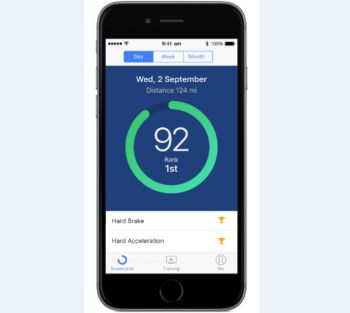
To monitor the results, you will need a scoreboard to help reinforce the KPIs so drivers know what they are playing for. The system takes the predetermined metrics and generates a score, then lets the driver see how they perform against their peers. It is an opportunity to improve behavior behind the wheel and performance out of pride because they see metrics that show a direct correlation to how they are helping make their operation successful. Managers can compare driver scorecards and the types and frequencies of training content being accessed to the rate of accidents, lost-time injuries and productivity, and draw direct correlations between what moves the needle and what does not.
A defined mission with measurable KPIs that are completely aligned with your organization and backed by company influencers has a higher chance of successful deployment.
Real results
Done right, gamification can be more than just a passing fad. The data derived can be a powerful force for change in your organization – you’ll see more than just better business results; you’ll have employees that are feeling more engaged and appreciated, recognized for good performance on the job and motivated to do their best.
A number of mobile businesses are running Telogis Coach today and report significant gains in achieving objectives for improved driver performance, including efficient driving and safety behind the wheel – something that can be a difficult goal to reach. Telogis Coach is gamification in action, and the results are speaking for themselves.
Sidebar:
GAMIFICATION INSIGHT
➔ MONITORING RESULTS
First of all, you want to make sure everyone in your organization knows what your objectives are. If one of your KPIs is to reduce speeding by 50% then let the whole team know, not just management. A team wins when it knows what it’s playing for. You’ll also need a scoreboard. Telogis Coach includes a dashboard that shows real-time results for specific KPIs – you can log in from anywhere and get an up-to-date score, either across the entire fleet or individual crews.
➔ CELEBRATING WINS
You don’t need to do cartwheels in the office every time a driver gets a perfect score but there should be recognition and reward. In most cases the size of the reward is not important; it’s about making sure they know you know, and it means something to you and the company.
➔ RECORDING THE GAME TIME
Decide on how long each “game” lasts. Employees will soon tire of a game with no end in sight. You can choose any reasonable period but in general, for achieving fleet KPIs, a period of 90 days is most common. At the end of each period, results are tallied, players rewarded and recognized and the game starts over.