Wider availability, lower price expected to spur demand.
by Paul A. Eisenstein on Mar.30, 2015 in Detroit Bureau
Toyota Safety Sense is designed to support the driver’s awareness, decision making and vehicle operation over a wide range of speeds.
Toyota has two big SUV debuts planned for this week’s New York International Auto Show – but some folks may be more focused on the Japanese maker’s big safety news.
When the next-generation Toyota RAV4 Hybrid and Lexus RX models come to market later this year, they will offer new, low-cost automated braking packages that, the maker hopes, will bring this technology within reach of a mass audience.
“Pushing these systems across our lineup, as quickly as possible, can help protect people in the event of a crash,” said Jim Lentz, president and CEO, Toyota Motor North America. “More importantly it will help prevent some crashes from ever happening in the first place.”
Adrian Lund, director of the Insurance Institute for Highway Safety, has called forward collision warning systems one of the automotive safety biggest breakthroughs in recent years, government data revealing a significant reduction in crashes. The IIHS won’t even give its Top Safety Pick+ rating to vehicles that don’t offer some version of the technology.
The Pre-Collision System uses a camera and laser radar to detect objects ahead of the vehicle and determines a collision possibility and prompts the driver to brake.
The new systems coming on products like the RAV4 and RX will run anywhere from $300 to $500 on Toyota vehicles, and from $500 to $635 on Lexus models.
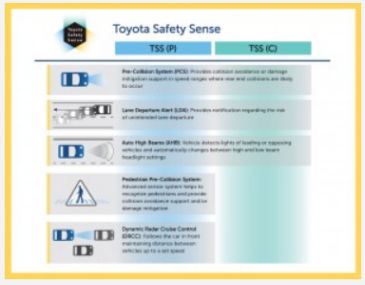
Toyota Plans to offer two different packages. The basic one, dubbed Toyota Safety Sense C, will include three basic technologies:
Pre-collision System, or PCS. Using a camera and laser radar, it can detect a potential frontal collision, initially alerting the driver. If no action is taken, it can apply the brakes to either prevent, or at least reduce the severity of, a crash;
Lane Departure Alert, or LDA, uses a camera to detect when a vehicle starts to drift out of its lane, sounding an alert to get the driver to regain control;
Automatic High Beam, or AHB, also uses a camera, in this case to detect oncoming vehicles and the taillights of vehicles ahead, automatically switching the high beams on and off.
The Toyota Safety Sense P package adds several more features, including Pedestrian Pre-Collision capabilities. As with the basic PCS system, it can spot pedestrians who might be in the vehicle’s path, sounding an alert or, if necessary, applying the brakes automatically.
Automatic High Beam helps enhance forward visibility during nighttime driving using a camera to detect the headlights of vehicles ahead.
The more expensive package also gets Dynamic Radar Cruise Control. This system relies on a camera and millimeter-wave radar to track traffic ahead. Unlike conventional cruise control, it will automatically adjust the vehicle’s speed to maintain pace with traffic flow while keeping a safe distance from vehicles ahead.
To put Toyota’s pricing strategy into perspective, what is generally known as Active Cruise Control routinely adds another $1,000 or more to a vehicle’s price tag.
As for Lexus vehicles like the 2016 RX, the Lexus Safety System + package offers all the features of the more comprehensive Toyota Safety Sense P.
Industry observers suggest that these various technologies will become increasingly common and, much as happened with anti-lock braking systems and electronic stability control, they eventually could become the norm, rather than the exception. Some anticipate federal regulators will eventually require such technologies as pre-collision warning, as a standard feature.
Radar Cruise Control uses radar to detect vehicles and determine their speed and adjust vehicle speed to help maintain a pre-set distance between vehicles.
The good news is that by integrating these various features into a single package, sharing cameras, radar sensors and computer control circuits, costs are falling rapidly, much as is happening with popular consumer electronics technologies.
“Advanced active safety technologies can have a profound effect on automotive safety,” said Bob Carter, senior vice president of U.S. auto operations. “Toyota is proud to expand the availability of these technologies – and to do so at an excellent value proposition for our customers as well.”
The announcement by Toyota could spur competitors to respond with price cuts of their own.