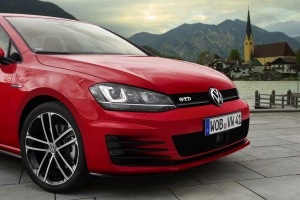
Volkswagen of America plans to bring its newest clean diesel engine to North America later this year, a move that could add even more momentum to the revival of the high-mileage technology.
VW has been one of the biggest proponents of the new diesel technology beginning to show up in a growing array of automotive applications – with makers as diverse as Chevrolet, Jeep, Mazda and Mercedes-Benz adding new “oil-burners” to their line-up.
VW’s latest diesel, known internally as the EA288 engine, was unveiled this week during a conference in Detroit. According to Douglas Skorupski, VWoA” manager of technical strategy, it will power the 2015 Golf, Beetle, Beetle Convertible, Passat, and Jetta models, all of which are set to arrive in dealer showrooms during the second half of 2014.
“The Volkswagen Group is a leader in clean diesel technology,” proclaimed Skorupski. “With the introduction of the new EA288 engine, we are excited that our family of TDI Clean Diesel vehicles is continuing to improve.”
VW could use a helping hand. The maker has been struggling to reverse a year-long sales decline. But while overall demand is down, it has also experienced a surge in diesel deliveries, fueling an even bigger bet that the technology can its fortunes in the U.S. market.
While emphasizing fuel economy throughout their advertising and marketing campaigns, none of the Asian manufacturers have brought diesel engines to the U.S. The extra cost of the necessary emissions control systems, along with the higher pump price for diesel fuel, are the reasons most often cited by the Asian carmakers for holding off.
The exception is Mazda, which several years ago announced plans to sell a diesel-powered version of the Mazda6 sedan in the U.S. But that project has repeatedly been delayed. After testing the SkyActiv diesel version, executives concluded the diesel powered Mazda 6 simply didn’t deliver the kind of sporty driving characteristics customers have come to expect from the brand.
Company officials say they still plan to add the diesel but are likely to make some significant changes. The original version was able to avoid the need for AddBlue, the chemical additive that is used by most modern diesels to comply with U.S. emissions standards. But the trade-off was lower performance. Mazda sources tell TheDetroitBureau.com that the eventual U.S. diesel will likely have to use the additive to balance emissions with classic Mazda “zoom-zoom” performance.
Chrysler, meanwhile, is moving ahead with plans for diesel-powered truck models. It can barely keep up with demand for the new Ram 1500 diesel. But Sergio Marchionne, chief executive officer of Fiat Chrysler Automobiles, said last week it is difficult to justify putting a diesel engine in one of the company’s passenger cars.
“It doesn’t make economic sense,” Marchionne cautioned, noting that when the expense of the necessary emission treatment system is factored into the equation, the cost of a diesel engine becomes prohibitive.
It doesn’t help that diesel fuel prices continue to run as much as $1 more per gallon than regular unleaded gasoline, a price that wipes up much of the mileage advantage the fuel offers. But diesel also does have an advantage over costlier hybrid technologies that don’t deliver as much performance.
Despite such concerns, Volkswagen and its Audi sibling continue to add more diesel models and last year delivered collective sales of 105,899 TDI Clean Diesel vehicles. It was the first time Volkswagen of America topped the 100,000 sales milestone in a calendar year – a figure representing nearly 75% of total diesel sales for passenger cars and SUVs in the United States in 2013.
Volkswagen and Audi currently offer 12 different TDI Clean Diesel powered models in the United States. Audi plans to add another model for 2015 on top of the three it launched this year.
The new EA288 engine will eventually replace all the 2.0-liter TDI Clean Diesel engines currently fitted in Audi and Volkswagen models. It is a turbocharged, common-rail, direct-injection four-cylinder engine making 150 horsepower—an increase of 10 hp over the current engine—and 236 pound-feet of torque.
A number of changes have been made to further reduce emissions, including: use of a complex exhaust gas recirculation system; integration of the intercooler with the intake manifold, which also improves throttle response; and packaging the exhaust after-treatment components closer to the engine.