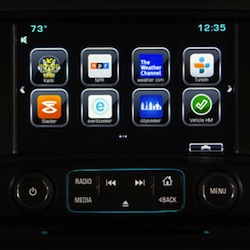
Starting next month, many car buyers will be getting a novel feature: Internet connections with speeds similar to those on the fastest smartphones—and even a few early dashboard-based apps, engineered to be as dumbed-down as possible.
Backseat passengers could get streaming movies and fast Wi-Fi connections to smart watches and tablets in (and near) the car. For drivers, high-resolution navigation maps would load quickly, and high-fidelity audio could stream from Internet radio services. But the first dashboard apps will be limited, spare versions of familiar ones like the Weather Channel, Pandora, and Priceline.
The first U.S. model with the fast wireless connection—known as 4G LTE, around 10 times faster than 3G connections—is expected to be the 2015 Audi A3, which goes on sale next month for a starting price of $29,900. Data plans will cost extra—an average of around $16 a month.
GM says it expects to sell 4G-equipped 2015 Chevrolets and other models starting in June. Many other carmakers, including Ford and Toyota, are following suit, both in the U.S. and worldwide, using partnerships with wireless carriers to deliver the connectivity.
By providing apps, carmakers see an opportunity for product differentiation and steady revenue streams. They also suggest that connectivity can lead to new safety features, and that using these onboard services will be safer than furtively glancing at phones.
But when drivers browse the GM AppShop, they shouldn’t expect what they get on an iPhone or a Galaxy phone. GM expects to provide just 10 apps initially, most of them mapping, news, and radio services.
That’s partly because the automaker’s screening process for apps is brutal, says Greg Ross, director of product strategy and infotainment for GM vehicles. “They go through rigorous safety and security standards,” he says. “And since it’s pulling data from the car, it’s locked down before it ever gets into the vehicle.”
As a result, the technology and interface need to be almost as simple as an analog radio knob, says Bruce Hopkins, cofounder of BT Software, based in San Diego. He is one of a very few developers whose apps will be available in GM cars.
Called Kaliki, BT Software’s app provides audio readings of stories—done by humans, not text-to-speech software—pulled from mainstream publications such as USA Today and TV Guide, as well as podcasts from radio and TV stations. (Its advantage over the radio? “Radio has been around for the last eight decades, and you still can’t pause it,” he says.)
Hopkins followed detailed rules from GM—no pinch-zoom controls or tiny icons allowed, for example—and spent two years developing the app, including time in a test facility in Detroit. “One of the terms GM talks a lot about is driver workload,” he says. “You cannot have anything that would require the driver to have several different things they have to think about. At the end of the day, they want something that works as simple as the regular radio.”
The apps know if you are driving. Drivers will never be able to open a “terms and conditions” screen—or play a game, assuming games ever come—unless the vehicle’s transmission is in “park.”
Despite the hurdles, 4,000 developers have registered with GM’s app store, because the payoff could be large for them: getting their apps included in a car could help them market versions that work on smartphones. And apps in cars command much more attention if they are among just a few that a driver can choose from while sitting behind the wheel for an hour or two every day.
In the longer term, apps will emerge that draw on data generated by the car, says GM’s Ross. This could be useful for maintenance or driving efficiency—or to generate data for insurance discounts. Apps tapping information from many cars could alert drivers to accidents; signals indicating hard braking or slipping wheels in other cars could warn of slick roads ahead. Sensors can ultimately help bring about semi-autonomous or fully autonomous cars (see “Data Show’s Google’s Robot Cars Are Smoother, Safer Drivers Than You or I”).
Henry Tirri, CTO of Nokia, says the potential for apps in cars is vast, given the amount of data vehicles produce. “The car is already probably the densest sensor hub that an individual owns right now,” he says. (See “After Microsoft Deal, What’s Left of Nokia Will Bet on Internet of Things.”)
In Audi’s case, the service will cost $100 for up to five gigabytes of data over six months, or $500 for 30 gigabytes over 30 months. GM has not announced pricing except to say that customers can get various plans combining service to their homes, phones, and cars. Both GM and Audi are using AT&T to provide service (see “GM and AT&T Blur Line Between Car and Smartphone”).