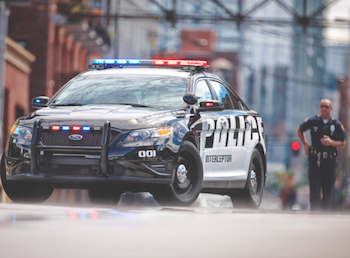
Everyone’s seen a cop driving like a jerk: Double parking and blocking traffic. Cruising down the highway way beyond the speed limit, with no suspect to run down. Blatantly texting while driving. Pulling the old turn-on-the-siren-just-long-enough-to-run-the-red-light trick. And for anyone who’s fantasized about making a citizen’s arrest of one of their city’s finest, police departments soon will be able to track how their cops are driving, and when they’re behaving badly.
Ford has created a way for law enforcement bosses to see where their subordinates go and track how they’re driving. Fifty Los Angeles Police Department cruisers have been outfitted with transmitters that send officers’ driving information to their supervisors, and can even tell if the boys in blue are wearing seat belts. The system is a joint effort by Ford and California software firm Telogis, and designed for the Police Interceptor models of the Explorer and Taurus. The idea is that accountability will lead to better and safer driving behavior. Auto insurance companies have been doing the same thing for years.
“From a business standpoint, these are expensive vehicles with expensive employees driving them,” says Bryan Vila, a professor and researcher at Washington State University. He also spent 17 years as an officer, including nine with the LA County sheriff. “When they crash, they’re also more likely to kill bystanders and civilians, so there’s a public safety side. I’ve been looking forward to seeing the LAPD implementing this.”
Police organizations have been ramping up education about the risks of driving fast, but Vila, having spent time with a badge and gun, understands the urge to ignore those lessons. “If you’re a young cop and someone gives you a fast car to drive, there’s a lot of temptation to do it,” Vila says. “Whether its safe, or not, and whether it’s legal, or not.”
Ford Telematics for Law Enforcement lets police departments see if their officers are giving in to those temptations. The system knows if the light bar is turned on, and measures the speed of the car against the limit. It looks for hard braking and sudden acceleration. It sees when the car spins and when the anti-lock braking system is engaged. Unlike conventional black boxes for cars, it can transmit data in real-time. And if the airbags deploy, dispatchers will see it and know to send backup immediately.
There are safety advantages for cops, too. Car crashes kill dozens of officers annually, but most California police don’t wear seat belts, according to a recent study. That may be because they find it uncomfortable while wearing other gear, they think it can prevent them from reaching their gun, or they may find it annoying given how often they get into and out of their cars. If the higher-ups want to enforce the use of seat belts, having info on who’s buckled up is a big help.
“With officers, you’re talking about a culture,” says Detective Meghan Aguilar, who’s been at the LAPD for 18 years, and whose title makes her one of the aforementioned higher-ups. “When I started it was much more common for police to not wear their seatbelt. You’re fighting a misperception that [wearing a seat belt] slows you down exiting the vehicle, pursuing a suspect.”
This type of monitoring uses technology to give supervisors eyes where they couldn’t see before. The basic principle is that being watched will prompt officers to follow the rules. “If there’s equipment that allows me to monitor that, without having to be in front of every vehicle,” Aguilar says, “there’s a good chance that behavior is going to be modified.”
That doesn’t mean every cop likes the idea of being watched over. “There’s a distinction between encouraging and active real-time monitoring that’s going to your supervisor,” says Bill Johnson, executive director of the National Association of Police Organizations. “It almost sounds like they’re trolling for violations.”
Professor Vila says this type of monitoring, used along side education about the consequences of driving irresponsibly, will be effective, and for that reason, a moral imperative. “How do you say, ‘No, I don’t want to be safer,’” he says. “There isn’t a responsible way to defend that.”
Ford hasn’t announced what the factory-installed system costs, but it should be available next year. It’s an advantage for the company, which, three years after discontinuing the Crown Victoria, competes with Chrysler and GM to provide vehicles to the nation’s police departments. If Ford can link its name to an exclusive technology like this, it could have an edge. Depending on how the LAPD’s test goes, Ford’s tech could end up in more of the 1,800 police vehicles driven by the city’s 10,000-strong police force.