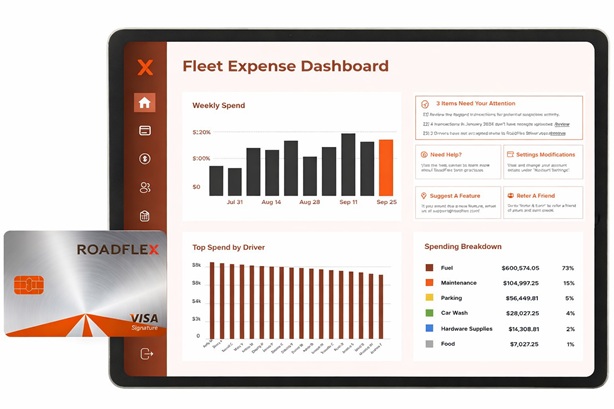
New capabilities help public-sector and public works fleets streamline fuel tax exemptions, reclamation, reconciliation, and audit-ready reporting.
RoadFlex, a leading solution provider of fuel risk management, announced it is expanding its fuel tax compliance capabilities for government and public works fleets. The capabilities are built to help eligible public-sector agencies reduce the administrative burden of managing fuel tax exemptions, reimbursements, and reclamation, giving them a more automated and auditable way to manage fuel transactions, flag eligible purchases, and produce clean records for finance and audit teams.
 For many public-sector fleets, fuel tax compliance is still a manual process built on receipts, spreadsheets, merchant-level review, department coding, and end-of-period reconciliation. RoadFlex pulls these workflows into a single platform by connecting each fuel transaction with cardholder, vehicle, merchant, department, cost center, and transaction-level detail.
That matters most for the agencies running the widest range of vehicles and equipment. Public works, transportation, and municipal fleets spread fuel spend across departments, cost centers, and field sites, which makes exemption tracking and audit prep harder the moment it leaves a single fuel island.
“Government fleets need more than a payment card. They need a platform that manages spend, enforces controls, and documents compliance in a way auditors can follow,” said Rush Akin, Chief Revenue Officer of RoadFlex. “These capabilities cut the administrative work behind fuel tax compliance and give agencies cleaner, more defensible records of every fuel purchase.”
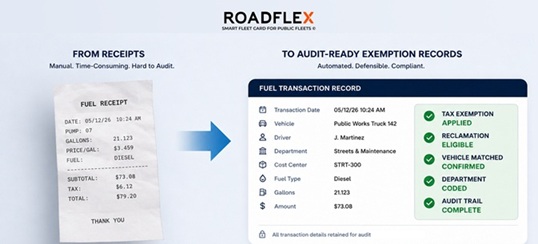
RoadFlex’s fuel tax compliance capabilities help agencies:
- Identify eligible fuel purchases automatically using enhanced transaction data, instead of sorting them by hand
- Distinguish exempt or reclamation-eligible spend from purchases that require standard tax treatment
- Support exemption handling at the point of sale where available, and streamline reclamation where tax is paid upfront
- Tie each transaction to the relevant vehicle, driver, department, and cost center, cutting spreadsheet and receipt reconciliation
- Retain transaction-level evidence, including merchant, date, amount, fuel data, cardholder, vehicle, and department, for audits and reimbursement reviews
- Manage exemptions, controls, and compliance reporting for multi-department, multi-location fleets in one platform
The capabilities run on RoadFlex’s open-loop Visa platform and use enhanced transaction data and card-level controls to identify eligible fuel purchases. Where an exemption can be applied at the point of sale, it is. Where tax is paid upfront, which is common when crews fuel at retail stations, the same transaction-level detail supports exemption handling where available and streamlines reclamation. That gives fleet and finance teams a clearer view of which purchases may be eligible for exemption or recovery and which require standard tax treatment.
Because the platform is open-loop, drivers can fuel wherever Visa is accepted rather than inside a limited fuel network. For fleets working across districts, depots, and field sites, that means fewer out-of-network workarounds and a more complete record for compliance reporting to draw from.
The capabilities are built to support both savings and compliance. Recovering eligible taxes is part of it, but so is giving agencies a more controlled, transparent, and auditable fuel spend process overall.
 The new capabilities build on RoadFlex’s broader public-sector offering, a modern alternative to legacy fuel card programs that combines open-loop Visa acceptance, configurable spend controls, audit-ready reporting, cooperative purchasing readiness, and integrations across fleet and financial systems. For agencies that procure through cooperative purchasing channels, fuel tax compliance adds another public-sector-specific capability tied to fuel savings, compliance, and administrative efficiency.
They also extend RoadFlex’s work with Visa to modernize fleet payments for government and enterprise fleets. RoadFlex recently collaborated with Visa on a public-sector fleet payments whitepaper on how modern card technology, transaction controls, data visibility, and compliance workflows can help agencies reduce administrative burden and improve oversight of fleet spend.
RoadFlex discussed its public-sector fleet payment and compliance capabilities at the Government Fleet Expo & Conference (GFX), the largest annual conference for public fleets, which was held earlier this month in Long Beach, California.
For more information about RoadFlex for government and public-sector fleets, visit roadflex.com.