By National Grid
October 29, 2025
The first phase of the fleet electrification, Planning, was covered in the whitepaper titled “Accelerating fleet electrification with utility advisory programs” and was recently shared in a recent Fleet Management Weekly communication. It provided an overview of everything a fleet needs to get started with fleet electrification, including:
- Benefits of Fleet Electrification: O&M cost reduction, emissions reduction, vehicle and infrastructure financial incentives, a better driver experience, and better community health through lower air pollution.
- Tools available to find grid capacity: Utility system capacity maps, EPRI’s GridFAST portal, and fleet electrification planning tools.
- How Utility Fleet Advisory programs can help: Utilities such as National Grid have programs in place to develop a roadmap to electrification, including route analyses, Total Cost of Ownership (TCO) savings estimates, and vehicle procurement plans.
- How to contact your utility, e.g., National Grid at nationalgridus.com/ev-fleet-
hub/
This article is a follow up to that and aims to answer the question you may now be asking: “I’ve chosen a site and contacted my utility – now what?”
Phase two of fleet electrification is building out the necessary charging infrastructure and vehicle procurement.
Across the country, many utilities have infrastructure incentive programs in place to support the infrastructure necessary for EV fleets. Commonly called “Make-Ready,” these incentives can cover up to 100% of grid-side and customer-side project costs, and in certain cases can support the cost of EV Supply Equipment (EVSE). EEI has a database of available utility incentive programs here: eei.org/en/issues-and-policy/electric-transportation/evprograms that can be used to explore opportunities available to you.
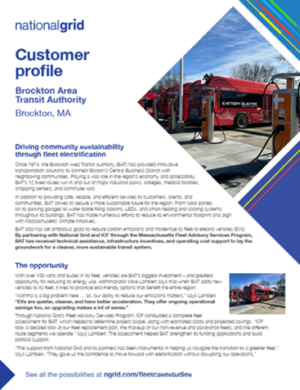 National Grid’s Massachusetts EV Charging Program, for example, can fund up to 100% of the electrical infrastructure costs associated with installing EV charging stations, as well as tiered EV charger rebates for eligible customers. Brockton Area Transit (BAT), a public transit authority in Massachusetts, leveraged National Grid’s support when electrifying 5 full-size buses. Through the program, BAT received $723,000 toward its project costs, significantly reducing its infrastructure costs and accelerating the project. You can read the full case study at ngrid.com/fleetcasestudies.
Getting into details – How much of the project can be supported?
Make-ready infrastructure programs can sometimes support a large portion of the total project costs. For a hypothetical fleet of 4 trucks, the infrastructure incentives can cover the entire infrastructure costs, saving ~$400k. The fleet can also potentially save on O&M, with electricity costs saving thousands of dollars per month vs. diesel. For details on a DCFC project in National Grid’s Massachusetts territory, you can go to ngrid.com/ma-fleet.
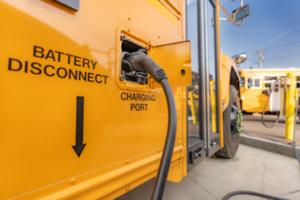 Highland Electric Fleets, a school bus operator in Beverly, MA, leveraged National Grid’s infrastructure support when electrifying their vehicle-to-grid school bus project, which provides MWh of energy back to the grid while earning thousands of dollars in revenue. You can watch this video and learn more about their project here.
Manage around your connection limits with new solutions like Flexible Connections
Utilities such as National Grid are continuing to create new solutions to accelerate fleet electrification. One such solution is Flexible Connections, which allows fleet customers to build nameplate charging capacity above and beyond the typical utility connection limit, and use those chargers during times when there is existing circuit capacity. Essentially, this allows utilities and customers to use more power in the grid infrastructure during non-peak times, while any necessary grid upgrades are being completed.
Flexible connections allow large fleet projects to be:
- Bigger: Installing a larger nameplate capacity for each charger means faster fill-up times for individual vehicles.
- Faster: Installing charging stations before necessary grid upgrades can save months if not years of utility upgrade time.
- Cheaper: Fleets can start saving on fuel and O&M costs much faster, while also deferring or eliminating hundreds of thousands of upgrade costs.
How it works:
Flexible Connections have been used in solar and battery projects and is now starting to be applied to EV projects as well in select states (e.g., National Grid in NY and MA). The utility studies the grid impact of a potential fleet’s load and performs an interconnection calculation: the forecast of the expected capacity on a feeder, assigns a target curtailment for a customer, and then sends day-ahead signals to be followed. If you’re interested in learning more about Flexible Connections, please reach out to National Grid at [email protected].
Next steps: What is the process to get connected with EV Infrastructure?
Beginning a fleet electrification project is a straightforward process. Once you’ve connected with your utility, you’ll follow the steps below to get started today!
Step 1: Information & Application. Potential participant reviews program information and contractor resources.
Step 2: Review. Customer reviews program eligibility and program requirements.
Step 3: Design. Program participant works with a contractor and utility on charger selection and site design.
Step 4: Application Review. Participant or contractor submits application and utility reviews eligibility and site information, assessing costs and feasibility.
Step 5: Construction. Utility and contractor build the EV charging infrastructure into parking spaces.
Step 6: Activation. Chargers are installed and activated. Customer provides documentation and utility makes incentive payment.

Utility incentive programs help fleets create a cleaner and more efficient business, providing infrastructure incentives and support for fleet electrification projects. Getting started with the application steps above will help ensure your project progresses smoothly and efficiently while preventing potential project delays. Resources to get started are below or reach out to your local utility to get started.
Resources:
- EV Fleet Hub: nationalgridus.com/ev-fleet-
hub/ - EEI database of EV programs: eei.org/en/issues-and-policy/
electric-transportation/ evprograms - Investigate your utility’s website for EV Points of Contact
- EPRI GridFAST portal: https://www.gridfast.com/about?url=home