How AI-driven coaching, predictive analytics and personalized engagement are transforming fleet safety and operational performance
By Ed Pierce, Contributing Editor, Fleet Management Weekly
May 20, 2026
The recent NAFA I&E conference featured several sessions on fleet safety, highlighting ways to improve fleet safety and efficiency through AI, telematics, and behavioral coaching technologies. In this article, we summarize the key concepts.
 For years, fleet safety programs have relied heavily on reactive management practices. An incident occurs. Telematics data is reviewed, and supervisors conduct an investigation. Corrective training is assigned, and insurance claims are processed. Eventually, a lesson is learned.
But in today’s connected fleet environment, safety leaders are beginning to realize that traditional telematics alone is no longer sufficient.
A session focused on improving fleet safety and efficiency was among the highlights of the recent NAFA I&E. Panelists explored how AI, telematics, in-cab coaching, and behavioral science are converging to fundamentally reshape how fleets identify risk, coach drivers, and prevent incidents.
The discussion highlighted a growing industry shift: from reactive incident response to proactive behavior management.
From Data Collection to Behavior Change
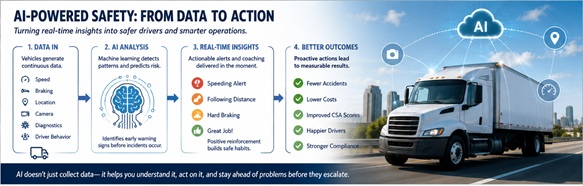
Modern fleets already generate vast amounts of operational data. Vehicles continuously produce streams of information related to:
- Speed
- Braking
- Acceleration
- Idling
- Route history
- Fuel consumption
- Vehicle diagnostics
- Driver behavior
- GPS location
- Camera footage
Historically, however, many organizations struggled to translate that data into meaningful action. Safety managers often spend hours manually reviewing reports, searching for trends after incidents have already occurred. According to the panelists, AI changes that equation.
Machine learning systems can now analyze telematics, camera feeds, and operational data in real time, identifying subtle patterns that humans might miss — such as early signs of fatigue, aggressive driving, or heightened collision risk.
Instead of merely recording unsafe behavior, AI systems can proactively flag emerging risks before an incident occurs. One panelist succinctly described the evolution: “AI doesn’t just give you data. It helps you understand it, act on it, and stay ahead of problems before they escalate.”
AI-driven fleet safety systems help organizations identify and address risky driving behaviors before incidents occur, reducing accidents and operational disruptions.
Why Immediate Feedback Matters
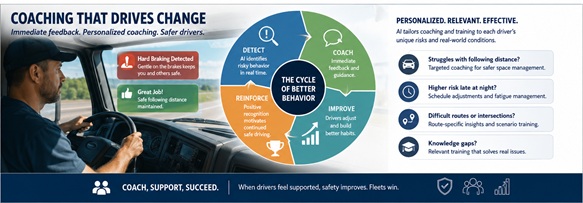
One of the most important themes throughout the session was the science of behavior change. Traditional fleet safety programs often rely on delayed coaching — an email after a shift, a weekly report, or a quarterly review. Behavioral experts at the session argued that delayed feedback significantly weakens learning.
Instead, AI-powered in-cab coaching systems now provide immediate prompts and reinforcement during the behavior. Examples include the following:
- Speed alerts
- Tailgating warnings
- Harsh braking notifications
- Lane departure alerts
- Fatigue detection
- Positive reinforcement for safe driving
Immediacy is critical. Research consistently shows that behaviors are more likely to change when feedback is delivered close to the event.
The panelists also emphasized that positive reinforcement may be as important as corrective feedback. Rather than focusing solely on mistakes, fleets can reinforce desired behaviors, including:
- Full stops at intersections
- Maintaining safe following distances
- Proper turn signal usage
- Fuel-efficient driving habits
- Safe cornering behavior
The goal is not merely to punish unsafe driving but to create an environment in which safe driving becomes habitual.
 Predictive Analytics: Identifying Risk Before the Crash
Another major advantage of AI is its predictive analytics. Traditional telematics programs typically identify risk only after a violation or crash occurs. AI systems, however, can identify precursor behaviors — subtle patterns that often precede larger incidents.
For example:
- Slight lane drifting
- Increasing harsh braking frequency
- Gradual speeding trends
- Irregular steering corrections
- Reduced reaction times
These indicators may signal fatigue, distraction, stress, or deteriorating driving habits long before a serious incident occurs. By recognizing these patterns early, fleets can intervene proactively through coaching, schedule adjustments, or targeted retraining.
One panelist compared this approach to behavioral intervention strategies used in healthcare and education. Rather than waiting for a major behavioral event, organizations intervene earlier, when smaller warning signs appear. For fleet operations, that could mean preventing collisions entirely rather than merely responding to them.
Personalized Training Replaces Generic Retraining
The session also challenged a longstanding assumption in the fleet industry: that standard training programs alone improve safety. According to the behavioral specialists on the panel, training is effective only when the issue involves a genuine knowledge or skill gap.
 If drivers already understand seatbelt policies or speed regulations, repeatedly assigning generic online training may do little to improve performance. In fact, poorly targeted retraining can create resentment and disengagement.
AI systems offer a more individualized approach. Instead of assigning the same safety module to every driver, AI can identify:
- Specific driving weaknesses
- High-risk routes
- Time-of-day risk trends
- Behavioral triggers
- Fatigue-related patterns
- Regional driving challenges
Training can then be personalized to the driver’s actual risks.
For example:
- A driver struggling with following distance may receive coaching focused on space management.
- A driver with fatigue-related alerts may receive scheduling or wellness interventions.
- A driver operating in congested urban areas may receive city driving scenario coaching.
The result is training that becomes more relevant, more engaging, and more actionable.
 Gamification and Driver Engagement
One of the more intriguing discussions focused on gamification. Many fleets already use scorecards or leaderboards, but the panelists warned that poorly designed competition programs can discourage participation. When only the top-performing driver receives recognition, many employees quickly conclude they have no realistic chance of winning.
AI-driven gamification systems enable fleets to create more inclusive incentive structures. Examples discussed included:
- Recognition for achieving safety thresholds
- Improvement-based rewards
- Team safety competitions
- Point-based reward systems
- Tiered achievement programs
- Driver badges and milestones
Importantly, fleets increasingly reward behaviors rather than simply outcomes. Rewards can include:
- Branded apparel
- Gift cards
- Electronics
- Safety recognition awards
- Additional paid time off
- Public recognition
One fleet example highlighted during the session adopted a “Coach, Not Cop” philosophy, emphasizing supportive improvement rather than punitive monitoring. The broader objective is to build a positive safety culture in which drivers feel recognized for doing the right thing — not simply monitored for mistakes.
 AI’s Operational Benefits Extend Beyond Safety
Although safety dominated the discussion, the speakers emphasized that AI also improves overall fleet operations.
Potential operational benefits include:
- Reduced insurance costs
- Lower accident frequency
- Reduced vehicle downtime
- Improved fuel efficiency
- Better route optimization
- Faster compliance reporting
- Predictive maintenance alerts
- Reduced administrative workload
AI can automatically compile compliance documentation, centralize driver records, and generate standardized reports across departments. Instead of spending hours reviewing spreadsheets or manually compiling safety records, fleet managers can focus on coaching, operational planning, and strategic improvement.
The panelists stressed that these efficiencies directly contribute to a measurable return on investment. Fewer incidents and improved driver performance can translate into lower liability exposure, reduced insurance premiums, and stronger customer service performance.
 Ethical and Privacy Considerations Remain Critical
Despite the enthusiasm surrounding AI, the session acknowledged significant concerns about driver privacy and trust. Many employees remain wary of constant monitoring.
Panelists emphasized that fleet organizations must maintain transparency regarding:
- What data is collected
- How the data is used
- Who can access the information
- How long records are retained
- How AI decisions are audited
Successful Programs Depend Heavily on Trust
 Drivers are more likely to support AI initiatives when they understand that the technology is designed to improve safety and support professional development — not simply to increase disciplinary oversight.
The speakers also stressed the importance of regularly auditing AI systems to ensure algorithms remain accurate, unbiased, and aligned with organizational goals.
As AI continues to evolve, governance and ethical oversight will become increasingly important elements of fleet management strategy.
The Future of Fleet Safety
The session concluded with a forward-looking discussion of technologies that may soon become mainstream. Among the possibilities discussed were:
- Biometric fatigue monitoring
- Vehicle-to-vehicle communication
- AI-assisted crash reconstruction
- Autonomous convoy operations
- Hyper-personalized driver coaching
- Hazard crowdsourcing
- Dynamic route adjustments based on driver risk profiles
Many of these technologies already exist in early forms. The pace of advancement suggests that fleets may soon operate within highly connected ecosystems in which vehicles, drivers, infrastructure, and AI systems continuously communicate to reduce risk.
 For fleet operations leaders, the takeaway was clear. AI is no longer just a future technology. It is rapidly becoming a practical operational tool that can transform safety management from a reactive compliance exercise into a dynamic, data-driven performance system.
Fleets that successfully integrate AI, behavioral coaching and driver engagement strategies may ultimately gain advantages not only in safety performance but also in operational efficiency, driver retention, and overall competitiveness.
Key Takeaways for Fleet Managers: AI-Driven Fleet Safety Priorities
- Shift from reactive to proactive safety management
- Use real-time coaching to reinforce behavior immediately
- Personalize training based on driver-specific risks
- Incorporate positive reinforcement, not just corrective action
- Design gamification systems that encourage broad participation
- Integrate telematics, HR, and compliance data into unified dashboards
- Maintain transparency and driver trust
- Audit AI systems regularly for fairness and accuracy
 About the author
Fleet marketing expert and consultant Ed Pierce is a contributing editor at Fleet Management Weekly. He can be reached at 484-957-1246 or [email protected].