By Gokul Vishwanathan, Director of Research, Development, and Innovation, Propane Education & Research Council (PERC)
July 1, 2026
The dramatic fuel price swings of 2026 have highlighted a challenge fleet operators know all too well: fuel costs can change quickly due to market forces far outside their control, leaving businesses with little choice but to absorb the added expense.
 As gasoline and diesel prices surged by more than 50% in a matter of weeks this spring, leaders explored a range of ideas aimed at providing short-term relief at the pump. But ongoing volatility has underscored a larger reality: reducing fuel costs is only part of the challenge. For fleets, gaining greater control over those costs is just as critical.
That realization is prompting many operators to ask a different question: How do we lower fuel costs, maintain price stability, and regain budget control?
One answer has been quietly helping fleets do both for years: Propane Autogas. While many operators watched their gasoline and diesel costs climb past $4 and $5 per gallon this year, those running propane autogas vehicles continued to fuel for under $2 per gallon.
Behind America’s abundant, overlooked fuel

Gokul Vishwanathan, Propane Education & Research Council (PERC)
In my role as Director of Research, Development, and Innovation at the Propane Education & Research Council (PERC), I regularly speak with fleet operators, OEMs, and industry partners looking for ways to better manage volatile energy costs. While some are well-versed in the benefits of propane autogas, many still hold outdated perceptions that I am always happy to dispel.
I still see heads turn when I explain that the United States is actually the world’s largest producer and exporter of propane. In 2025 alone, the U.S. produced roughly 40 billion gallons of propane and exported 27 billion gallons. Because it is an abundant, domestically produced energy source with robust inventory, its pricing stays far lower and more stable than diesel and gasoline, which remain tethered to volatile global oil markets.
Propane’s abundant domestic supply helps explain how propane autogas offers fleets such a significant competitive advantage over traditional fuels like diesel and gasoline — but it doesn’t tell the full story.
The propane autogas pricing model: behind the math
To illustrate how this translates into a distinct competitive advantage, I developed a simplified propane autogas pricing model. It demonstrates how fleets can leverage propane’s unique cost structure to reduce operating expenses and secure long-term budget predictability.
1. Domestic supply drives price stability
Because the United States produces far more propane than it consumes, wholesale prices stay low and relatively stable, even during periods of market disruption.
2. Flexible, supplier-backed infrastructure
Low-cost supply is only part of the equation; infrastructure is the other. Unlike traditional retail gasoline and diesel, propane autogas gives fleet operators access to unique operational advantages:
- Predictable pricing & secure storage: Because propane is highly stable and can be stored on-site for long periods without degradation, fleets use private bulk storage tanks to lock in predictable fuel pricing for up to 36 months.
- Zero upfront equipment costs: Fleet operators rarely need to worry about capital expenditures for infrastructure. Propane autogas marketers typically install, own, and maintain the fueling stations, spreading the infrastructure costs across a mutually beneficial, long-term fuel agreement.
- Scalable savings: As a fleet grows and consumes more fuel, the effective infrastructure cost per gallon drops even further.
3. Favorable tax structure
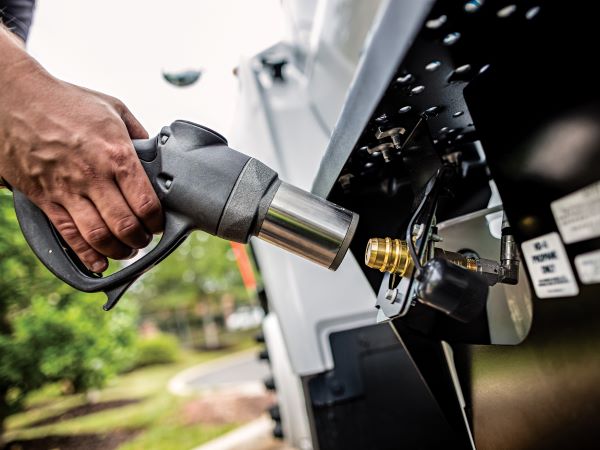 Because propane autogas has a different energy density than gasoline, it qualifies for a lower federal tax rate based on its Gasoline Gallon Equivalency (GGE). This brings the federal rate down to $0.136 per gallon of propane, compared to $0.184 per gallon for gasoline. (State tax rates vary, ranging from $0.067 per propane gallon in Alaska to $0.53 per propane gallon in California.)
The bottom line: When you combine an abundant fuel supply, favorable infrastructure economics, and energy-equivalent tax treatment, expected fuel costs for a propane autogas fleet typically range from $1.64 to $2.10 per gallon, depending on the fleet size and state.
Beyond fuel savings: compounding emissions & maintenance advantages
The financial benefits of propane autogas extend far beyond immediate fuel cost reductions into a much lower total cost of ownership (TCO).
 Propane autogas engines achieve near-zero emissions levels without the complex aftertreatment systems required on modern diesel engines. By eliminating components such as diesel oxidation catalyst (DOC), diesel particulate filter (DPF), selective catalytic reduction (SCR), ammonia slip catalyst, diesel exhaust fluid (DEF) storage and associated components and controls, fleets reduce maintenance complexity, minimize downtime, and keep vehicles on the road.
Simultaneously, propane autogas delivers a regulatory advantage by exceeding the upcoming 2027 EPA Ultra-Low NOx mandates today. Current engine platforms are already certified to the near-zero level of 0.02 g/bhp-hr, providing a straightforward compliance path without operational and cost trade-offs.
Real-world results
These structural advantages are being proven daily by major operations across the country.
 Broward County Transit (South Florida): Over a 10-year period, the agency saved more than $13 million in fuel costs alone by operating a propane autogas-powered paratransit fleet. Because the fuel’s cost structure is inherently stable, the agency paid an average of just $1.34 per gallon over that entire decade — even when local gasoline prices climbed past $4.00.
Wa-Nee Community School Corporation (Indiana): This Indiana school district spent an average of just $0.99 per gallon on propane autogas, avoiding the volatility that saw neighboring districts paying over $5.00 for diesel. The district saves an estimated $10,000 for every 30,000 miles driven. Over time, those predictable savings have directly preserved student sports and music programs, keeping them completely free for families.
A long-term strategy for savings and stability
Recent market disruptions put a spotlight on the vulnerabilities inherent to global fuel markets. While no fuel is completely insulated from market dynamics, propane autogas offers fleets something increasingly rare: access to an abundant domestic energy source, price stability irrespective of market conditions, and a level of budget predictability that traditional retail diesel and gasoline simply cannot match.
For fleets evaluating their options, the conversation is no longer just about cutting costs. It’s about taking back control. Propane autogas has been helping fleets do both for years — the opportunity remains hiding in plain sight.
About the author
 Gokul Vishwanathan is Director of Research, Development, and Innovation for the Propane Education & Research Council. [email protected] | 202-452-8975 | propane.com
Methodology
| Propane Autogas Fleet Pricing Model | ||
| Cost layer | $/gal | Methodology |
| Energy Price | $1.00 | Based on wholesale spot price benchmarks. The Mt. Belvieu spot price has remained under $1.00 per gallon since 2022. This starting baseline conservatively factors in regional transportation, storage, and local marketer markups to deliver a realistic real-world price. |
| Fuel Infrastructure Price | +$0.44 | Propane retailers frequently install, own, and maintain the fueling station. This conservative figure assumes a $50,000 station leased over a 3-year contract for a small fleet of 10 vehicles driving 15,000 miles per year (at 4 MPG, totaling 112,500 gallons).
As fleet sizes scale, this cost drops significantly. |
| Federal fuel tax | +$0.136 | Fuel taxes are adjusted down for energy density. While the standard federal gasoline tax is $0.184, propane receives a lower rate to reflect its lower energy content (a gallon of propane is 0.74 Gasoline Gallon Equivalent (GGE)). |
| State fuel tax | +$0.067 –
$0.530 |
State tax varies depending on where your fleet operates. This range is modeled on July 2025 fuel tax rates and adjusted for propane density. |
| Final Stack | $1.64 to $2.10 | The expected fuel costs for a propane autogas fleet typically range from $1.64 to $2.10 per gallon, depending on the state. While true fleet costs are dependent on many factors, this model shows the scale of opportunity and realistic breakdown of how fleet costs are applied. |
| Source: Adapted from PERC’s propane autogas pricing model developed using Mt. Belvieu wholesale propane benchmarks, fleet infrastructure assumptions, and applicable federal and state fuel tax rates. | ||