By Fleet Management Weekly Staff
April 16, 2023
Fleet Management Weekly recently had the opportunity to interview ServiceUp’s Chief Business Officer Mark Hodes, who spoke about how the company’s innovative solution is streamlining the maintenance and repair of fleet vehicles.
What should fleet managers and fleet drivers know about ServiceUp’s offerings?
Established in late 2020, ServiceUp is quickly growing by making the fleet repair process faster and more convenient than ever. Our vertically-integrated software as a service (SaaS) helps fleet managers, drivers, and shops alike efficiently and cost-effectively manage all repair and maintenance tasks.
Through our platform, we help fleet managers increase their vehicle utilization by reducing the time it takes to repair and maintain vehicles. And we do so with a particular attention to quality standards, so that the vehicle retains its value and maximizes remarketing profits.
In what ways do ServiceUp’s solutions save fleets time and money?
If you look at the process for repairing a vehicle, there are lots of inefficiencies. Whether it’s identifying when a vehicle needs to be repaired or is due for service, generating estimates and appraisals, routing vehicles to repair centers, approving estimates and supplements, collecting all documents for the subrogation process, monitoring the repair process, or returning the vehicle back to the fleet.
 All of this is bouncing between multiple departments of a fleet organization. It typically involves manually moving paperwork around and managing logistics. We automate all of that and we shave weeks off the average cycle time.
How do your processes work?
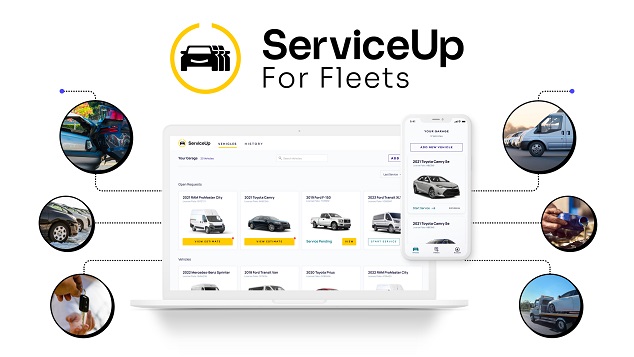
ServiceUp has a portal that securely maintains a dynamic list of vehicles in a fleet. We update these vehicles continuously via API feeds from other data sources to keep the list fresh and accurate. These updates identify when a vehicle has been in a collision, when a mechanical repair is needed, when there’s a manufacturer recall, or even when a service interval has been triggered.
All of this data alerts fleet managers when a vehicle needs a repair or is due for maintenance. If a vehicle is then identified as needing a repair or scheduled maintenance, it’s pulled from the portal and the repair is initiated.
There is another way you could go about this in a non-automated fashion. By using our driver app, a driver can remotely generate service requests, capture information required for an estimate, and auto-capture and decode the VIN.
We use AI-enabled picture analyses and integrated telematics to identify the mechanical and electrical health of the vehicle. So, whether the request is automated or enabled by the drivers themselves through our app, this is the first step of the ServiceUp process.
 Depending on the type of service, the first thing we would do is to generate a first notice of loss and any other estimates and appraisals. For collision repairs, which are particularly onerous, we will soon be expanding our functionality to determine whether a vehicle is a total loss.
If the vehicle is determined to be repairable, then the repair is initiated. For mechanical repairs, we apply fleet-specific auto approval rules. But if it falls outside auto approval, we use manual approvals that will be routed accordingly.
Once the approvals have been obtained, we have a matching algorithm that finds the best repair center for the required service. We then automate the pickup of the vehicle and transfer the data about the vehicle to the shop, where our shop app accesses all the information created to date.
 At that point, if additional approvals are needed, we would reroute through the approval process. This might happen, for example, following a tear down, or an inspection that may have detected other damage or mechanical issues with the vehicle. Once the approval process is done and the repairs are completed, we return the vehicle to the location designated by the fleet manager.
Lastly, all the data we accumulate is meticulously documented and kept in a secure data repository. When the vehicle is ready for disposal, those reports accompany the vehicle to the wholesale channel. And, as we all know, a well-documented vehicle will fetch a premium value at auction, which improves the fleet profitability from a remarketing perspective.
How does ServiceUp differentiate itself from the competition?
From our point of view, we have no direct competitors. There are companies who are considered in the same space. Mobile mechanic providers would be one category, but we see them as potential partners – they refer repairs to us when they are incapable of handling the repair remotely.
In addition, ServiceUp uses technology to manage the entire repair experience. We shield the driver and the fleet manager from inefficiencies and deliver shorter cycle times to improve utilization. We do this across the entire fleet lifecycle from acquisition to disposal. And finally, our service spans all types of repairs, from collision and mechanical to scheduled maintenance.
Where does ServiceUp operate now? Where do you plan to grow in the future?
We currently operate in Los Angeles, San Francisco Bay Area, Phoenix, Denver, and the greater NYC metro area. We’re expanding very aggressively, having closed a series A round about six months ago. We expect to have approximately 75% of the US population covered by the end of this year, concentrating (initially, at least) on Miami, Dallas, Houston, Austin, Chicago, Boston and more east coast cities.
Tell us about a ServiceUp success story.
 We work with a large rental fleet that has multiple thousands of vehicles under management. Their business problem is vehicle utilization, which is a consistent challenge for most fleets. Prior to our partnership, they were managing the collision repair process with their own systems. Their cycle times were too lengthy. They needed more scalability and efficiency because they expected to rapidly increase their fleet size by the end of this year.
We came in, presented our platform, and convinced them to use us initially on just a handful of collision repairs so we could validate the metrics and our capabilities. With this cohort of vehicles, we were able to shave multiple weeks off their cycle time while maintaining their threshold for repair expenses and increasing the repair quality.
This resulted in our relationship expanding vertically by getting more of their collision repair business, as well as horizontally by helping them with recalls and mechanical repairs. We expect to soon have the majority of their repairs flowing through our platform. Once we expand on scheduled maintenance services, we will have all the records maintained. Detailed records will accompany the vehicle when they decide to sell it through the wholesale channel.