One last mile delivery service fleet achieved a stunning 81 percent reduction in collisions
By Mark Boada, Executive Editor
The war against distracted driving has largely focused on cell phones and fleets have taken a variety of approaches to prevent it, from changing their policies to ban cell-phone use, to intensive messaging on its dangers, classroom and online driver training, and cell-phone blocking technology. To some extent or another, they all may have some effect, and all fleets need to pursue them. One big problem, though, is that using a cell phone to talk or text isn’t the only form of distraction.
In fact, distracted driving long predates the advent of digital technology. Before cell phones and lap top computers, there were many other actions that could take a driver’s eyes off the road long enough to lead to a collision, and all of them still exist. These include, but are not limited to, adjusting radio and climate controls, reaching for objects inside the cabin, reading, eating, grooming, talking to passengers, drowsiness, or simply gazing at the passing scenery.
One thing going for fleets that ban cell phone use while driving is that when someone is on the phone, there’s a record at the service provider that can be checked. Knowing that that record could be discovered after an accident is a strong incentive for drivers to comply with a no-cell-phone use provision in a fleet policy. Still, you can be sure that a good many fleet drivers violate such policies every day, because most of the time they get away with it.
Of course, if your fleet cars are equipped with two-way cameras that record both what happens on the road ahead and the driver, that, too, can provide evidence that a driver involved in a crash was distracted by a cell phone or one of the many other ways as well. So, two-way cameras are another way to provide an incentive for drivers to avoid distraction of any kind.
Yet, distraction-caused accidents still occur, because, once again, drivers more often than not get away with all of their distractions, many of which may well become habitual. So, what’s needed is some kind of system that both warns a driver that he or she is distracted and that provides a record of that event even if it doesn’t result in an accident. Ideally, it would also help fleets coach the driver.
So, that being a long drum roll, let me introduce you to Nauto, which may well be the most robust, full-spectrum anti-distraction system on the market today. It’s the only system we at Fleet Management Weekly are aware that combines multiple sensors (GPS, accelerometer and two-way dashboard camera sensors), telematics, and a distraction warning (an in-cabin alert) that resembles forward-crash warning systems; is powered by artificial intelligence (AI), and enables fleet managers to coach risky drivers. We’re undoubtedly not going to relay in detail every aspect of the Nauto device and system, but we hope the description below will encourage you to take a look at it for yourself.
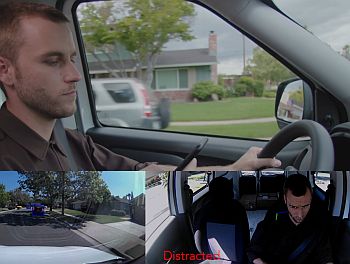
Unlike systems that focus on a driver’s use of a cell phone, Nauto is programmed to determine whether a driver is distracted by several factors. Using its cabin-facing camera, it looks at the driver’s direction of focus, head movement and general body position within the cabin, all of which can reveal all of those non-digital related distractions drivers can succumb to.
If the system detects that the driver is distracted, its progressive alarm system kicks in. After 2.5 seconds, it will emit what the company says is a mild audible alarm to alert the driver. If the distraction continues, the system will issue another alert after 4.0 seconds, this one louder than the first with a verbal cue, “distracted,” to help the driver understand the behavior correction required, and at 5.5 seconds, the system issues a severe audible alert.
Nauto provides another benefit, similar to those provided by forward crash avoidance systems. Nauto’s forward-facing camera system is programmed to detect potential hazards in the road ahead, and takes into account speed and distance to issue a warning when the driver is tailgating and at risk of a collision. The only thing missing from this, however, is automatic braking, but systems that merely warn the driver have been proven to help reduce the number and severity of collisions.
The system also incorporates two more features that resemble those offered by some other camera-equipped telematics systems. The first is a driver score, based on the number of a driver’s harsh driving events; unique to Nauto, though, is that the additional distraction event data is used to compute a driver’s score. The score ranges from 0 to 100 – the higher the number the better the driver – and is available for both fleet managers to review on a desktop computer, and drivers via a smartphone through the Nauto Driver mobile app. From the information provided, drivers can also coach themselves in the ways they need to improve and raise their scores.
The second additional feature is connectivity to the system’s fleet management app, which enables hazardous event data tracking and uploads of video taken during hazardous events. In addition to ranking all drivers by their score and identifying the highest-risk drivers, Nauto retains videos of high-risk events, which makes it possible fleet administrators to conduct context-rich coaching of high-risk drivers.
Does it work? Nauto recently completed an eight-month study of commercial drivers and found nearly four out of five drivers in fleets across industries studied saw improvements in distraction frequency, duration and distance traveled after activating Nauto in-cabin alerts. On average, these drivers reduced their frequency of distractions by 40 percent (4.8 to 2.9 distractions per driving hour), duration by 43 percent (15.4 to 8.8 seconds per hour), and distance traveled while distracted by 47 percent (0.15 to 0.08 miles per driving hour).
But perhaps, the most significant result was one it achieved with a last mile delivery service fleet: a stunning 81 percent reduction in collisions. So, if you’re frustrated in your ability to enforce your fleet’s distracted driving policy, if you want proven defense against distractions of all kinds, and if you want to prevent accidents caused by distraction, you just might want to look into what Nauto can do for your fleet.
For more information, visit www.nauto.com.