Truemag

  • Newsletters
  • Thought Leadership
  • Mobility
  • Safety
  • Work Trucks
  • Videos
  • Home
  • Subscribe
  • Contact Us
  • Media Kit
  • Who We Are

Variable Speed Limits Could Reduce Crashes, Ease Congestion in Highway Work Zones

News Bureau, University of Missouri

As the summer months approach, most people turn to thoughts of sunshine, outdoor barbecues and destination trips.Yet travelers often are greeted by detours, lane closures and delays for road repairs that generally are reserved for warmer weather.

Researchers at the University of Missouri have studied systems to alleviate inevitable backups and delays.

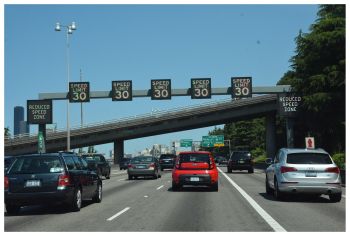
Researchers found that using variable speed limits in construction zones may ease congestion, reduce crashes and make work zones safer for both workers and travelers nationally.

With assistance from the Missouri Department of Transportation, Praveen Edara, associate professor of civil and environmental engineering in the MU College of Engineering, tested the use of variable advisory speed limit (VASL) systems and the effect they may have on lessening congestion and reducing rear-end and lane-changing accidents on a fairly dangerous stretch of I-270, a major four-lane highway in St. Louis.

“The idea was to see if warning drivers of slower speeds ahead helped reduce crashes,” Edara said. “Where there is queueing, if drivers are not aware of the queue downstream, they don’t have enough time to hit the brakes to slow down or stop, thus, increasing the likelihood of a crash. Instead of posting a message asking them to slow down, the VASL system posts an advisory speed limit based on the actual downstream traffic speed, so drivers would know that if they’re driving 50 mph, they should slow to 30 mph downstream.”

Edara’s data collection and simulation analysis uncovered a few key pieces of data. First, the use of VASL systems is effective in gradually slowing drivers as they enter work zones. VASL use resulted in a 39 to 53 percent decrease in average queue length, and just a 4 to 8 percent increase in travel time.

Additionally, using VASL meant that maximum speed differences also decreased by as much as 10 mph, and the chance of rear-end collisions dropped by 30 percent. Researchers also noted a 20 percent decrease in lane changing conflicts. Essentially, travel time was slightly longer, but lines were shorter and collisions were less frequent.

“You can get both safety benefits and mobility benefits by deploying variable advisory speed limit systems in work zones,” Edara said.

“Evaluation of variable advisory speed limits in congested work zones” recently was published in the Journal of Transportation Safety and Security. Carlos Sun, an MU professor of civil and environmental engineering, and Yi Hou a doctoral student at Mizzou, co-authored the study.

Jun 12, 2017connieshedron
ARI & Institute for Supply Management Partner to Host Free WebinarCEI Promotes John Wolford to VP of Business Process, Quality and Sourcing
Recent Posts
  • IMPROVLearning: How Comedy, Behavioral Science and AI Improve Fleet Safety
  • Improving Productivity with AI: Turning Fleet Data into Faster Decisions
  • National Safety Council Projects Increased Traffic Crash Risk during Fourth of July Weekend
  • Keep Every Heavy-Duty Maintenance Inspection on Track — Free Fullbay Checklist
  • Gain Data-Driven Insights into Commercial Vehicle Market Trends at Executive Leadership Summit
  • Last Chance to Save: Register for NAFA’s Maintenance Workshop
  • License Plate Cameras Are About to Start Tracking a Lot More Than Just Your Car
  • America’s Heavy EV Problem May End with Drivers Paying More
  • Trends in U.S. Drivers’ Perceptions and Attitudes Toward Vehicle Automation, 2019–2025
  • 2026 NETS Strength IN Numbers Conference: Early Bird Rates!
ASSOCIATION NEWS
Last Chance to Save: Register for NAFA’s Maintenance Workshop
How AFLA Is Positioning Itself for the Future of Fleet Mobility
‘Raise Your Hand and Get Involved’
NAFA Names 2026 Class of Fellows, Honoring Leaders in Fleet Management
Award Winners Honored at NAFA I&E
2026 NAFA I&E Seeks to Change Perceptions, Invigorate Fleets
NAFA Announces Lineup for Media Day at I&E 2026: Industry Leaders to Showcase the Latest Innovations
TECHNOLOGY
Improving Productivity with AI: Turning Fleet Data into Faster Decisions
Fleet Operations Are Changing – The Industry Needs to Evolve With Them
AI-Powered Vehicle Inspections Move Beyond the Checklist
Motive’s New Workforce Capabilities Aim to Improve Performance, Automate Rewards
AI + Human Insight: Why Fleet Leaders Need Both to Win in 2026
NTSB Finds Automation Overreliance Contributed to Two Fatal Ford BlueCruise Crashes
New AI Assistants Automate Fleet Data Analysis, Decision Making and More
CONFERENCES & WEBINARS
2026 NETS Strength IN Numbers Conference: Early Bird Rates!
AFLA 2026 – Keynotes Announced!
Private Fleets Flex at National Private Truck Council Conference
Free NAFA Webinar: Manage Your Fuel Cost Volatility
Registration Now Open for NETS Annual Conference
Early Bird Pricing for AFLA 2026 – Ending June 1
NAFA Online Seminar: Essentials of Fleet Management
INDUSTRY ANNOUNCEMENTS
Union Leasing Becomes Moventum Fleet Management as 70-Year Company Accelerates into Next Phase
Fleetio Wins Innovations Award at NAFA’s 2026 Institute & Expo
WIFM is heading to NAFA!
Cox Automotive Unveils Cox Fleet, Setting a New Standard for Fleet Uptime Nationwide
AFLA Canadian Fleet Professional of the Year Award: Nominations Open!
NAFA Webinar: Kickoff the 2026 100 Best Fleets Contest on December 4!
Join NAFA’s Free Fleet 101 Live Course

Fleet Management Weekly Newsletter Archive
Access to back issues of the FMW newsletter.

FMW Mobility
How mobility is rapidly changing the fleet management landscape.

Newsletter

Subscribe

FMW Fleet Videos
Video clips of industry leaders speaking on a variety of engaging hot topics in fleet.

2014-2020 © Fleet Management Weekly