Red light camera programs in 79 large U.S. cities saved nearly 1,300 lives through 2014, researchers from the Insurance Institute for Highway Safety have found.
Shutting down such programs costs lives, with the rate of fatal red-light-running crashes shooting up 30 percent in cities that have turned off cameras.
“We know we have a problem: people dying at signalized intersections because of people running red lights,” IIHS President Adrian Lund said as he presented the new research at a red-light-camera forum hosted by the Institute. “We know red light cameras are part of the solution.”
Red-light-running crashes caused 709 deaths in 2014 and an estimated 126,000 injuries.
Red light runners account for a minority of the people killed in such crashes. Most of those killed are occupants of other vehicles, passengers in the red-light-running vehicles, pedestrians or bicyclists.
Automated enforcement deters red light running. While traditional police enforcement can help, there aren’t enough resources to station officers at every intersection. Cameras increase the odds that violators will get caught, and well-publicized camera programs discourage would-be violators from taking those odds.
Although surveys have found strong support for red light cameras in communities that have them, opposition from a vocal minority has led some jurisdictions to shut off their cameras. While programs are still being launched in some places, the total number of communities with red light cameras fell to 467 in 2015 from a peak of 533 in 2012.
Supporting effective enforcement
Thursday’s forum, held at the IIHS Vehicle Research Center, was organized to support red light camera programs by focusing on best practices. Representatives of law enforcement and municipal and state governments, as well as highway safety advocates and researchers, spoke.
Many speakers emphasized the importance of organizing camera programs so that the public understands their value as a safety tool, not as a revenue generator.
One way to do that is to keep camera revenues separate from the general fund and dedicate them to traffic safety. Several speakers also cited the importance of consistent data collection and transparency.
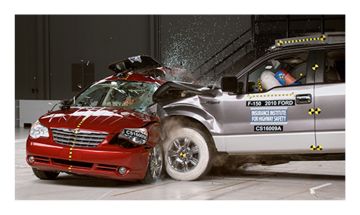
As part of the day’s events, IIHS conducted a demonstration crash that recreated a real-life red-light-running crash in which a driver was severely injured. In the 2012 crash, the driver of a 2010 Ford F-150 ran a red light in Yuma, Ariz., and collided with a 2007 Chrysler Sebring as it was turning left. The pickup was moving at 48 mph as it struck the sedan. The injuries to the Sebring’s driver included a concussion and pelvis and rib fractures.
Building on years of research
The forum builds on years of research demonstrating the effectiveness of red light cameras. Earlier studies showed that red light camera enforcement leads to declines in red-light-running violations and crashes at camera-equipped intersections, as well as nearby spillover locations.
A 2011 IIHS study found that in large cities with red light camera programs during 2004-08, there were substantial decreases in the per capita rates of both fatal red-light-running crashes and fatal crashes of all types at intersections with traffic signals.
The new study updates that analysis, using a more rigorous design, a larger number of cities and a longer study period. It also looks at the effect of ending camera programs, something not previously studied.
Read more of the original article at IIHS.org.