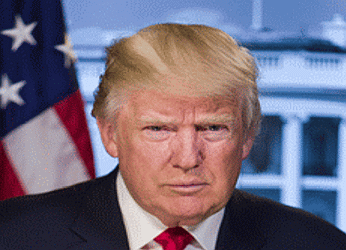
President Trump isn’t expected to show up at the New York Auto Show this week, but his presence will be felt with the reveal of every new model.
Many of the cars making their debut at the show are larger and thirstier, reflecting a new era in which Trump administration may ease gas-mileage targets and slow the adoption of other regulations. The administration says its goal is to put the U.S. auto industry on a solid path and promote American jobs.
To a large extent, Trump can take advantage of a trend that was already in progress in an era of cheap gas — the nation’s transition from cars to crossovers, sport-utility vehicles, and pickup trucks. The big losers are smaller cars, which helped the nation save on gas during the Obama administration.
In March, Trump ordered a review of the Obama administration’s stringent fuel economy standards, which force automakers to promote smaller cars or those with fuel-saving technologies like hybrids, electrics or even hydrogen fuel cells. If the regulations are eased, automakers will be freer to concentrate on making the larger cars that Americans want most. That’s good for automakers since those models generally carry higher price tags and are more profitable than small cars or those with advanced fuel-saving technology.
U.S. small-car sales fell 6.2% in 2016 to 2.9 million units, as vehicles such as the Ford Fiesta and Chevrolet Sonic suffered. That represents 16.5% of total industry sales, down from 19.2% in 2012, according to Autodata.
During that same stretch, sales of crossovers and SUVs ballooned from 29.7% of the industry to 38.4%.
Among the big SUV or crossover reveals expected at the New York International Auto Show this week are the Infiniti QX80 Monograph concept, a redesigned Lincoln Navigator and a new Buick Enclave.
“Consumers have made it pretty clear that they prefer crossovers,” AutoPacific analyst Dave Sullivan said.
Although the crossover trend may be unstoppable, the Trump administration will still have the power to shape the direction of the automobile in several ways.
“We are going to ensure that any regulations we have protect and defend your jobs, your factories,” Trump said in March at an event near Detroit, where he ordered the Environmental Protection Agency to review Obama’s corporate average fuel economy (CAFE) standards.
“If the standards threaten auto jobs, then common-sense changes could have — and should have — been made.”
Another factor that directly affects what Americans drive is Trump’s threat to impose a border tax on vehicles imported from Mexico, where most small cars are made but also some larger vehicles like General Motor’s pickup trucks. That tax could make some vehicles more unaffordable in the U.S, though few analysts expect the tax to be enacted.
Here are key questions to ponder as the New York International Auto Show gets underway:
How much power does Washington really have over the auto industry?
In one respect, it’s significant because the EPA sets fuel economy standards, and Washington can pursue or abandon free-trade agreements that the industry relies upon.
On the other hand, the auto industry is a global sector, and China is its biggest market. General Motors, for example, sells more vehicles in China than it does in the U.S. Design and engineering decisions on global vehicles must take into account all markets.
So don’t expect automakers to suddenly shift strategies in the U.S. since many of the vehicles they sell here must also be sold in other markets.
“Other than pickup trucks and minivans, the U.S. market doesn’t get special treatment,” Sullivan said. “We’re really a recipient of whatever happens for the Chinese market now. Even if emissions requirements or other things change, the automakers still have to think about what the other markets are going to need and what’s required to sell vehicles there.”
Was Trump’s election the death blow to the small car?
Small cars and passenger sedans remain sickly because low gasoline prices and design preferences have sent consumers flocking into bigger vehicles — namely crossovers and sport-utility vehicles.
Automakers believe they must continue to sell some small cars to entice entry-level buyers or cost-conscious consumers to their brands. Compact car transaction prices averaged $20,531 in December, or 42% less than the industry average of $35,430.
Still, small car sales have plummeted as low oil prices translated into gasoline nearing $2 per gallon in 2016, making bigger vehicles more enticing. What’s more, car buyers recognize that they can often get similar fuel economy with small crossovers that they previously believed was only available in small cars.
“There are still people who want to buy them,” IHS Automotive analyst Stephanie Brinley said. But “automakers are going to respond to how consumers are behaving.”
Will automakers pump the brakes on hybrids and electric vehicles if regulations are eased?
Possibly. Sales are sluggish, with the exception of Tesla’s luxury electric cars. Even the stalwart Toyota Prius is flagging, as sales plunged 26.1% in 2016.
If the EPA loosens gas-mileage standards after Trump ordered the agency to review rules implemented by the Obama administration, there will be less incentive for automakers to manufacture electric vehicles to meet federal fuel economy targets.
“So what I worry about is just, if the incentive to push forward goes away and folks feel like they can relax, do we start to go backwards?” former Obama Transportation Secretary Anthony Foxx told reporters last week.
But there’s a big reason why they might not pull back aggressively. California and 13 other states have a waiver that allows them to set stricter requirements on vehicle emissions, which are tied to fuel economy, than the rest of the nation. Some include the requirement that automakers sell zero-emission vehicles. Unless the Trump administration seeks to withdraw California’s ability to set its own standards — which is possible but would likely trigger a legal battle — automakers may continue manufacturing these vehicles to maintain access to the crucial California market.
Plus, automakers don’t want to fall behind in the technological race. Although most consumers have spurned current electric vehicles, the declining cost of batteries will eventually lower prices, potentially sparking more interest. Auto companies need to be ready.
Lastly, if auto companies are making environmentally friendly vehicles for foreign markets, they will still have the opportunity to offer them in the U.S., as well.
“All of the big players are global,” Gartner Inc. auto analyst Mike Ramsey said. “Car companies are going to have to invest in these technologies.”
Will Trump straighten out autonomous vehicle regulations?
By all accounts, Trump has shown little interest so far in addressing one of the auto industry’s greatest concerns in Washington: that the growing thicket of self-driving car regulations among the states will throttle innovation.
The Obama administration’s Transportation Department had signaled plans to help develop a national framework of regulations governing self-driving car testing, for example.
With few clues on how Trump views the matter, industry analysts said whatever action he takes is likely to favor the industry.
Ramsey said it seems likely Trump will “take a light hand on regulation.” On the other hand, concerns over job losses among blue-collar workers such as truckers and taxi drivers could fuel policies to protect workers from autonomous vehicles, he said.
Industry leaders are grasping for insights on how the National Highway Traffic Safety Administration may address the matter.
If the regulatory process stalls, that could similarly hurt development of autonomous vehicles, preventing them from reaching consumers anytime soon and ceding ground to foreign competitors.
Will Trump’s Department of Transportation mandate more safety technology?
Don’t expect much. Trump has repeatedly pledged to abolish regulations, even signing an executive order dictating that for every single new regulation on the books, the government must remove two.
The Obama administration finalized a rule requiring rearview cameras in vehicles by 2018 and helped convince automakers to commit to automatic emergency braking systems as standard technology on virtually all models by 2022.
But any additional safety mandates may be viewed as cumbersome and expensive for the industry, which is already developing close ties to Trump. General Motors CEO Mary Barra and Ford CEO Mark Fields serve on panels of business leaders advising the president on economic issues.
“It would be reasonable to think that a president who suggests that regulation is high may not be supportive of increasing regulations,” IHS analyst Brinley said.
Still, that doesn’t necessarily mean automakers will abandon new safety technologies. In fact, the industry has begun to view safety systems as critical to selling new cars. Systems such as forward collision alert and lane departure warning are becoming increasingly common.
“Consumers are demanding it,” Sullivan said. “Whether or not the government mandates it is one thing, but consumers want it. Consumers are already dictating what the automakers are putting in their vehicles.”
Contributing: Brent Snavely of the Detroit Free Press.
Follow USA TODAY reporter Nathan Bomey on Twitter @NathanBomey.