Truemag

  • Newsletters
  • Thought Leadership
  • Mobility
  • Safety
  • Work Trucks
  • Videos
  • Home
  • Subscribe
  • Contact Us
  • Media Kit
  • Who We Are

How Otto Defied Nevada and Scored a $680 Million Payout from Uber

Back Channel

It could be the plot of an Ocean’s Eleven movie: A team of daring engineers heads to the wilds of Nevada to create a dazzling spectacle, defy officials, and walk off with a $680 million jackpot.

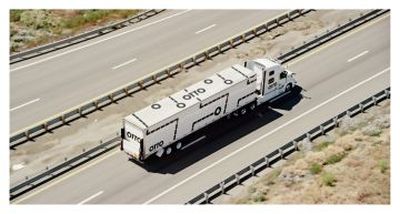
In May of this year, Otto unveiled a video of an 18-wheeler thundering down a freeway with no one at the wheel. The San Francisco-based startup had retrofitted a freight truck with lidar, video cameras, radar, and other sensors, enabling it to operate “completely driverless without a driver in the backseat,” according to co-founder Lior Ron at the time.

Even Google, which had been developing self-driving cars for eight years, still insists on having a human in the driving seat should anything go wrong. That a tiny startup emerging from stealth mode could confidently demonstrate an autonomous big rig on a public interstate with no one in the front seats suggested Otto’s technology was really special.

Within just a couple of months, ride-sharing unicorn Uber had acquired the fledgling Otto in exchange for 1 percent of the company’s stock (representing $680 million) and 20 percent of any future self-driving trucking profits — a payout that could exceed a billion dollars for Otto’s founders.

So far, just another Silicon Valley fairytale. Yet Otto’s rapid ascent involved a high-stakes gamble that could have landed the startup in legal hot water, rather than the arms of the world’s biggest transportation network company.

When Otto performed its test drive — the one shown in the May video — it did so despite a clear warning from Nevada’s Department of Motor Vehicles (DMV) that it would be violating the state’s autonomous vehicle regulations. When the DMV realized that Otto had gone ahead anyway, one official called the drive “illegal” and even threatened to shut down the agency’s autonomous vehicle program.

The story of why Otto flouted Nevada’s directive, how it got away with it, and what this means for the future of self-driving regulation stretches back to the dawn of driverless cars.

On May 1, 2012, the world’s first government-run self-driving test took place on Las Vegas’s famous Strip. In the driver’s seat of a heavily modified 2008 Toyota Prius was Chris Urmson, then the head of Google’s self-driving car project. Next to him sat Anthony Levandowski, the brilliant engineer whose startup 510 Systems had been acquired by Google the previous year, after it had built the tech giant’s first autonomous vehicles.

As the Prius nosed its way past casinos and tourists, its performance was being watched from the back seat by a driving examiner and by Bruce Breslow, then the head of the Nevada DMV. The test was a quick zip around Las Vegas’s surface streets and freeways on a route chosen by Google itself. Despite Urmson having to take control of the vehicle on two occasions, the Prius passed the test with flying colors.

Read more of the original article at Back Channel

Nov 30, 2016connieshedron
This FICO Score Gives Credit for Good DrivingCarpe Diem
Recent Posts
  • IMPROVLearning: How Comedy, Behavioral Science and AI Improve Fleet Safety
  • Improving Productivity with AI: Turning Fleet Data into Faster Decisions
  • National Safety Council Projects Increased Traffic Crash Risk during Fourth of July Weekend
  • Keep Every Heavy-Duty Maintenance Inspection on Track — Free Fullbay Checklist
  • Gain Data-Driven Insights into Commercial Vehicle Market Trends at Executive Leadership Summit
  • Last Chance to Save: Register for NAFA’s Maintenance Workshop
  • License Plate Cameras Are About to Start Tracking a Lot More Than Just Your Car
  • America’s Heavy EV Problem May End with Drivers Paying More
  • Trends in U.S. Drivers’ Perceptions and Attitudes Toward Vehicle Automation, 2019–2025
  • 2026 NETS Strength IN Numbers Conference: Early Bird Rates!
ASSOCIATION NEWS
Last Chance to Save: Register for NAFA’s Maintenance Workshop
How AFLA Is Positioning Itself for the Future of Fleet Mobility
‘Raise Your Hand and Get Involved’
NAFA Names 2026 Class of Fellows, Honoring Leaders in Fleet Management
Award Winners Honored at NAFA I&E
2026 NAFA I&E Seeks to Change Perceptions, Invigorate Fleets
NAFA Announces Lineup for Media Day at I&E 2026: Industry Leaders to Showcase the Latest Innovations
TECHNOLOGY
Improving Productivity with AI: Turning Fleet Data into Faster Decisions
Fleet Operations Are Changing – The Industry Needs to Evolve With Them
AI-Powered Vehicle Inspections Move Beyond the Checklist
Motive’s New Workforce Capabilities Aim to Improve Performance, Automate Rewards
AI + Human Insight: Why Fleet Leaders Need Both to Win in 2026
NTSB Finds Automation Overreliance Contributed to Two Fatal Ford BlueCruise Crashes
New AI Assistants Automate Fleet Data Analysis, Decision Making and More
CONFERENCES & WEBINARS
2026 NETS Strength IN Numbers Conference: Early Bird Rates!
AFLA 2026 – Keynotes Announced!
Private Fleets Flex at National Private Truck Council Conference
Free NAFA Webinar: Manage Your Fuel Cost Volatility
Registration Now Open for NETS Annual Conference
Early Bird Pricing for AFLA 2026 – Ending June 1
NAFA Online Seminar: Essentials of Fleet Management
INDUSTRY ANNOUNCEMENTS
Union Leasing Becomes Moventum Fleet Management as 70-Year Company Accelerates into Next Phase
Fleetio Wins Innovations Award at NAFA’s 2026 Institute & Expo
WIFM is heading to NAFA!
Cox Automotive Unveils Cox Fleet, Setting a New Standard for Fleet Uptime Nationwide
AFLA Canadian Fleet Professional of the Year Award: Nominations Open!
NAFA Webinar: Kickoff the 2026 100 Best Fleets Contest on December 4!
Join NAFA’s Free Fleet 101 Live Course

Fleet Management Weekly Newsletter Archive
Access to back issues of the FMW newsletter.

FMW Mobility
How mobility is rapidly changing the fleet management landscape.

Newsletter

Subscribe

FMW Fleet Videos
Video clips of industry leaders speaking on a variety of engaging hot topics in fleet.

2014-2020 © Fleet Management Weekly