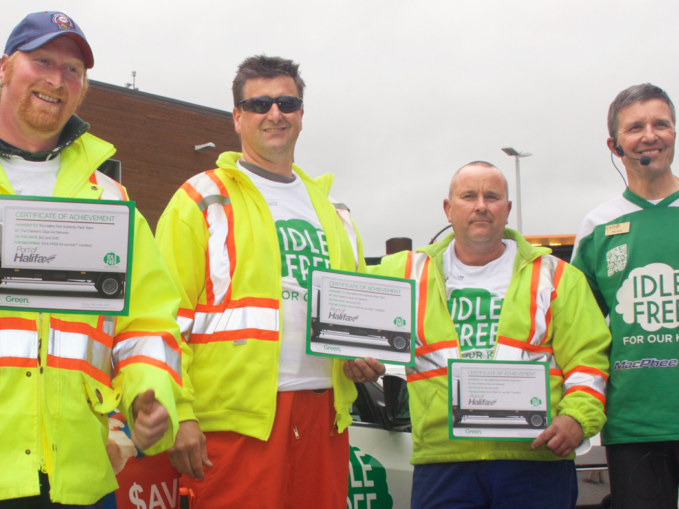
Ron Zima (right) Hosting Clean Air Day, Port of Halifax, Nova Scotia
By Ron Zima ADpPR and George Survant
Fleet managers face many challenges in improving their fleet’s fuel efficiency. Perhaps the most daunting of those challenges is idle reduction. Based on numbers provided by Argonne National Laboratory, Americans and Canadians annually spend 6.6 Billion Gallons of gasoline and diesel idling for zero mileage and minimal if any benefit.
Further research reveals that Individual fleets across all sectors are spending an average of 40% of engine hours at idle when not in motion, generally not in traffic or performing a business function, such as running power take off (PTO) to run a bucket on a utility truck.
Unrequired idling is an enormous waste of money and contributes to an estimated 33 million tons of CO2 and other pollutants annually in a time when it is widely recognized that we must reduce emissions as quickly as possible. Electrification of our fleets can help, but it will take decades to completely convert all fleets. Even then, we will need strategies wide in scope to upgrade drivers’ beliefs and behaviors on idling today’s internal combustion engine technology — which requires virtually zero idle time. And, like gas and diesel, electricity requires energy. We cannot afford to waste it.
Meanwhile, there is wide agreement that idling needs to be reduced. Twenty-three states have passed regulations limiting idling; many offer incentives for equipment to assist in the effort. Well-intended as they may be, these regulations cannot solve the driver idling behavior problem fast enough to deal with the increasing need to stem emissions, as well as reduce operating costs. For one thing, enforcement is difficult, if not almost impossible.
In addressing the challenge of idle reduction, fleet managers should subdivide the problem into two segments:
- New equipment.
- Legacy equipment.
In new equipment, fleet managers have a number of choices directly from the OEMs.
- BEV, battery powered electric vehicles.
- HEV, hybrid electric vehicles.
- PHEV, plug-in hybrid electric vehicles.
There are also a number of alternative fuel sources to consider in the new equipment segment, such as compressed natural gas (CNG). Although ‘alt fuels’ may not affect fuel burn per se they can lower costs as well as emissions. The downside in managing the fuel efficiency challenge in new equipment is that few if any managers have unlimited capital. Research tells us that about 9.5% of the fleet in North America is replaced annually. Meaning that it could be three years before even 25% of a fleet is replaced with newer technologies that are more fuel efficient. So, solving a manager’s fuel efficiency challenge by looking at replacement equipment programs is a long-term solution.
Then, there are many intriguing mechanical or electronic solutions for idle reduction, and there are some programming options. For example, turning engines off after a pre-set idle time, or limiting idling in traffic or waiting in fast-food drive-in lines. But in the short term, nothing is as powerful as modifying your driver’s mindset and how they approach their portion of the fuel efficiency challenge. This is what we call driver ‘idle reduction behavior modification,’ which addresses driver ‘idling by choice’ (as opposed to traffic idling which is mostly unavoidable).
A key virtue of idle reduction behavior modification is that it applies to all of a fleet’s assets that are powered by an internal combustion engine. Behavior modification is not limited strictly to on-the-road assets. For example, tree crews would shut the chipper down when not putting product through it; or if the forklift operator would shut the forklift off when it is not in operation.
As tempting as it is to look to the future and some point when our vehicles and fleets will be all electric, the fact is that dramatic improvements in fuel efficiency and emissions reduction in a manager’s legacy fleet are available right now.
In the case of idle reduction behavior modification for the drivers, a well-managed and executed program will produce extraordinary savings in a relatively brief period of time. These initiatives can quickly pay for themselves not only in fuel savings, but downstream costs such as maintenance, lifecycle, and productivity. In short, cost reduction and reductions in greenhouse gas emissions and exhaust pollutants from ‘driver choice idling’ can be enormous.
So, how do fleet managers get employees to care about reducing their ‘by choice’ idling in a continuously monitored and managed fashion with as little disruption as possible? A highly effective driver engagement program coupled with actionable, readily accessible data, will allow many fleets to be green-fleet leaders by reducing and confidently measuring unrequired idling and its downstream costs.
Over the years, we have developed a number of key principles for winning enthusiastic support from drivers. First, drivers need to be ‘emotionally engaged’ as much as they need to be enlightened to achieve maximum impact in transforming old idling beliefs and behaviors. Emotional engagement creates the highest rates of comprehension and course completion.
That is why GoGreen’s eLearning program, IDLE FREE for our kids® for Fleets is unlike any other driver training: it is highly visual, interactive, based on storytelling principles with idle reduction data from actual people. Drivers tend to become emotionally engaged early and then stick with the full course. This is due in part to the authentic stars of the program: school kids, educators, doctors, and auto experts.
It is also because driver ‘idling by choice’ engagement begins at home around the impacts that unconscious idling habits have on three values drivers universally care about in their personal vehicles: how does my habit affect my kids (people I care about), my car, my cash.
As dedicated as employees may be on the job, fleet managers know from experience that they generally have little emotional investment about idling’s impact on company vehicles or fuel bills. However, once emotionally engaged at home on improving air quality for their kid with asthma, on saving hundreds of engine hours in their vehicle, and hundreds of dollars annually in their bank accounts, they tend to enthusiastically bring their new idle reduction habit to work.
In fact, a large segment of fleet driver populations (>50% of drivers) are typically ready to embrace ‘kids, cars, cash’ values messaging; and will be a key factor in building traction for your fleet’s initiative. Celebrating drivers who are early champions of the program to help spread the word (‘social proof’) is a powerful strategy in building traction and momentum across the organization early on.
From our experience > 80% of drivers over time can be enlisted into this idle reduction movement with effective communication strategies in place, including a ‘continuous feedback loop’ of driver recognition. And, since most fleet operators don’t have the time or resources to assess their fleet idle time data (70%), GoGreen’s IDLE FREE Manager™ predictive analytics will help them transform a flood of telematics data into intelligent, actionable data on managing and celebrating their progress.
About ten percent of drivers typically are outliers. They may never comply with idling policy without strict supervision and enforcement. In large fleets we have studied (the rare idle reduction culture leaders), outliers are cycled out after a period of noncompliance, which allows management to achieve the highest level of continual compliance.
Last but certainly not least, it is critical that management be seen as champions of any idle reduction program; fully understanding and embracing the initiative. The outcomes are strongly influenced by the level of support and enthusiasm by management. Without it, their fleet will lag those whose fleet employees are fully and emotionally engaged by management’s leadership on the WHY of their new idle reduction habit and behavior. In the process, management will also distinguish its fleet as an idle reduction green fleet leader.
GoGreen’s behavior modification research and practice began as a grassroots campaign at an elementary school in Canada in 2006 to engage parents to reduce their idling. The effort was so effective, car dealers and media outlets hopped on board, engaging a province and a nation. Fleet operators soon requested a program; a leading bus company reduced idle by 80% sustained over two years. Its IDLE FREE Bus was endorsed by the Olympics and carried the men’s’ hockey teams. Today, this content and formula is available as an eLearning program with no equipment to buy. Drivers log in from any approved web-enabled device, anytime, anywhere. Find out more.
Ron Zima is an idle reduction behavior modification expert, and CEO of GoGreen Communications Inc.