Mobile technology, gamification, and the evolution of how we communicate with mobile workforces to achieve greater safety, productivity and compliance.
By Tim Taylor, Chief Client Success Officer, Telogis
Today’s utility fleets all have a powerful tool at their disposal – and it’s one of the most basic tools we all carry with us: our mobile phone or tablet. New applications tied into existing fleet management and work order management solutions can significantly improve how mobile workers perform their day-to-day work – and it can all be unlocked through the mobile device they’re already using. This article will look at some of the most effective ways today’s utility fleets are leveraging these solutions to coach and improve worker performance in real time, and why today’s utility fleet manager should consider engaging with these technologies today.
Gamification of Driver Behavior and Worker Performance
Curbing unwanted driving behavior, even with recent telematics and fleet management solutions, has largely been reactionary: “Yesterday you were speeding and had a hard braking event”, or, “I received an alert that you exceeded 90 miles per hour this afternoon.” Both examples are a reflex, take the tone of a principal confronting a student, and lose the ability to affect change in real time.
So how does a supervisor teach a mobile workforce to do the right thing when they’re not there to help guide them in the decision making process?
Positive reinforcement through competition.
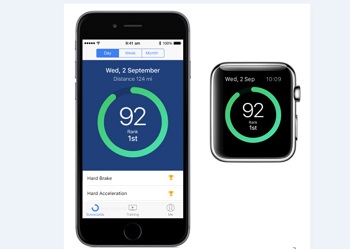
Gamification appeals to our most inherent desire for recognition and achievement. That’s what fleets can now do with telematics and mobile programs, such as Telogis Coach, that score driver behavior and “gamify” it to rank performance against their peers. These technologies also allow fleet managers to deliver real-time coaching and training to drivers in the field, so that learning opportunities are immediate.
In the past, telematics data related to driver performance and productivity would go directly to the fleet manager, who would then take action as they saw fit. These new technologies take the information and show it to the driver in real time. It could be related to driving performance and behavior (hard braking, hard acceleration, speeding, etc.). It could be related to the productivity of the work they are performing: Did you arrive to the job on time, how long did it take you to do the job, and how did you rate on the customer satisfaction survey?
The system takes those metrics and generates a score (1-100), and then lets the driver see how they perform against their peers. The general theory: the natural desire to be recognized as a leader will lead to safer and improved performance without having to “discipline” the driver. That’s the real key: it doesn’t become a trip to the principal’s office to get scolded. It’s an opportunity to improve their behavior and performance out of pride, and because they see metrics that show a direct correlation to how they are helping make their operation successful.
It also creates the opportunity to incentivize those who establish themselves as leaders. It’s not necessarily a monetary thing – for instance, we see badges awarded in other industries for safety records. That same model can be implemented in utility fleets to recognize leaders and drive continuous improvement through pride and achievement.
An important note: the exercise is not about shaming the bottom performers. It may be that only a very small percentage of all mobile workers are actual problem employees. Gamification and ranking motivates every worker on that list to be better – and it empowers those who may be at or near the bottom to take a look at how they work and what they do, and make improvements as needed.
A Focus on Safety
Utility work can be dangerous. Workers handle high-voltage lines – and that work is often performed at a significant height. Or they’re working off-road, around trees and other hazards – but the most dangerous element of the job is actually the commute to the worksite.
Driver safety factors – speeding and braking – as well as other tracked metrics such as seat belt use, or speeding while windshield wipers are engaged, weigh heavily in driver rankings. Mobile workers motivated to improve their standing and ranking will drive safer and reduce overall incidents while on the road. This keeps those workers safe, and helps keep liability and vehicle damage/replacement costs down.
In addition to the scoring, this mobile interface delivers specific tips and training materials related to driving performance to the driver in real time. This includes videos and questionnaires, and the system keeps a digital record as to whether that driver actually watched the training or took the quiz. For instance, if a driver triggers three speeding alerts in a week, a safety video detailing the hazards of speeding in their vehicle can be deployed and played, followed up by a set of questions derived from the video. This kind of real-time engagement goes a long way into improving driver behavior.
It also helps curb supervisory negligence. If a supervisor knows an employee is participating in an unsafe behavior, and they don’t help or provide training to mitigate that behavior, that may be considered negligence. If a program can nip that behavior in the bud earlier, and offer training to correct the behavior and verification that the training has taken place – that is a big step towards reducing liability, and it’s done automatically.
Collaboration and Access to Relevant Information
Another benefit that mobile technologies provide – different than gamification but through the same mobile interface – is collaboration between field resources. If a worker is at a job and encounters a repair they are not familiar with, they now have the power of that mobile resource at their fingertips. They can communicate with other workers nearby to see if they have the knowledge needed to make the repair. They can call up stored spec and information sheets that may show them how to make the repair. If they are missing a part or tool, they can identify another worker in the area that might have what they need, and coordinate with them rather than driving all the way back to the shop.
These mobile programs also allow for the storing of how-to information (videos, tip sheets, tutorials) and other resources critical to the work that is being performed. They essentially have the intelligence of the entire organization at their fingertips, making them efficient and more skilled at their job.
This ability to collaborate and access information is a huge value proposition to those in the utility sector, and provides benefits that ultimately result in faster response, better customer service and satisfaction.
Compliance
Compliance – while related in many ways to safety – is an entirely different challenge for utility contractors. Mobile technology can help utility workers better comply with standards and practices required for their work. One example of this is Driver Vehicle Inspection Reports (DVIR). From checking that the boom is in its cradle, to making sure the ladder is tied down and that all tools are off the deck of the vehicle, completing a DVIR with this mobile device helps log it and cut down on errors, oversight and loss that might happen with handwritten checklists.
One of the really effective things that can be done is to use the extended capabilities of the mobile device to ensure completion of the DVIR. For example, the worker can take a photo of parts of the truck or use near field communication (NFC) technology which is increasingly seen as a better, less expensive replacement for RFID to ensure that these tasks have been completed. This practice helps ensure that they have engaged with each point required by the checklist before they move on to the next step. This same technology can be used to ensure that lockout requirements are met when working on critical systems. They can even use the mobile device they’re using to take pictures that show that proper lockout procedures have taken place before they proceed, both for record keeping and liability purposes.
Putting Data to Work for You
All of these technologies – and the data derived from them – go a long way to quantifying what training and coaching methods are effective, and which aren’t. A fleet manager can compare driver scorecards and the types and frequencies of training content being accessed to the rate of accidents, lost-time injuries and productivity, and draw direct correlations between what moves the needle and what doesn’t. They ultimately take a tool that already exists with every worker – they’re mobile device – and it makes them safer, smarter and more productive. A winning equation.