Fleet Logistics has three main priorities in the coming months: to integrate and harmonize its IT systems, to standardize its business processes and to adapt the organization to the new standards and approach.
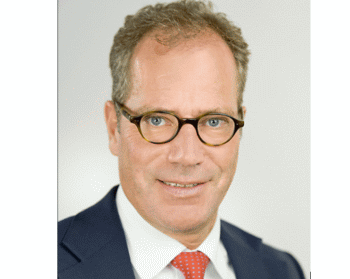
That’s the view of Chief Executive Officer, Dr Jörg Löffler, as he marks his first 100 days in the business at the helm of Europe’s largest independent fleet management company, having joined at the end of the summer.
Fleet Logistics recently celebrated 20 years in the international fleet management arena and currently has over 180,000 vehicles under contract on behalf of major corporate clients throughout Europe, the Middle East, Asia Pacific and Latin and Central America.
However, despite the success of previous years, that doesn’t mean there is no room for improvement within the business over the coming months and years.
Dr Löffler said: “We have identified three main priorities throughout 2017 and beyond.
“The first of these is the integration and harmonization of our IT systems. We currently have two systems in existence, one in Germany and one serving the other countries in which we operate. We are now integrating these into one so that we provide one global, modular IT platform across all countries and regions in which our clients do business.
“This will bring our fleet customers a number of clear benefits. Firstly, it will create a seamless process flow that increases quality and speed, and introduces great efficiency.
“And secondly it will enable us to produce a new suite of management information reports with greater clarity and reach, and with a more modern, flexible and dashboard-type layout to more readily meet the needs of our customers.
“Our objective is to finalize the phase-out of the system in Germany by the end of quarter two and complete the integration by the end of quarter three,” he said.
The next area of priority for Fleet Logistics will be the harmonization of its business processes.
“Going forward, there will be more focus on standardizing our processes. The way we were set up historically meant that we adopted a de-centralized approach in many of our process areas.
“But, as the number of our global customers increases, it is of paramount importance that we have standardized processes in all areas of our operations. While we need to take into account local legislation and taxation, it is no longer acceptable that we work differently in Italy, say, compared to France.
“That then leads us onto our next challenge, which is to adapt the organization to accept and work to these standardized processes, and to make our service offering more modern and more flexible for our customers, especially in relation to their market and technological requirements,” he said.
Turning to external challenges within the international fleet arena, Dr Löffler said that the area of growing electrification and the move away from diesel power was becoming a major issue for fleet operators.
His remarks came on the same day that four major cities – Paris, Madrid, Athens and Mexico City – announced that they planned to ban diesel vehicles completely from the middle of the next decade.
“Increased electrification is part of a wider process to reduce carbon emissions and we are starting to see a concerted move away from diesel, thanks in part to ‘dieselgate’ and in part to new legislation, and a swing back to gasoline.
“The challenge for our customers is to make the right choices for their fleets going forward and for us it is to provide the solutions to help them do that. One example is our new fuel card which allows our customers to buy conventional fuel or to pay to recharge their electric vehicles – all from the same card,” he said.
As times change, fleet management providers needed to make their solutions more driver-focused rather than car-centric, argued Dr Löffler.
“We need to switch the emphasis away from the car to the driver and become more flexible in meeting the driver needs.
“For example, the latest inter-modal mobility approach demands more flexible solutions. With city centers becoming increasingly off-limits for drivers, we need to be able to provide the driver with the means to identify the nearest park-and-ride and then find the best route via public transport to arrive at his destination via a smart-phone app – which should then also allow payment to be made by credit card,” he said.
Another area of priority for Fleet Logistics in the coming months will be the consolidation of operations in new areas of the globe in which it has established businesses to support international customers.
“We have, in recent months, opened businesses in the APAC and LATAM regions to provide fleet management support services to customers with operations in those regions,” explained Dr Löffler.
“A priority for us will be to consolidate those businesses and establish them for the future. Therefore, we need to onboard more clients in these areas and increase our resources to reach critical mass and improve our offering, which is still rather limited at present.
“We would hope to stabilize our newly integrated regions during 2017, before opening new operations, probably in the following year,” he said.
In terms of new locations around the globe, Dr Löffler identified China as a region with immense promise.
“Given the volumes involved, China could be a more interesting fleet market than, say, the US. It is still a very immature market but we believe it will develop very quickly and may present us with future opportunities,” he said.
Dr Löffler concluded that he would be delighted to achieve all these objectives during the coming months. But the company operated in a very dynamic customer environment in which there would be things coming up that it would be impossible to foresee, so flexibility in operations and processes was going to remain very important.
“However, Fleet Logistics is a market leader in its chosen field and it is clearly our ambition to retain that position. We believe that improvement in the areas we have identified and earmarked for development will help us continue to achieve that,” added Dr Löffler.