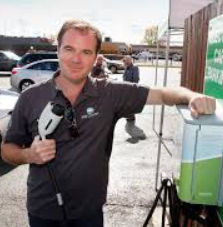
Let’s talk about the evolution of Sun Country Highway.
Sun Country Highway was originally created to put an end to the chicken and the egg scenario with electric vehicles and electric vehicle infrastructure, which has been going on for over a century, and to finally allow the electric vehicle industry to move forward by actually creating an infrastructure which was ahead of the electric vehicle for the first time in history. So, basically we wanted to create the infrastructure to allow people to travel with electric vehicles, and once they could travel, the idea was what they would buy electric vehicles.
Our mission was to put electric vehicle charging stations across Canada so that electric vehicles would be able to travel from British Columbia to Prince Edward Island.
Tell us about the financing to build this infrastructure.
Well, it needed to be done without requesting funds from the government and from the taxpayer. Not only because of speed of implementation, but also to prove a point that average people can make a difference and if enough average people come together we can actually implement better than government run programs in some cases. So, it allowed us the flexibility to maneuver when we needed to and simply get it done.
Yes, there were lot of financial sacrifices, but for anybody to really do anything which is probably the right thing to do, there are going to be some financial or time sacrifices. So, in the scheme of things globally, and for the EV industry itself, it really wasn’t that much of a sacrifice.
For the government to invest in infrastructure it is almost like going to a horse race. You really don’t know or they don’t know what is going to work, what is not going to work, where the electric vehicles are going to go – that sort of thing.
As long as there is a charging infrastructure that works for them today it is going to be a good bet, but to focus on the charging infrastructure and hope that you pick the right one, the right level, the right company, that is the challenge. The “right technology” has failed miserably if you look at that model globally. Governments have lost a lot of money and, if anything, the industry will lose credibility if they continue to do that.
They should, if they are going to support the movement, help fund the vehicles and provide some rebates there; those vehicles will be around for a very long time because the maintenance is very little. One day they are going to have to pay carbon taxes if they don’t do something. So, by funding electric vehicle purchases they could actually mitigate some of the reasons why in the future they are going to actually implement a carbon tax, so it is either pay now or pay later.
How did you manage to do this?
Well, first, we needed to have a charging station that was incredibly reliable. Bells and whistles were not really necessary; it was really important to have something that people could rely on when they came to charge and that it would work when they plugged their car in. It is difficult to create a movement when the infrastructure is failing. It was decided that we would get one of the companies in the movement to create our products for us, adjust them a little bit to make sure they were able to charge every single electric vehicle in North America, and then not only charge it but be able to charge the vehicles faster by a few hundred percent more than what the actual electric vehicles could charge presently.
So, we determined who we were going to use and got an agreement in place with them to supply the products and adjust them to our specs and then we started trying to give them away. That was a lot more difficult than expected. First we heard: I have never actually seen an electric car, never been in one. And second was: I have never even heard of electric cars and you want me to cover the install on these units? That was really the most challenging, finding the host locations that could understand what we were doing and believed in what we were doing and were willing to cover the costs to install those chargers.
The reason that was critical was because when electric vehicles arrived at those host locations, we wanted to make sure the host location was incredibly excited and happy to see them and was very excited to give away their power for free to that electric car, even if that electric vehicle owner wasn’t spending money at their location. So, that was just to make sure the movement would be enhanced and the experience was one that electric vehicle owners were maybe not used to.
It is pretty cool when you can go to a place and they are willing to open their doors to you and spend money on you just to empower you to continue doing what you are doing and to allow the movement to take place. That was really complicated because to find those host locations, not only the charging station or the install or the electricity down the road, but to find them, the cost was substantial.
What kind of feedback have you gotten since this project was completed?
Well, the feedback was substantial to say the least. One of the goals in launching Sun Country Highway and creating the world’s longest green highway across one of the world’s largest and most geographically diverse countries was to prove that electric vehicles could travel long distances, in the middle of a Canadian winter – over the Plains and the Rocky Mountains – at very little cost, with very little emissions.
So, the completion of the world’s longest green highway project proved that electric vehicles do have a place and they can actually make a difference in the economics, in the social aspect of things and on the environment, giving a little bit of hope towards the future to a lot people that were maybe looking for a little bit of hope.
Have you talked to many fleets about this project?
Initially, when we launched we weren’t talking to fleets too much. We were simply focused on getting the charging stations installed as fast as possible and launching the highway as fast as possible. There was a lot of criticism towards our project – that it was impossible, that we couldn’t do it without government funding, that we couldn’t do it without large corporate funding, and there was just no way we could put it in one of the largest countries in the world and do it in a year. Further, that it didn’t make sense to give away electricity for free and it didn’t make sense.
People were focused on the urban centers – New York, L.A. But, doing the urban centers wouldn’t really prove a point. People simply won’t buy into the electric movement if they can’t travel when they want to. So, the whole idea was to allow people to travel long distances between cities instead of just in cities.
Let’s talk about the next phase.
In the first year Sun Country Highway created the world’s longest highway green highway and we drove it in the middle of a Canadian winter in a 100 percent electric vehicle and it didn’t cost us anything to do it– it was a pretty cool experience.
The second year was to “green” most of Canada’s highways, roads and freeways and we are coming up to almost 90 percent of those, meaning that it is possible to drive one of the production electric vehicles today over 80 percent of the roads in Canada. Again, the goal is there is to get up to 90 percent right around the two year mark; right around our birthday.
We are also expanding throughout the States and looking at many other countries on the electric vehicle infrastructure side; if we can make people’s travel greener, it can save them money. It can assist society and if it can make the world better at the same time, then we are probably going to make something happen.
How can fleets make an impact in this movement?
If fleets can “green” their fleets, save money, reduce some of their other issues that they are dealing with today – and really make a true difference for more people than just themselves – then it is substantial. Fleets do control a lot of the vehicles around the world, so they have a lot of power and a lot of influence. However, if they do not buy into technology in transportation, there is a chance the technology may fail.
It is the fleets this time that are probably going to have to probably adopt a little bit quicker, because otherwise the fleets that do will have a huge competitive edge on them whether it is a municipality, a province, a nation, a state or another corporation.