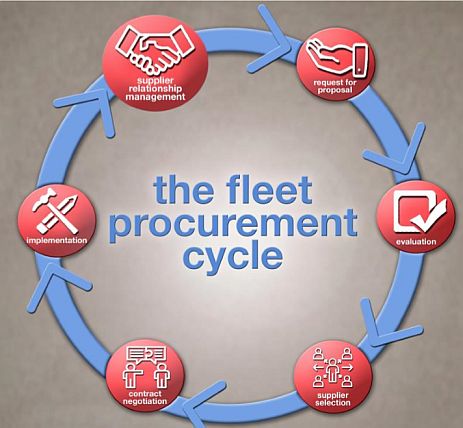
Following is an excerpt of the NAFA Foundation’s newest paper. To download a free copy of the full paper, please visit this link.
Driven by increasing demands from executive management to control costs, over the past decade procurement professionals have assumed a position of increasing influence over automotive fleet management. This ranges from simply being granted a more assertive role in selecting vehicles and suppliers, to the absorption of fleet into the procurement domain.
Faced with entirely new paradigms for fleet management, it’s vital that all players with significant roles in running the fleets of tomorrow — both those whose background is in fleet and those who come from the world of procurement — form a strategic partnership based on expanded knowledge of each other’s discipline.
Learning Each Other’s “Language”
It has been said that fleet and procurement speak different “languages.” What this really refers to are the different metrics by which their performance is measured. Organizations in which fleet and procurement have reached a measure of consensus embrace both sets of standards, resolving the dynamics that sometimes pull in divergent directions to achieve optimal results for the business as a whole.
Traditionally, procurement’s key performance indicators for its engagement in fleet are:
- Cost savings on the purchase of vehicles and outsourced services
- Improved quality
- Procurement efficiency
- Transportation improvements
While these, on the surface, would seem to coincide with fleet’s goals, fleet managers operate on a much deeper set of vehicle performance indicators:
- Vehicle downtime
- Maintenance and repair shop productivity
- Safety, including crash rates and the cost of accidents
- Sustainability
- Total cost of ownership (lifetime cost of the vehicle, including depreciation, fuel expenses, maintenance and accident repair)
Ideally, both perspectives can work hand in hand. In practice, however, there is often disagreement between fleet and procurement on key decisions. In this paper, we’ll explore some examples in several areas that will illustrate the potential for adverse results:
- Vehicle selection
- Vehicle cost of repairs
- Vehicle cost versus residual value
- Bundled versus unbundled services
- Safety and risk management
- Supplier selection
- Streamlined acquisition potential
Observations from the Field
Industry professionals who have occupied roles in both procurement and fleet operations, as well as client relations executives in two major fleet management companies, agree that deep knowledge of both disciplines is necessary for top results.
Said David Hayward, a professional with over 12 years of experience in both procurement and large pharmaceutical fleets, “At its core, procurement’s task is often cost-focused, whereas fleet managers are customer-service focused. The two are inherently opposed, and this can result in silos if both areas are not seeking to collaborate and understand one another so that a common goal/strategy can be defined.”
For Hayward, it’s a matter of finding the right balance between what fleet drivers and managers want and what they really need. “Sometimes, drivers want a more expensive vehicle when a cheaper one will do the job. On the other hand, drivers need to have the right vehicle to do their job, and it might not always be the least costly. Sometimes you should opt to pay more for a vehicle that gets better fuel economy, is safer, has a greater residual value, is cheaper to repair or creates the right image.
But in his opinion, “Fleet works best when it reports into procurement and procurement understands the proper agenda and priorities of fleet management so that a holistic sourcing process can be applied,” Hayward said. “The result can not only cost improvement, but efficiencies that will benefit the fleet operations and often the supplier as well.”
Dimensions of Fleet Management
Fleet management is an evolving discipline, but its core is comprised of eight dimensions. Fleet operations professionals need to master each of these in order to deliver the strategic results demanded of them by senior management. The paper covers these in detail.
Partnership Foundations
An ideal partnership between procurement and fleet requires knowledge of and sensitivity to the demands and goals of each discipline. Fleet and procurement need to understand that both sets of metrics and standards of their fields are necessary to achieve the long-term goals of their organization.
In addition, optimal fleet functionality can only be achieved if the needs and objectives of all fleet stakeholders are taken into consideration — these include senior and field management, drivers, human resources, occupational health and safety and the legal department. Open communication must be continual, and it’s the responsibility of those directly charged with managing fleet to assemble teams of representatives from these departments to evaluate the fleet program on a regular basis. This paper provides additional guidance on this crucial area.
Senior management typically expects those responsible for fleet to make recommendations on improving fuel efficiency, the rush toward all-electric and autonomous vehicles, reducing carbon emissions, and more. Without a firm grasp of these issues’ effects on the future, neither fleet, nor procurement professionals, will be able to come up with all the right answers.
The NAFA Foundation, a not-for-profit charitable organization formed in 1976 to promote, encourage, support, and assist the fleet industry, drives the advancement of the profession through the promotion and encouragement of education and research projects. It also makes grants and gifts to aid in and support persons, institutions, and organizations in the development, maintenance, and expansion of educational programs related to the management of motor vehicle fleets. To support the NAFA Foundation, visit here. Your gift is tax-deductible.
Read this article in PDF Format