Truemag

  • Newsletters
  • Thought Leadership
  • Mobility
  • Safety
  • Work Trucks
  • Videos
  • Home
  • Subscribe
  • Contact Us
  • Media Kit
  • Who We Are

Can Better Maps Help Cadillac Beat Tesla’s Autopilot?

Fortune

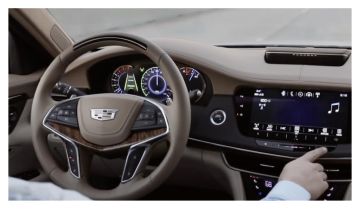
General Motors’ Super Cruise is a hands-free driving system comparable to Tesla’s Autopilot. It’ll debut this fall in the Cadillac CT6 sedan, and Cadillac is describing it as “the industry’s first true hands-free driving technology for the highway.”

That’s a bit of a shot at Tesla, whose Autopilot system has been on the road for years.

But Tesla now requires that drivers actually keep their hands on the wheel, even when Autopilot doing the driving.

Cadillac’s Super Cruise will be truly hands-free thanks to a “driver attention” system that monitors head position and stops the car if the operator takes their eyes off the road for too long.

That’s a neat step forward, but the map at the heart of the Cadillac system is an even bigger deal. All driver-assist systems, and future driverless cars, rely on detailed digital maps, maybe just as much as they rely on decision-making AI systems. Tesla, whose Autopilot is widely regarded as the state of the art in advanced driver assistance, has gathered more than 1.3 billion miles of road and driving data from real-world users since 2014.

Analysts regard that data as a huge edge, allowing Tesla to continually improve the performance of Autopilot and autonomous systems. But GM has taken what it says is a unique approach to catching up, focusing on the quality of their road data, rather than the volume. The company told The Verge that they’ve mapped 160,000 miles of highways using LIDAR, a kind of highly precise 3D laser imaging.

The top-down mapping approach requires a lot more resources than Tesla’s data-harvesting. For instance, according to chief engineer Barry Walkup, Cadillac will monitor construction zones and re-map them regularly using LIDAR trucks. The benefits of the hands-on approach were on display in a recent video of a Tesla getting fooled by imperfect lane markers in a construction zone.

Cadillac is playing it safe in another way, by strictly limiting the use of its hands-free tech to highways. Of course, Tesla could do the same thing if they wanted to, but the company has gotten a ton of mileage out of videos of Autopilot performing well on smaller roads. That looser approach means more risk, but Tesla customers are a daring bunch, most of them seemingly comfortable with being guinea pigs in a grand experiment. Cadillac targets a different crowd, who may be fine with a more limited assist feature if that’s a tradeoff for safety.

In the end, even assuming that Cadillac’s system works perfectly, it’s not a real threat to Tesla’s position at the front of the driver-assistance pack. Cadillac is borrowing a concept that works and making it (hopefully) foolproof for an older, more mainstream customer base. Meanwhile, Tesla is already on to the next – six months ago, it started installing the hardware for full level-5 autonomy in all of its new cars. Testing and regulatory progress are all that it needs to switch it on.


Apr 17, 2017connieshedron
Aspiring Tech Prodigy Tries To Re-Route Self-Driving CarsCEI To Preview New DriverCare™ Mobile Application At 2017 NAFA Conference
Recent Posts
  • Why Case Studies Close More Deals Than Product Brochures
  • California Just Became the Best Place to Buy a Brand-New EV
  • AFLA Membership Growth: Mary Saunders on Engagement, Volunteerism, and the Value of Connection
  • The Fleet Manager’s Breaking Point: Why AI Must Do More Than Advise
  • Four More Models Take Home Top Safety Pick+ Awards in Latest IIHS Ratings
  • Ford Can Now Stop Some Vehicles Starting, Even with the Key
  • All New Cars in the EU Now Need to Have a Camera Aimed at the Driver’s Face in the Latest Privacy Nightmare
  • WEX Grows EV Charging Network with Greenlane, Synop, and QuickCharge CPO Integrations
  • Moventum Fleet Management is Here!
  • WEX DriverDash Adds CITGO to Mobile Fuel Payments for Fleets
ASSOCIATION NEWS
AFLA Membership Growth: Mary Saunders on Engagement, Volunteerism, and the Value of Connection
How AFLA Is Positioning Itself for the Future of Fleet Mobility
Last Chance to Save: Register for NAFA’s Maintenance Workshop
‘Raise Your Hand and Get Involved’
NAFA Names 2026 Class of Fellows, Honoring Leaders in Fleet Management
Award Winners Honored at NAFA I&E
2026 NAFA I&E Seeks to Change Perceptions, Invigorate Fleets
TECHNOLOGY
The Fleet Manager’s Breaking Point: Why AI Must Do More Than Advise
All New Cars in the EU Now Need to Have a Camera Aimed at the Driver’s Face in the Latest Privacy Nightmare
The Grid Was Melting Down in Last Week’s Heat – Until EVs Came to the Rescue
Improving Productivity with AI: Turning Fleet Data into Faster Decisions
Hyundai Unveils New ‘Plasma Care UVC’ Cabin Sanitizer
Fleet Operations Are Changing – The Industry Needs to Evolve With Them
AI-Powered Vehicle Inspections Move Beyond the Checklist
CONFERENCES & WEBINARS
For The Leaders In The Room
2026 NETS Strength IN Numbers Conference: Early Bird Rates!
AFLA 2026 – Keynotes Announced!
Private Fleets Flex at National Private Truck Council Conference
Free NAFA Webinar: Manage Your Fuel Cost Volatility
Registration Now Open for NETS Annual Conference
Early Bird Pricing for AFLA 2026 – Ending June 1
INDUSTRY ANNOUNCEMENTS
Union Leasing Becomes Moventum Fleet Management as 70-Year Company Accelerates into Next Phase
Fleetio Wins Innovations Award at NAFA’s 2026 Institute & Expo
WIFM is heading to NAFA!
Cox Automotive Unveils Cox Fleet, Setting a New Standard for Fleet Uptime Nationwide
AFLA Canadian Fleet Professional of the Year Award: Nominations Open!
NAFA Webinar: Kickoff the 2026 100 Best Fleets Contest on December 4!
Join NAFA’s Free Fleet 101 Live Course

Fleet Management Weekly Newsletter Archive
Access to back issues of the FMW newsletter.

FMW Mobility
How mobility is rapidly changing the fleet management landscape.

Newsletter

Subscribe

FMW Fleet Videos
Video clips of industry leaders speaking on a variety of engaging hot topics in fleet.

2014-2020 © Fleet Management Weekly