Truemag

  • Newsletters
  • Thought Leadership
  • Mobility
  • Safety
  • Work Trucks
  • Videos
  • Home
  • Subscribe
  • Contact Us
  • Media Kit
  • Who We Are

Is CAFE Making Cars Bigger?

Automotive News

The tough fuel-economy standards that took effect in 2012 are getting tougher every year. So why are cars getting bigger?

The average new vehicle’s “footprint” — the rectangle formed by its wheelbase and track width — hit a record 49.9 square feet in the 2015 model year, according to the EPA, up by about 1 square foot, or 2 percent, since the agency been tracking the measure in 2008.

The EPA says that growth mostly reflects shifting sales toward trucks and SUVs.

And to be sure, cars and trucks have been growing for decades to reflect the visual tastes of designers, the safety concerns of engineers and consumer desire for more interior space.

But these days, analysts say, automakers have an added incentive to make their cars a little bit larger: more forgiving fuel economy targets.

The Obama administration’s so-called National Program assigns mpg and CO2 emission targets to vehicles based on their footprint, and requires annual improvements for every footprint size. They’re also set on curves, one for cars and another for light trucks, in which smaller vehicles face more stringent targets than larger ones.

For manufacturers, that means adding just a few inches to a vehicle’s wheelbase during a redesign can result in a lower mpg target — sometimes 1 to 2 mpg lower — than if the vehicle had stayed the same size. The redesigned vehicles must still get better fuel economy than their predecessors, but don’t need to stretch as far to meet their targets.

“Cars are changing their dimensions in order to take advantage of this, but I don’t think it’s anything new,” said Dave Sullivan, an analyst at AutoPacific Inc. “We’ve been using every available credit or loophole that the system allows for years now.”

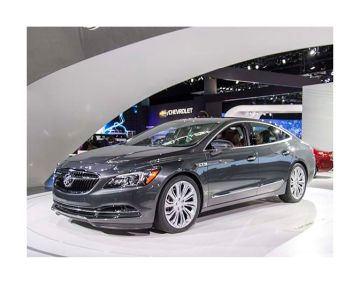
To see how the targets work, take the Buick LaCrosse. The new model is 2.7 inches longer between the wheels, and about 1.2 inches wider. That roughly 2.1-square-foot size difference, says GM spokesman Nick Richards, helps the full-size sedan meet the tastes of U.S. and Chinese customers.

It also boosts the footprint to 50.1 square feet, yielding a 2017 model-year target of 36.3 mpg under the government’s corporate average fuel economy rules. That’s up from the previous model’s 35.7 mpg CAFE target, but 1.4 mpg less than the 37.7 mpg it would have faced had GM carried the smaller 2016 LaCrosse into the 2017 model year, according to calculations provided by the Union of Concerned Scientists.

There are many more like the LaCrosse. An Automotive News review of 25 vehicles redesigned since the footprint-based standards took effect in 2012 found that 21 models got bigger — from cars to pickups, large and small, from luxury and mainstream brands alike.

Read more of the original article at Automotive News.

Aug 16, 2016connieshedron
Sleeping at the Wheel Costs the U.S. a Shocking Amount of Lives and MoneyDr Jörg Löffler New CEO at Fleet Logistics
Recent Posts
  • IMPROVLearning: How Comedy, Behavioral Science and AI Improve Fleet Safety
  • Improving Productivity with AI: Turning Fleet Data into Faster Decisions
  • National Safety Council Projects Increased Traffic Crash Risk during Fourth of July Weekend
  • Keep Every Heavy-Duty Maintenance Inspection on Track — Free Fullbay Checklist
  • Gain Data-Driven Insights into Commercial Vehicle Market Trends at Executive Leadership Summit
  • Last Chance to Save: Register for NAFA’s Maintenance Workshop
  • License Plate Cameras Are About to Start Tracking a Lot More Than Just Your Car
  • America’s Heavy EV Problem May End with Drivers Paying More
  • Trends in U.S. Drivers’ Perceptions and Attitudes Toward Vehicle Automation, 2019–2025
  • 2026 NETS Strength IN Numbers Conference: Early Bird Rates!
ASSOCIATION NEWS
Last Chance to Save: Register for NAFA’s Maintenance Workshop
How AFLA Is Positioning Itself for the Future of Fleet Mobility
‘Raise Your Hand and Get Involved’
NAFA Names 2026 Class of Fellows, Honoring Leaders in Fleet Management
Award Winners Honored at NAFA I&E
2026 NAFA I&E Seeks to Change Perceptions, Invigorate Fleets
NAFA Announces Lineup for Media Day at I&E 2026: Industry Leaders to Showcase the Latest Innovations
TECHNOLOGY
Improving Productivity with AI: Turning Fleet Data into Faster Decisions
Fleet Operations Are Changing – The Industry Needs to Evolve With Them
AI-Powered Vehicle Inspections Move Beyond the Checklist
Motive’s New Workforce Capabilities Aim to Improve Performance, Automate Rewards
AI + Human Insight: Why Fleet Leaders Need Both to Win in 2026
NTSB Finds Automation Overreliance Contributed to Two Fatal Ford BlueCruise Crashes
New AI Assistants Automate Fleet Data Analysis, Decision Making and More
CONFERENCES & WEBINARS
2026 NETS Strength IN Numbers Conference: Early Bird Rates!
AFLA 2026 – Keynotes Announced!
Private Fleets Flex at National Private Truck Council Conference
Free NAFA Webinar: Manage Your Fuel Cost Volatility
Registration Now Open for NETS Annual Conference
Early Bird Pricing for AFLA 2026 – Ending June 1
NAFA Online Seminar: Essentials of Fleet Management
INDUSTRY ANNOUNCEMENTS
Union Leasing Becomes Moventum Fleet Management as 70-Year Company Accelerates into Next Phase
Fleetio Wins Innovations Award at NAFA’s 2026 Institute & Expo
WIFM is heading to NAFA!
Cox Automotive Unveils Cox Fleet, Setting a New Standard for Fleet Uptime Nationwide
AFLA Canadian Fleet Professional of the Year Award: Nominations Open!
NAFA Webinar: Kickoff the 2026 100 Best Fleets Contest on December 4!
Join NAFA’s Free Fleet 101 Live Course

Fleet Management Weekly Newsletter Archive
Access to back issues of the FMW newsletter.

FMW Mobility
How mobility is rapidly changing the fleet management landscape.

Newsletter

Subscribe

FMW Fleet Videos
Video clips of industry leaders speaking on a variety of engaging hot topics in fleet.

2014-2020 © Fleet Management Weekly