By Mark Boada
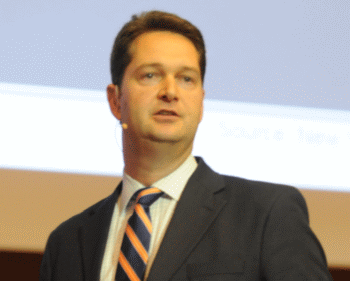
Since 2013, Lukas Neckermann has been one of the most visible proponents of shared, electric, self-driving vehicles as the means to achieving the three “zeroes”: zero roadway accidents, zero tailpipe emissions and zero private ownership of cars. Managing Director of the London, UK-based Neckermann Strategic Advisors, he is the author of three books on what’s widely called the “mobility revolution,” and has appeared as a keynote speaker at a number of fleet industry conferences. Neckermann is also an adjunct instructor at New York University and includes OEMs, government agencies and mobility startups worldwide among his clients.
In his latest report, “Being Driven,” Neckermann and his colleague Frederic John sound a first cautionary note for the high-tech and auto industry companies that are continuing to invest billions in the development of those kinds of cars. Subtitled, “A Study on Human Adoption and Ownership of Autonomous Vehicles,” the 71-page report, containing original research and released late last year, documents that many consumers aren’t as ready to buy in as quickly as the autonomous vehicle community would like or need them to.
The following is an edited transcript of an interview Fleet Management Weekly conducted this month in Neckermann’s London office.
FMW: On page eight of your latest report, you write that “those who monitor the evolution of smart cities, work in policy or are proponents of autonomous and shared transportation may not like the results of this study.” Why did you say that?
Neckermann: Most of the focus to date has been on creating the technology, infrastructure and regulations to make the mobility revolution possible, and not on how to make the public embrace it. But our research suggests that, at least in Europe and North America, there’s significant consumer resistance to making all the changes the revolution requires them to make.
With respect to autonomous vehicles, the most ambitious predictions by Uber, Waymo and some OEMs from a few years ago said that their self-driving vehicles would be on the road by this year or next. That now appears to have been overly optimistic. Our conclusion is that parts of this transformation aren’t going to happen quite as quickly as projected, and not without additional investment in programs that aim at overcoming public resistance.
FMW: Tell us about your research and what it found.
Neckermann: For our report, we surveyed a representative sample of 3,000 U.K. consumers and conducted in-depth interviews with more than two dozen expert from nine countries in the field of connected and autonomous vehicles – from across academia, business and government. While this isn’t fully representative of consumer attitudes worldwide, our findings aligned with those recently documented by other research institutions that sampled attitudes around the globe.
Specifically, we found that 75 percent of our respondents in the U.K. are uncomfortable with or undecided about the concept of the driverless vehicle. A study done in the U.S. last year similarly found that 71 percent of Americans are afraid to ride in a self-driving car. What’s more, this figure is actually increasing. The fear is not going away but getting worse. The big issue is a perceived lack of confidence that the technology is safe or can be made to be safe.
FMW: What about elsewhere in the world?
Neckermann: Bank of America Merrill Lynch conducted a survey of more than 200,000 people in nine countries. They found that safety was a concern for more than 80 percent of the respondents. Another study report by Deloitte found that some 50 percent of the 25,000 participants across 20 countries had safety concerns around autonomous vehicles. The one exception was China, where only a quarter of respondents had these concerns.
A manager at a major OEM we had interviewed, who had conducted similar research for his PhD dissertation, found consumer confidence in AVs at just 25 percent, and a government interviewee confirmed those results are in line with their findings.
It’s important, however, to take all of these results with a certain grain of salt. Most of these surveys have been done on the back of a hypothetical situation – in other words, by asking people who haven’t had personal experience with the technology. We address this in our study.
FMW: What do you believe is behind this lack of trust?
Neckermann: People are generally resistant to change and are fearful of the unknown. When it comes to shared AVs, people are being asked to make two disruptive leaps into the unknown: private vehicles toward shared and human-driven to self-driving. You can even add a third, from fossil-fueled to fully electric vehicles. We think it’s unrealistic to expect people to make these leaps all at the same time within the same 10-year period.
When it comes to safety, part of the problem is that most people believe they’re above average drivers – even though that’s not the case. For them, AVs have to achieve considerably better than average safety performance, given that national figures include the performance of drivers with considerably below average records, like novice drivers, teenagers, the elderly, and drunks. They’re also skeptical because of the intense coverage of recent AV accidents and the fact that much of the safety record OEMs tout comes from driving in ideal weather, limited access routes and simulations.
FMW: What did your survey find about consumer acceptance of shared vehicles?
Neckermann: We were stunned to find that, contrary to reports that the idea of car ownership is dying, 65 percent of our U.K. respondents indicated they want to continue owning their vehicles, even if autonomous. And only five percent would prefer to share them with a small group of peers.
FMW: What’s behind that, do you think?
Neckermann: People have an irrational, emotional attachment to their vehicles. Cars have become part of their identify and deliver a private experience they find deeply enjoyable. You can see that in the way carmakers advertise – they talk about “the ultimate driving machine,” “power, beauty and soul” and “the power for dreams.”
For some, a car is a sign of status, and a luxury vehicle lends them prestige – like wearing an expensive watch. For others, it’s a matter of freedom and ultimate convenience. Even though their car is sitting still more than 90 percent of the time, it’s there whenever they want it and wherever they want to go. These are the kinds of attitudes and habits that people don’t easily give up. Still, many people have given up their watches with the rise of the smartphone, so there’s reason to believe the car could go the same way.
People in urban centers with robust public transit systems are more accepting of shared vehicles, particularly where parking and insurance can be expensive. But in rural areas and in suburbs where public transit is limited and ride-hailing and car-sharing might not yet be established, a shared mobility lifestyle is unlikely to be adopted for the foreseeable future.
FMW: You have been among the leading advocates for the mobility revolution. Are you still?
Neckermann: Yes, I am. Ultimately, I still believe that shared, electric and autonomous vehicles are the best solution to many problems, like air pollution, traffic safety and urban traffic congestion. The mobility revolution is coming. It’s just that we need to differentiate more clearly between use-cases – the right mode for a specific problem or situation.
FMW: So, when will it happen?
Neckermann: There’s a growing consensus – one I agree with – that we’re going to undergo a lengthy transition period. In terms of autonomous vehicles, it starts with specific use cases, like AVs handling cargo at ports, or shuttles at airports, at resort hotels and retirement communities, and even on bus routes. These will continue to expand over this decade, and exposure to these everyday use-cases will drive user comfort and acceptance.
The commercial trucking and delivery industries are interesting as well – platooning is a very real, very positive use-case. The economics are compelling, just as they were in the mining industry, which is already using AVs heavily.
As for seeing vast fleets of Level 4 vehicles on the road? I would expect that to begin in the second half of this decade, in many countries perhaps not even until the 2030s.
FMW: In your report, you recommend a number of steps that the AV community at large needs to take to persuade the public at large to embrace AVs. What are they?
Neckermann: First and foremost, the community needs to educate the public about the technology, how it works and its benefits. Endless discussions on hardware, software and disengagement rates are almost useless. Developers need to communicate the vision and talk more about safety, reliability, and how it will make life better. We need to expose people to AVs, to take the vehicles out of closed environments and sanitized testbeds and get consumers to experience them.
The industry also needs to develop a common language that describes the technology, to avoid the confusion that is undermining public confidence. It’s also critical that global industry standards be established that offer consumers confidence that the technology being developed meets the levels of safety and quality they want. We have an initiative on this and will be sharing more in the coming months.