Truemag

  • Newsletters
  • Thought Leadership
  • Mobility
  • Safety
  • Work Trucks
  • Videos
  • Home
  • Subscribe
  • Contact Us
  • Media Kit
  • Who We Are

An Autonomous Car is Going Cross-Country for the First Time

On March 22, an autonomous car will set out from the Golden Gate Bridge toward New York for a 3,500-mile drive that, if all goes according to plan, will push robo-cars much closer to reality.

Audi’s taken its self-driving car from Silicon Valley to Las Vegas, Google’s racked up more than 700,000 autonomous miles, and Volvo’s preparing to put regular people in its robot-controlled vehicles.

But this will be one of the most ambitious tests yet for a technology that promises to change just about everything, and it’s being done not by Google or Audi or Nissan, but by a company many people have never heard of: Delphi.

“It’s time to put our vehicle to the ultimate test by broadening the range of driving conditions,” says Delphi CTO Jeff Owens.

Delphi doesn’t build cars; it builds the stuff that goes into cars. It’s a key supplier to the auto industry, and has been for almost as long as there’s been an auto industry. It’s got a solid record of innovation, too. It built the first electric starter in 1911, the first in-dash car radio in 1936, and the first integrated radio-navi system in 1994.

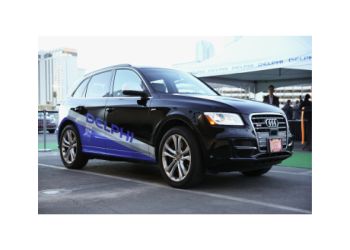
Now it’s built a self-driving car, based on a 2014 Audi SQ5 (chosen simply because it’s cool. No, really.). The car looks like any other SQ5 (but for the stickers), but it’s packed with sensors and computers Delphi developed to replace humans: A camera in the windshield looks for lane lines, road signs, and traffic lights. Delphi installed a midrange radar, with a range of about 80 meters, on each corner. There’s another at the front and a sixth on the rear. That’s in addition to the long-range radars on the front and back, which look 180 meters ahead and behind.

Building your own autonomous car is a good way to develop the hardware (radar and LIDaR) and software (the algorithms that make driving decisions) automakers will need. “What we expect to do is be able to create better sensors and more sensors, and then the software algorithms as well, which the [automakers] will need as they take more steps along that journey to automated driving,” says Owens.

So why the road trip? It’s about collecting data. Delphi says it’s covered hundreds of miles in the past year or so around Silicon Valley and Las Vegas, both on the highway and on city streets. Going from California to New York provides terabytes of information on how the sensor suite detects the world around it, and how the car drives. With that data, it can continue to improve its technology, tweaking software and hardware alike to make the car’s driving more reliable.

To see the original article go to wired.com.

Mar 16, 2015connieshedron
LeasePlan to Share Expertise at Conference of Automotive RemarketingSay the Word: Voice Systems can Reduce Some Types of Distraction
Recent Posts
  • Why Case Studies Close More Deals Than Product Brochures
  • California Just Became the Best Place to Buy a Brand-New EV
  • AFLA Membership Growth: Mary Saunders on Engagement, Volunteerism, and the Value of Connection
  • The Fleet Manager’s Breaking Point: Why AI Must Do More Than Advise
  • Four More Models Take Home Top Safety Pick+ Awards in Latest IIHS Ratings
  • Ford Can Now Stop Some Vehicles Starting, Even with the Key
  • All New Cars in the EU Now Need to Have a Camera Aimed at the Driver’s Face in the Latest Privacy Nightmare
  • WEX Grows EV Charging Network with Greenlane, Synop, and QuickCharge CPO Integrations
  • Moventum Fleet Management is Here!
  • WEX DriverDash Adds CITGO to Mobile Fuel Payments for Fleets
ASSOCIATION NEWS
AFLA Membership Growth: Mary Saunders on Engagement, Volunteerism, and the Value of Connection
How AFLA Is Positioning Itself for the Future of Fleet Mobility
Last Chance to Save: Register for NAFA’s Maintenance Workshop
‘Raise Your Hand and Get Involved’
NAFA Names 2026 Class of Fellows, Honoring Leaders in Fleet Management
Award Winners Honored at NAFA I&E
2026 NAFA I&E Seeks to Change Perceptions, Invigorate Fleets
TECHNOLOGY
The Fleet Manager’s Breaking Point: Why AI Must Do More Than Advise
All New Cars in the EU Now Need to Have a Camera Aimed at the Driver’s Face in the Latest Privacy Nightmare
The Grid Was Melting Down in Last Week’s Heat – Until EVs Came to the Rescue
Improving Productivity with AI: Turning Fleet Data into Faster Decisions
Hyundai Unveils New ‘Plasma Care UVC’ Cabin Sanitizer
Fleet Operations Are Changing – The Industry Needs to Evolve With Them
AI-Powered Vehicle Inspections Move Beyond the Checklist
CONFERENCES & WEBINARS
For The Leaders In The Room
2026 NETS Strength IN Numbers Conference: Early Bird Rates!
AFLA 2026 – Keynotes Announced!
Private Fleets Flex at National Private Truck Council Conference
Free NAFA Webinar: Manage Your Fuel Cost Volatility
Registration Now Open for NETS Annual Conference
Early Bird Pricing for AFLA 2026 – Ending June 1
INDUSTRY ANNOUNCEMENTS
Union Leasing Becomes Moventum Fleet Management as 70-Year Company Accelerates into Next Phase
Fleetio Wins Innovations Award at NAFA’s 2026 Institute & Expo
WIFM is heading to NAFA!
Cox Automotive Unveils Cox Fleet, Setting a New Standard for Fleet Uptime Nationwide
AFLA Canadian Fleet Professional of the Year Award: Nominations Open!
NAFA Webinar: Kickoff the 2026 100 Best Fleets Contest on December 4!
Join NAFA’s Free Fleet 101 Live Course

Fleet Management Weekly Newsletter Archive
Access to back issues of the FMW newsletter.

FMW Mobility
How mobility is rapidly changing the fleet management landscape.

Newsletter

Subscribe

FMW Fleet Videos
Video clips of industry leaders speaking on a variety of engaging hot topics in fleet.

2014-2020 © Fleet Management Weekly