Truemag

  • Newsletters
  • Thought Leadership
  • Mobility
  • Safety
  • Work Trucks
  • Videos
  • Home
  • Subscribe
  • Contact Us
  • Media Kit
  • Who We Are

UPS Is Conducting A Vast Rolling Lab Experiment To Create The Clean Truck Of The Future

Forbes

In Hamburg, Germany, as in a growing number of crowded cities, large trucks are banned from the city center during business hours.

The restriction is part of a 20-year plan to transform the city into a greener, healthier, vehicle-free metropolis.

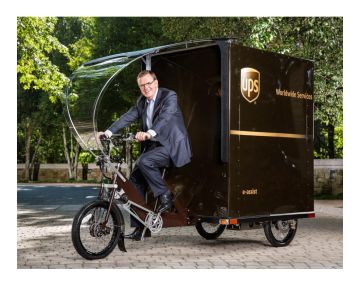
For United Parcel Service, the world’s largest package delivery company, that’s a revenue-killing nightmare. But the Atlanta-based shipping giant has a clever answer: it delivers the goods with electric-assist cargo tricycles.

Overnight, the company parks a trailer load of packages in the city center, then uses the brown UPS trikes to deliver them the next day.

With 77 cubic feet of cargo space (more than most mid-sized sedans), a range of 21 miles and a top speed of 15 miles per hour, UPS’ Cargo Cruisers are an economical and efficient way to get the job done. And they’re not just for narrow European streets; UPS customers in Portland, Ore., will soon see drivers pedaling around their neighborhoods in a similar model.

UPS is testing the e-trikes and thousands of other alternative fuel vehicles in various scenarios around the world as part of a “rolling laboratory” approach to its most vexing business problem: how to keep up with the boom in e-commerce while at the same time reducing its impact on the environment.

The 1,000-page algorithm, developed over 10 years, crunches real-time data from every package, along with customer information and detailed maps, to sort through 200,000 possible choices and dictate the driver’s optimal route. And it works, shaving 6 to 8 miles off the average driver’s route, according to UPS.ile at the same time reducing its impact on the environment.

As a global logistics company with $58 billion in revenue, UPS’ business depends on trucks and airplanes powered by petroleum-based fuels. Its goal is to reduce its “carbon intensity” – in other words, the amount of pollution it creates per package delivered – 20 percent by the end of 2020 (compared to 2007 levels). It’s inching closer: it was down 14.5 percent as of the end of 2015.

But here’s the rub: the explosion of e-commerce is rapidly changing the way UPS operates. Instead of dropping off a stack of boxes at regular business customers each day, UPS drivers today spend more time delivering stuff ordered from Amazon, Nordstrom and Williams-Sonoma to individual homes.

That means 2 billion stops a year, and fewer packages per stop, which translates into more miles driven, more fuel consumed and more emissions. (During the holiday season, UPS deliveries soar to 36 million packages a day – twice the usual rate.)


Oct 2, 2016connieshedron
Women Driving Auto Industry, From Design to DealershipsHow Ford Police Vehicles Will Get Even Sneakier
Recent Posts
  • IMPROVLearning: How Comedy, Behavioral Science and AI Improve Fleet Safety
  • Improving Productivity with AI: Turning Fleet Data into Faster Decisions
  • National Safety Council Projects Increased Traffic Crash Risk during Fourth of July Weekend
  • Keep Every Heavy-Duty Maintenance Inspection on Track — Free Fullbay Checklist
  • Gain Data-Driven Insights into Commercial Vehicle Market Trends at Executive Leadership Summit
  • Last Chance to Save: Register for NAFA’s Maintenance Workshop
  • License Plate Cameras Are About to Start Tracking a Lot More Than Just Your Car
  • America’s Heavy EV Problem May End with Drivers Paying More
  • Trends in U.S. Drivers’ Perceptions and Attitudes Toward Vehicle Automation, 2019–2025
  • 2026 NETS Strength IN Numbers Conference: Early Bird Rates!
ASSOCIATION NEWS
Last Chance to Save: Register for NAFA’s Maintenance Workshop
How AFLA Is Positioning Itself for the Future of Fleet Mobility
‘Raise Your Hand and Get Involved’
NAFA Names 2026 Class of Fellows, Honoring Leaders in Fleet Management
Award Winners Honored at NAFA I&E
2026 NAFA I&E Seeks to Change Perceptions, Invigorate Fleets
NAFA Announces Lineup for Media Day at I&E 2026: Industry Leaders to Showcase the Latest Innovations
TECHNOLOGY
Improving Productivity with AI: Turning Fleet Data into Faster Decisions
Fleet Operations Are Changing – The Industry Needs to Evolve With Them
AI-Powered Vehicle Inspections Move Beyond the Checklist
Motive’s New Workforce Capabilities Aim to Improve Performance, Automate Rewards
AI + Human Insight: Why Fleet Leaders Need Both to Win in 2026
NTSB Finds Automation Overreliance Contributed to Two Fatal Ford BlueCruise Crashes
New AI Assistants Automate Fleet Data Analysis, Decision Making and More
CONFERENCES & WEBINARS
2026 NETS Strength IN Numbers Conference: Early Bird Rates!
AFLA 2026 – Keynotes Announced!
Private Fleets Flex at National Private Truck Council Conference
Free NAFA Webinar: Manage Your Fuel Cost Volatility
Registration Now Open for NETS Annual Conference
Early Bird Pricing for AFLA 2026 – Ending June 1
NAFA Online Seminar: Essentials of Fleet Management
INDUSTRY ANNOUNCEMENTS
Union Leasing Becomes Moventum Fleet Management as 70-Year Company Accelerates into Next Phase
Fleetio Wins Innovations Award at NAFA’s 2026 Institute & Expo
WIFM is heading to NAFA!
Cox Automotive Unveils Cox Fleet, Setting a New Standard for Fleet Uptime Nationwide
AFLA Canadian Fleet Professional of the Year Award: Nominations Open!
NAFA Webinar: Kickoff the 2026 100 Best Fleets Contest on December 4!
Join NAFA’s Free Fleet 101 Live Course

Fleet Management Weekly Newsletter Archive
Access to back issues of the FMW newsletter.

FMW Mobility
How mobility is rapidly changing the fleet management landscape.

Newsletter

Subscribe

FMW Fleet Videos
Video clips of industry leaders speaking on a variety of engaging hot topics in fleet.

2014-2020 © Fleet Management Weekly